The Syrian Future Movement follows with deep concern the report published by Human Rights Watch on April 7, 2016, entitled “An Old Law Exacerbates the Suffering of Families of 100,000 Missing Persons in Syria.”
The report indicates that the application of Personal Status Law No. 59 of 1953 (amended by Legislative Decree No. 78 of 2019) deprives thousands of Syrian families of their right to prove the death of their relatives who went missing during the years of war and conflict, thus prolonging their psychological, social, and legal suffering for decades.
The Syrian Future Movement bases its analysis on the data contained in the aforementioned report, which confirms that the number of missing persons in Syria as a result of the armed conflict (from March 2011 to December 2014) is at least 100,000, according to estimates by the United Nations High Commissioner for Human Rights and the International Committee of the Red Cross.
These missing persons—most of whom are civilians abducted by the forces of the former regime and its affiliated militias—suffer from a complete absence of any trace of their whereabouts. Outdated Syrian laws prevent their families from obtaining official death certificates until 15 years have passed since their disappearance (if there is no conclusive evidence of death), or four years if there is strong evidence.
This means that thousands of families are still waiting (as of 2026) for a ruling declaring their sons, abducted in 2011 or 2012, dead.
The Syrian Future Movement points out that this deeply rooted Ottoman law (based on Hanafi jurisprudence) has not been substantially amended for decades, despite repeated recommendations from international and local human rights organizations.
The former Assad regime deliberately exploited this law to deprive the families of detainees and the missing of their financial and inheritance rights, and to cover up its crimes of abduction and extrajudicial killing. The Syrian Network for Human Rights estimates (March 2026 report) that more than 80% of families of missing persons have been unable to receive any compensation, inheritance, or legal rights due to the complexities of proving death.
The Syrian Future Movement affirms that this issue is a worsening humanitarian and social catastrophe.
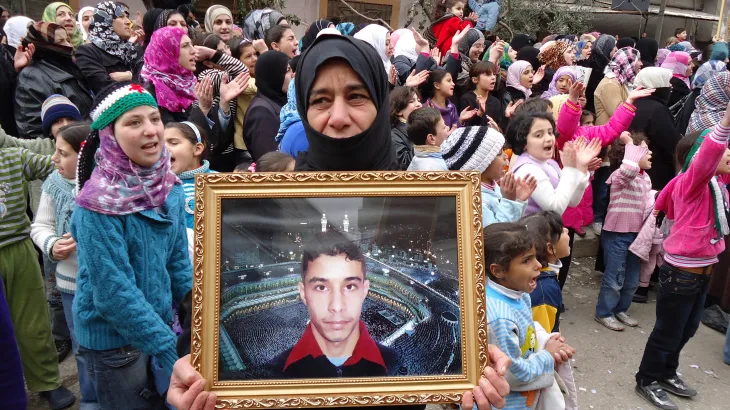
Syrian widows—estimated at around 70,000 women who lost their husbands without death certificates—live in a state of “civil death,” unable to remarry (because they are considered legally married), unable to access their husbands’ money or their children’s inheritance, and facing difficulties in obtaining documents for their children.
Orphaned children (estimated at around 200,000 who lost at least one parent during the war) are deprived of their rights to inheritance, compensation, and social care due to the lack of official death certificates.
The Syrian Future Movement believes that the transitional phase (following the liberation of Syria in December 2024) imposes a moral, legal, and political responsibility on the transitional government and the People’s Assembly to address this ongoing tragedy.
There can be no talk of transitional justice or national reconciliation without a radical solution to the crisis of the missing and their families.
Therefore, the Syrian Future Movement demands the following from the transitional government:
First: The issuance of a temporary law specifically addressing the registration of the deaths of those who disappeared during the revolution (2011-2024). This law should reduce the waiting period to one year only if there is strong evidence (such as disappearance at the hands of an entity known for committing crimes against humanity, testimonies from former detainees, or the presence of mass graves near the place of detention), and to three years if there is no evidence. Priority should be given to the most affected groups (widows, orphans, and the elderly).
Second: Activate the role of the National Commission for Missing Persons to receive reports of missing persons, collect evidence from witnesses, survivors, and mass graves, coordinate with the International Committee of the Red Cross and human rights organizations, and issue temporary administrative death certificates granting families the right to inheritance, compensation, and immediate remarriage, with final verification to follow.
Third: Launch a national campaign to document missing persons in cooperation with municipalities, local councils, and civil society organizations. A comprehensive list of missing persons, dates of disappearance, and those accused of abduction should be compiled within six months, and this data should be made available to families and researchers while respecting their privacy.
Fourth: Activate the role of Sharia and civil courts to urgently address missing persons cases, appoint judges specializing in this area, train them on human rights and transitional justice standards, and establish reception offices in each governorate to provide free legal support to families of missing persons.
The Syrian Future Movement goes beyond these urgent demands to a comprehensive future vision based on establishing a “Syrian National Memory” center as a permanent hub for documenting war crimes and grave violations. This center would be responsible (in cooperation with the International Criminal Court, when necessary) for collecting DNA samples from the families of the missing, exhuming mass graves (at least 140 have been discovered so far, according to reports from the World Health Organization and Human Rights Watch), identifying victims through DNA, returning their remains to their families, and issuing official national death certificates recognized by all state institutions.
The Syrian Future Movement rejects any attempt to procrastinate or use legal or administrative complexities as a pretext to obstruct the resolution of this issue. Every day that passes without a death certificate means an additional day of psychological torment and economic hardship for thousands of families.
The Syrian Future Movement also rejects any amnesty that includes perpetrators accused of abducting and forcibly disappearing the missing, and demands the establishment of a special court to try those responsible for enforced disappearances and extrajudicial killings, based on the Rome Statute and international humanitarian law.
The Syrian Future Movement announces its full readiness to contribute to any national or international effort aimed at ending the suffering of the families of the missing, whether through participation in expert committees to draft the temporary law, or through raising community awareness of the rights of families, or through other means.
The Syrian Future Movement calls for the Independent National Commission for the Missing to perform its duties and publish periodic progress reports.
The movement affirms that the dignity of the missing and the right of their families to truth, justice, and compensation are inviolable red lines in the new Syria.
The Syrian Future Movement concludes its statement by paying tribute to every mother, father, wife, and child who lost loved ones in the inferno of war and who still awaits a single word to close the chapter of their suffering: “Consider him a martyr” or “Consider him dead,” so that they may mourn in peace, receive their inheritance, marry, and live.
We believe that this word is the least the transitional state can offer to those who sacrificed their lives for its freedom.