
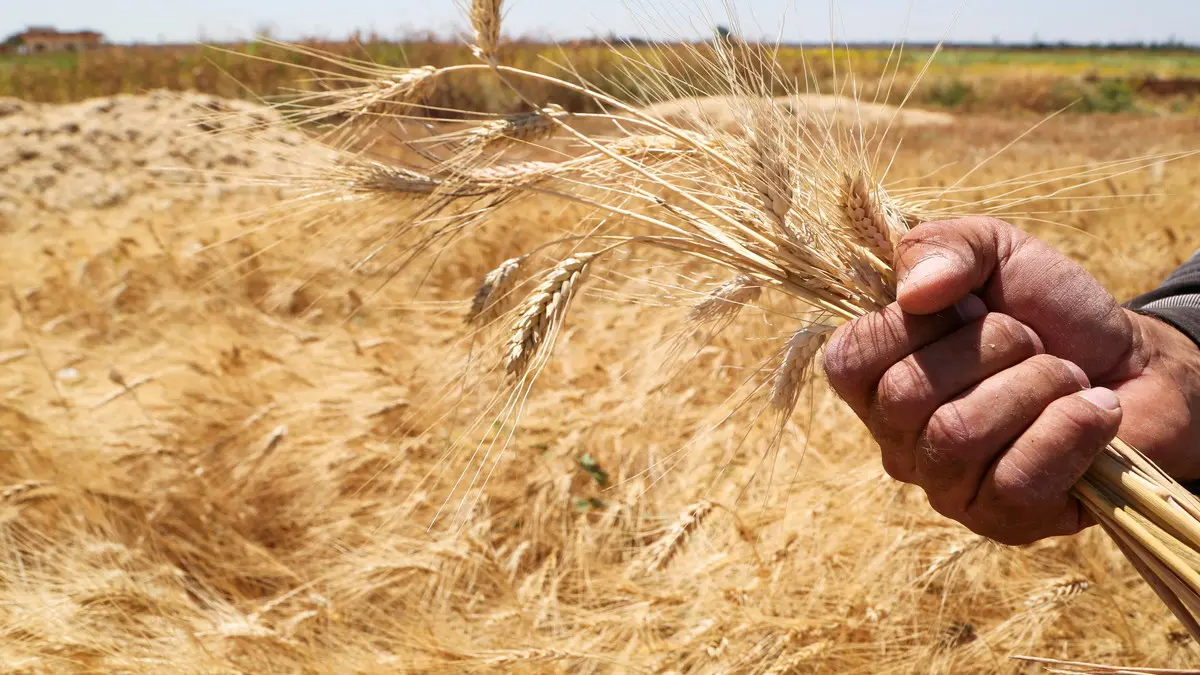
The Syrian Future Movement followed with great interest the official statements issued by the Syrian Ministry of Agriculture on Tuesday, April 21, 2026, confirming the completion of 86% of the wheat planting plan for the current season. Initial projections indicate that production will reach approximately 2.3 million tons if favorable weather conditions persist, thanks to the significant improvement in rainfall across various governorates.
Dr. Saeed Ibrahim, Director of the Agricultural Planning and Statistics Directorate, noted that the total area actually planted reached 1.2 million hectares, distributed between 505,000 irrigated hectares (79% completion rate) and 763,000 rainfed hectares (92% completion rate). This reflects a qualitative leap in the focus on rainfed lands, which form the backbone of national food security. These achievements are part of broader efforts that include the Syrian Grain Corporation launching a new electronic platform for booking and receiving wheat, and the launch of the “Interest-Free Loan” project to support farmers in facing ongoing economic and climatic challenges.
The Syrian Future Movement welcomes this significant agricultural achievement, which marks the beginning of the recovery of the national agricultural sector and represents a tangible step towards strengthening food security and reducing reliance on imports.
We see it as evidence of the resilience of Syrian farmers and the efforts of the Ministry of Agriculture, and a continuation of the positive improvement in food security indicators that we have been witnessing since 2025, when the percentage of food-secure households rose to 18.4%, compared to 11.1% in 2024, according to the Household Food Security Survey.
However, we also note that the current improvement, while valuable, remains fragile and insufficient given the ongoing historical drought crisis, the challenges of climate change, and the inability of domestic production to meet the country’s needs of approximately 4 million tons annually. This necessitates that we continue working with determination to transform these positive indicators into lasting and sustainable food security.
The Syrian Future Movement reiterates its firm and principled stances on food security and support for the agricultural sector, which it has published on its official website. Among the most prominent of these stances are:
- Our paper entitled “The Food Security Crisis in Syria” (dated August 19, 2025): In it, we analyzed the existential threats posed by the historic drought to agricultural production, particularly wheat production in the Hasakah and Aleppo regions, and we called for the establishment of a national water resources management authority.
- Our statement on “The Relative Improvement in Food Security Indicators for 2025 and the Requirements for Transitioning Towards Sustainable Food Resilience” (dated March 11, 2026): In it, we welcomed the progress made in food security indicators, but we cautioned that the improvement remains fragile, and that more than 13 million Syrians still suffer from food insecurity, with a production gap estimated at 2.7 million tons of wheat.
- Our position on the launch of the “Ghiath” National Rainfall Platform (dated March 12, 2026): We commended the Ministry of Agriculture’s launch of the national platform for monitoring and analyzing rainfall, considering it a significant step towards adopting a digital transformation approach in agricultural and climate management, which has clearly yielded positive results in the accurate planning of the current season.
- Our position on “Hasakah Farmers’ Complaints Regarding Wheat Crop Damage” (dated March 4, 2026): We strongly condemned the distribution of unsuitable seeds in areas controlled by the “Autonomous Administration,” which led to the damage of more than 50,000 dunams and losses exceeding 60% in some fields. We demanded an immediate investigation and accountability for those responsible.
The Syrian Future Movement views this agricultural achievement as the fruit of concerted efforts between the government and farmers, but it is only the beginning of a long road towards achieving sustainable food security.
We believe that the success of this season, despite the challenges, proves that Syria is capable of recovery and advancement, provided that support for the agricultural sector continues, irrigation systems are improved, certified seeds are provided, and storage and marketing mechanisms are developed. The improvement in rainfed areas (by 92%) reflects a strategic shift towards promoting rainfed agriculture, which is well-suited to the Syrian climate. This should be reinforced through supportive government policies and climate change adaptation plans.
Based on the above, the Syrian Future Movement recommends the following:
- Consolidating gains and expanding success: Working to generalize successful experiences in governorates that have achieved high implementation rates, and providing additional incentives to farmers in areas that have demonstrated commitment to the agricultural plan, with a focus on supporting small farmers.
- Developing the approved seed system: Expediting the establishment of a national seed bank based on improved and drought-resistant varieties, with strict monitoring of the quality of distributed seeds, and implementing a technical oversight system to prevent a recurrence of the contaminated seed disaster that occurred in Hasakah.
- Linking agriculture to digital transformation: Generalizing the experience of the national “Ghiath” platform for rainfall and expanding it to include early warning systems for drought and agricultural pests, and establishing a central database of cultivated areas and expected production to enable sound scientific planning.
- Strengthening storage and marketing infrastructure: Accelerating the rehabilitation of grain silos and receiving centers, and expanding the use of the electronic booking and receiving platform to ensure harvest receipt with minimal losses and maximum efficiency.
- Establishing a national fund to support farmers: Activating and expanding the “interest-free loan” project to include all governorates, providing farmers with easy credit facilities to purchase seeds, fertilizers, and pesticides, and compensating those affected by natural disasters quickly and transparently.
The Syrian Future Movement affirms that food security is a matter of paramount national security, and that advancing the agricultural sector is a national responsibility that falls on the shoulders of the government, farmers, and civil society together.
We highly commend the efforts of the Ministry of Agriculture and Syrian farmers in achieving this important accomplishment, and we call for continued work with determination and dedication to transform Syria from a wheat-importing country to a self-sufficient, producing nation capable of providing decent bread for every Syrian citizen.