
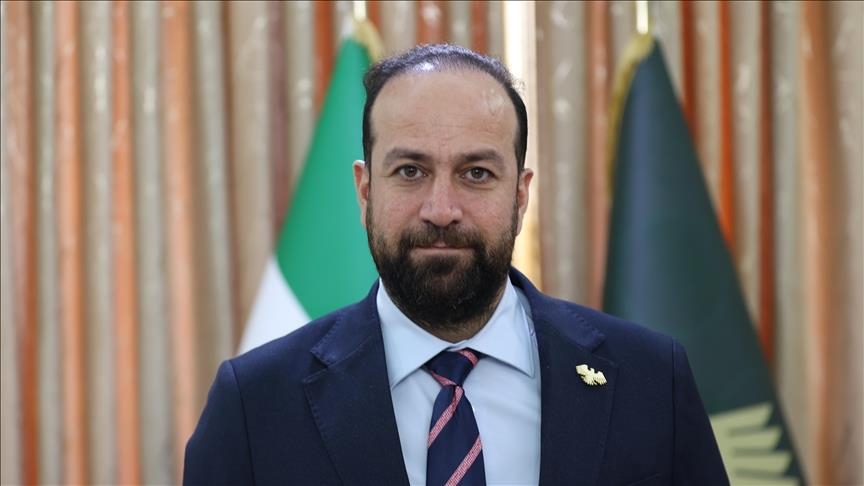
On February 28, 2026, Hamza al-Mustafa, the Minister of Information in the Syrian Interim Government, gave a statement to the Turkish Anadolu Agency, which is considered one of the most prominent official media statements since the new administration assumed power in Damascus.
The statement—made during a visit by a high-level Turkish delegation to the Syrian capital—announced the Syrian government’s intention to “strengthen cooperation with Turkey to counter media disinformation campaigns,” noting the establishment of a joint 24/7 communication mechanism between Ankara and Damascus.
The context in which the statement should be viewed:
Since the fall of Bashar al-Assad’s regime on December 8, 2024, Syrian-Turkish relations have undergone a dramatic transformation:
In January 2025, a framework agreement for security and economic cooperation in the northern regions was signed.
By October 2025, Turkey fully reopened the Bab al-Hawa border crossing for legitimate trade after years of partial closure.
Trade volume between the two countries reached over $1.2 billion annually in February 2026 (according to figures from the Istanbul Chamber of Commerce), an increase of nearly 180% compared to 2023.
In this context, the media statement comes as a logical step to complement the political and economic trajectory, moving from a phase of “tension and confrontation” (2012–2024) to one of “pragmatic partnership.” Why “media manipulation” specifically now?
Syria suffers from one of the highest rates of information chaos in the world:
According to a report issued by the Syrian Center for Strategic Studies (an independent organization) in January 2026, 73% of Syrians rely on social media platforms as their primary source of news (Facebook 41%, Telegram 29%, WhatsApp 18%, X 9%).
Trust in traditional media (television and newspapers) does not exceed 19%, according to a survey conducted by an independent research group in Damascus, Aleppo, and Homs during November–December 2025.
Between January 2025 and February 2026, more than 4,800 false or misleading news items related to the political and security situation in Syria were monitored on major digital platforms (according to estimates by the independent Syrian Rumor Observatory initiative).
In this environment, cooperation with Turkey—which has developed advanced mechanisms to combat disinformation through the Turkish Presidency’s Directorate of Communications in recent years—becomes a practical and logical option.
Domestic Political Risks and Challenges:
Despite the technical and diplomatic logic of the statement, it carries significant domestic political risks that cannot be ignored:
- A large segment of Syrian activists and the opposition views cooperation with Turkey as a “concession” or “subservience,” especially given the Turkish military presence in northern Syria (Afrin, Azaz, Jarabulus, Tal Abyad, and Ras al-Ayn).
- There are concerns that the joint cooperation mechanism could later be used to “unify the narrative” against any criticism of the transitional government or the Turkish role, potentially leading to further internal polarization.
After observing the Syrian media landscape since 2011, the statement appears to be a shrewd diplomatic move in the context of a fragile transitional phase, but it requires very careful internal management:
- The cooperation must be transparent and strictly limited to combating documented disinformation (fake news, fabricated images, systematic campaigns), and not a tool for suppressing dissenting opinions.
- It should be accompanied by a national plan to rebuild independent and professional public media, rather than relying solely on an external partner.
- Any joint mechanism must be subject to clear Syrian national oversight to avoid being interpreted as a “sovereign concession.” In conclusion, Minister Hamza al-Mustafa’s statement is, in essence, a clear political message indicating that the transitional government is counting on Turkey as a key strategic partner in the coming phase and wants to transform the relationship from a “historical tension” to a “practical partnership.”
- The success of this endeavor hinges on its ability to manage internal balance by fostering cooperation without it being perceived as subservience, and by countering disinformation without it becoming a tool for restricting freedoms.
Therefore, the coming months will reveal whether this cooperation is a step towards national media stability, or merely another chapter in the ongoing Syrian polarization.
References:
Al-Sharq Al-Awsat. (2025, August 14). Turkey and Syria lay the groundwork for restoring trade and boosting the industrial sector. Retrieved from https://aawsat.com
Media News. (2025, November 24). Bab al-Hawa: Reopening of the border crossing between Syria and Turkey. Facebook. Retrieved from https://www.facebook.com
Al Jazeera Net. (2025, August 13). Turkey intends to assist Syria with weapons systems and logistical support. Retrieved from https://www.aljazeera.net
Sky News Arabia. (2025, August 13). After the Ankara visit: A Turkish-Syrian security and military agreement. Retrieved from https://www.skynewsarabia.com
Enab Baladi. (June 13, 2025). Report: Influencers Outperform Traditional Media in News Delivery. Retrieved from https://www.enabbaladi.net
Al Jazeera Net. (December 17, 2025). A “Planned” Digital Conflict over the New Syria. Retrieved from https://www.aljazeera.net
Syrian Ministry of Higher Education and Scientific Research. (January 26, 2026). Minister of Higher Education Discusses Scientific Cooperation Prospects with Turkish Ambassador in Damascus. Facebook. Retrieved from https://www.facebook.com