
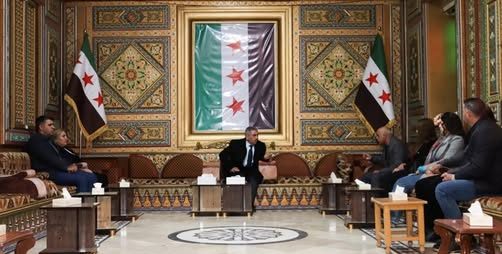
The Syrian Future Movement is closely following the expanded meeting held in Hasakah on March 2, 2026, between Presidential Envoy Brigadier General Ziad al-Ayesh and the Commander of the Syrian Democratic Forces (SDF), Mazloum Abdi, in the presence of Hasakah Governor Noureddine Ahmed and a number of military and security leaders.
This meeting represents a significant practical step in implementing the January 29, 2026 agreement, which marks a historic turning point towards unifying the national territory and rebuilding the Syrian state on the foundations of institutions and equal citizenship.
The Syrian Future Movement welcomes the tangible progress announced at the meeting, which includes:
- The integration of three SDF brigades into the 60th Division of the Syrian Army, under the command of Brigadier General Awad al-Jassem, as a first step towards unifying the military command under the Ministry of Defense.
- The commencement of the release of 60 prisoners against whom no criminal charges or criminal affiliations have been proven, along with the submission of additional lists for reviewing the cases of detainees who participated in previous revolutionary activities, with a view to their release – an important humanitarian gesture for building trust.
- Access routes to Hasakah were opened from five axes (with the exception of the M4 international highway, which is temporarily closed until it is secured), and committees were formed to ensure the safe return of displaced persons.
- A joint technical and engineering team was formed to take over and develop the Rmeilan and Suwaidiya oil fields, with ongoing meetings to ensure stable production and the return of revenues to the state treasury.
The Syrian Future Movement believes that these steps confirm the commitment of both parties to implementing the comprehensive agreement, which includes a ceasefire, gradual military and administrative integration, the handover of border crossings and civilian institutions, and the protection of the cultural and linguistic rights of the Kurdish component, in accordance with Presidential Decree No. 13 of 2026.
However, the Syrian Future Movement emphasizes the need to enhance transparency and accountability during this sensitive transitional phase by:
- Accelerating the comprehensive release of all political and revolutionary detainees, while ensuring fair trials for those against whom criminal charges have been proven, in accordance with international humanitarian law standards.
- Ensuring a genuine and transparent military integration that includes thorough security vetting of personnel and the exclusion of anyone involved in past violations, while preserving the rights of integrating fighters (ranks, benefits, protection).
- Involving civil society and local communities (Arabs, Kurds, Syriac/Assyrians, and others) in the implementation and oversight committees to ensure no party is excluded and to foster mutual trust.
- Activating neutral international monitoring mechanisms (in cooperation with the United Nations or the sponsoring countries) to monitor the implementation of the agreement’s provisions, particularly regarding the return of displaced persons, the management of oil resources, and joint counterterrorism efforts.
- Accelerating a comprehensive national dialogue that includes all political forces and communities to draft a new constitution that constitutionally recognizes Syria’s diversity and guarantees balanced administrative decentralization while preserving national unity.
The Syrian Future Movement views these steps as a genuine opportunity to transform Syria’s diversity from a source of tension into a constructive force, leading to a unified, democratic, and civil state that protects the dignity of all its citizens without discrimination or exclusion. We also call on both parties and the international community to seriously support this path, in order to achieve lasting stability, transitional justice, and the comprehensive national reconciliation that the Syrian people deserve after years of suffering.