
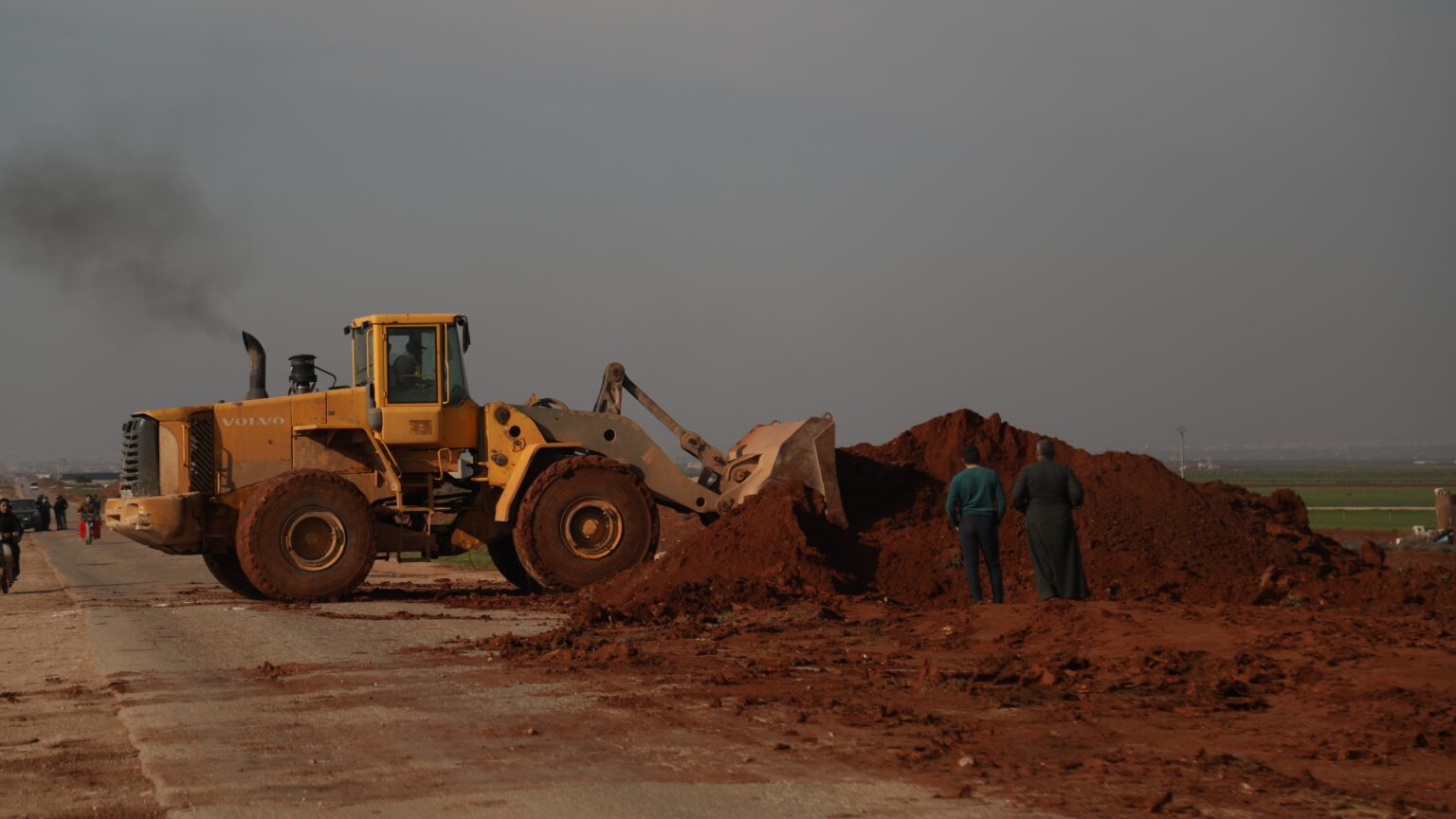
The Syrian Future Movement, as a national, civil political entity striving to build a unified and stable Syrian state, is closely monitoring the positive developments underway in Idlib Governorate. In late March 2026, teams from the Military Engineering Directorate of the Ministry of Defense began removing former military earthen berms along a stretch of approximately six kilometers in the town of Afes, in the eastern Idlib countryside (north of Saraqib), while simultaneously widening the roads connecting Taftanaz, Afes, and Saraqib.
These works are expected to be completed within about a week, paving the way for the reclamation of hundreds of hectares of agricultural land that have remained uncultivated for years due to the effects of the armed conflict.
The Syrian Future Movement views these efforts as a continuation of the organized campaigns launched in 2025, which have achieved tangible results up to October 2025, including:
- Completion of approximately 35% of the berm removal plan in Idlib Governorate.
- Movement of more than 85,000 cubic meters of earth.
- Removal of more than 80 kilometers of earthen berms.
- The removal of 3,200 dunams (approximately 320 hectares) of land has been restored to agricultural production, directly benefiting over 300 farmers.
The Syrian Future Movement affirms that the removal of these earthworks—constructed between 2012 and 2024 for defensive purposes—represents a multi-dimensional strategic step in the national recovery phase following the fall of the former regime in December 2024. This step offers several advantages:
- Economically: It means restoring fertile agricultural land in the eastern Idlib countryside, enhancing food security, reducing reliance on foreign aid, and providing sustainable employment opportunities for rural families.
- Humanitarianly: It facilitates the movement of civilians, reduces the risks of accidents and pests, and supports the return of displaced persons to their lands and properties.
- Politically and symbolically: It removes the vestiges of the conflict and the former regime, transforming former contact zones into areas of production and stability, reflecting the commitment of those in charge to rebuilding the state on sustainable civil and economic foundations.
The Syrian Future Movement calls on government agencies and partners to:
- Accelerate and expand these campaigns to include all affected areas in Idlib, rural Aleppo, and elsewhere, ensuring the removal of unexploded ordnance and mines in full coordination with specialized agencies and international organizations.
- Provide comprehensive agricultural support, including improved seeds, fertilizers, modern irrigation systems, and accessible loans, to ensure the sustainability of land reclamation and enhance productivity.
- Strengthen partnerships between government agencies (Ministry of Defense, Ministry of Agriculture and Agrarian Reform, and governorates), civil society, and international organizations, including agricultural support programs from the Food and Agriculture Organization (FAO) and the United Nations Development Programme (UNDP), in line with the National Agricultural Strategy 2026–2030.
- Prioritize youth and women in new agricultural projects, recognizing them as essential drivers in revitalizing rural Syria and building a comprehensive local economy.
The Syrian Future Movement renews its firm commitment to supporting national efforts aimed at rebuilding a unified, safe, and productive Syria, free from the effects of conflict and foreign interference. We call on all Syrian parties to cooperate constructively to achieve economic and social stability, leading to a democratic civil state based on the principles of justice and equal citizenship.