
One of the most prominent pillars of Russian influence in the Middle East collapsed with the fall of Bashar al-Assad’s regime on December 8, 2014. Russia had militarily intervened in Syria in 2015 to support Assad, achieving significant strategic gains: permanent military bases at Hmeimim (air base) and Tartus (naval base), strong influence in the Eastern Mediterranean, and its role as a key player in the regional balance of power.
The fall of Assad, who fled to Moscow, initially appeared to be a strategic disaster for Russia, especially given its war in Ukraine, which was draining its resources.
However, a year later (as of February 2016), Russian-Syrian relations showed a pragmatic shift toward a “cautious partnership” instead of the previous dependency. The Syrian transitional government sought to redefine the relationship based on parity and mutual interests, while Russia maintained a limited but strategic military presence.
This shift was not unexpected; rather, it was the result of a new balance of power imposed by the internal and regional realities in Syria, with the increasing roles of Turkey, the Gulf states, and the United States.
The Historical and Strategic Context: From Close Alliance to Temporary Vacuum:
Russian-Syrian relations began strongly during the era of Hafez al-Assad, but the Russian military intervention in 2015 transformed them into an existential alliance. Russia used Syria as a springboard to reassert its role as a great power, especially after the annexation of Crimea and its tensions with NATO. The bases in Khmeimim and Tartus gave Moscow the capability to project air power in the Mediterranean, support its operations in Africa, and counter American influence.
With the fall of Assad, the initial weeks saw a partial withdrawal, characterized by:
The transfer of military assets to Libya (under the control of Khalifa Haftar) and a reduction of the presence in Qamishli in northeastern Syria.
The withdrawal of a significant portion of the forces from Tartus was completed by March 2025, leaving only a limited presence at Khmeimim.
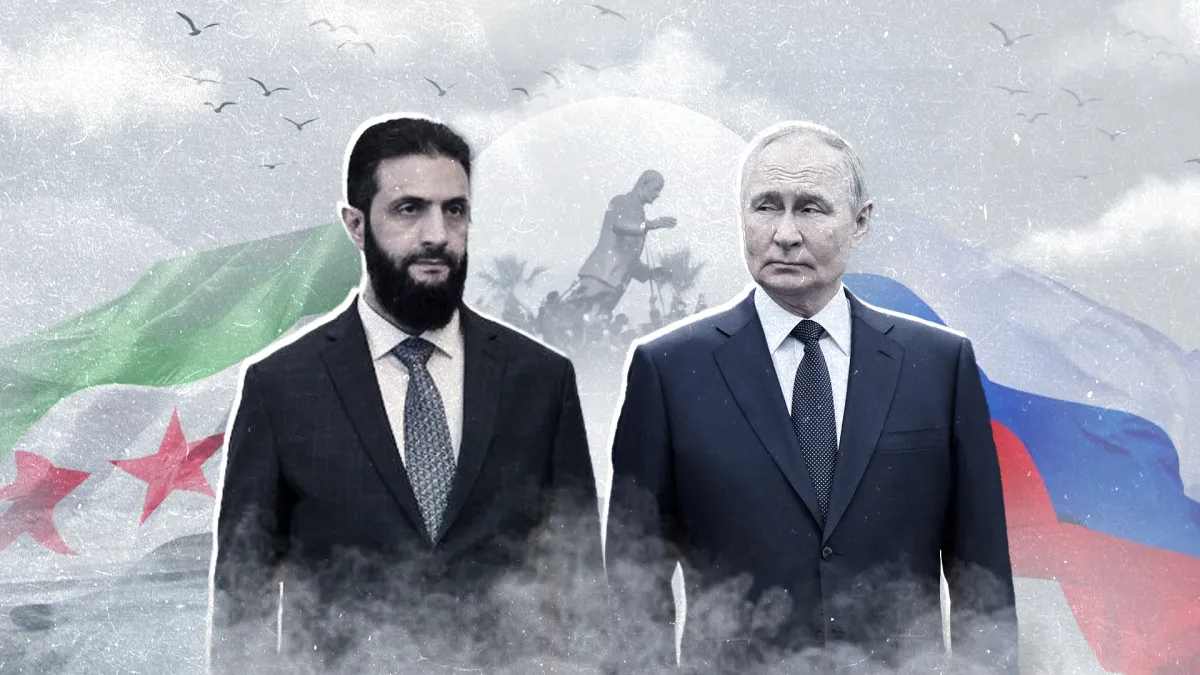
However, by October 2025, Russian military flights to Khmeimim resumed, and al-Sharaa made a historic visit to Moscow on October 15, 2025, where he affirmed respect for previous agreements while redefining them to guarantee “Syria’s sovereignty and unity.” This shift reflects Damascus’s pragmatism: the new Syria needs Russian support in the Security Council, economic aid (oil, wheat, energy reconstruction), and a balancing role against Israel. For its part, Russia wants to maintain its bases as a strategic asset, especially given the war in Ukraine, which makes the Mediterranean a vital logistical corridor.
The current military situation: a limited presence with the possibility of renegotiation:
The Russian presence will remain until February 2026, concentrated at Hmeimim (air base) and Tartus (naval base), with a gradual withdrawal from Qamishli.
Reports indicate that Hmeimim continues to be used for supplies, with military flights resuming after a six-month hiatus. Damascus has allowed a limited presence in exchange for guarantees: no support for remnants of the Assad regime, and assistance in rebuilding the Syrian army (training on older Soviet-era weapons).
In July 2025, a high-level Syrian delegation (the foreign and defense ministers) visited Russia, requesting the return of Russian forces to southern Syria (near the Israeli border) to deter Israel, particularly after Israeli strikes in Damascus. But Israel objected, halting the progress.
This demonstrates the limits of Russian influence. Moscow is no longer able to impose its presence as it did under Assad, but rather relies on negotiations with Damascus and regional players.
Economic and humanitarian dimensions, tools of soft power:
Russia provided immediate aid in the form of oil and wheat shipments since the spring of 2025, and promises to rehabilitate the energy and transportation infrastructure. This helped the transitional government cope with the energy and food crisis, in exchange for concessions regarding military bases.
Economically, Russia is seeking investments in gas fields and ports, but Damascus terminated a Russian investment contract in the Tartus commercial port in 2025 due to non-compliance, demonstrating Damascus’s commitment to economic sovereignty.
Regional and international dynamics, a multipolar balance:
The new Syria is pursuing a policy of “positive equilibrium” by strengthening relations with Turkey (Damascus’s main supporter), the Gulf states (financial support for salaries and energy), and the United States (negotiating sanctions, terrorism, and consolidating Syrian unity). Russia has become “one player among many,” not the sole partner.
Israel prefers Russia’s continued presence as a “buffer” against Turkish influence, while Turkey wants Russia to counterbalance Israel.
The United States is watching cautiously. The fall of Assad would have been a blow to Iran (severing its land bridge to Hezbollah), but Russia’s continued presence raises concerns about a resurgence of its influence.
The European Union called for Russia’s expulsion by March 2025, but the pressure has eased.
Challenges and risks: distrust and interdependence:
Syrian suspicions of Russia run deep. Its support for Assad has caused thousands of casualties, and its refusal to hand him over hinders transitional justice.
President al-Sharaa faces domestic pressure to reduce the Russian presence, but he needs its support against Assad’s remnants (especially on the coast) and in the Security Council.
Russia faces constraints: the war in Ukraine is draining its resources, and its influence in Syria has become “fragmented” and “temporary.” If it fails to provide genuine support, it could lose even its limited presence.
Conclusion: Towards a limited, pragmatic partnership;
The new relationship between Russia and Syria is not a return to the old alliance, but rather a new model based on mutual interests and caution.
Syria benefits from Russia as a “balancing factor,” while Russia maintains a strategic foothold.
However, this balance is fragile and could shift with the progress of internal reforms or regional changes.
Ultimately, this transformation reflects the Middle East’s move toward multipolarity, where no single player can achieve absolute dominance.
References:
- INSS Insight No. 2077, “Is Russia Returning as a Security Actor in Syria?” (19 يناير 2026).
- The Washington Institute, “The Window to Counter Russia in Syria Is Closing” (20 أكتوبر 2025).
- Carnegie Endowment, “The Rapprochement Between Russia and Syria Is a Temporary Necessity” (4 سبتمبر 2025).
- MEMRI Inquiry & Analysis No. 1898, “Al-Sharaa Regime Strengthening Ties With Russia Amid Public Disapproval” (25 نوفمبر 2025).
- جسور للدراسات، “إعادة بناء العلاقات الروسية السورية ما بعد نظام الأسد” (30 نوفمبر 2025).
- CSIS, “Syria’s Promise and Challenges One Year After Assad’s Fall” (4 ديسمبر 2025).
- The Soufan Center IntelBrief, “Syria Exploits Great Power Competition” (20 أكتوبر 2025).