
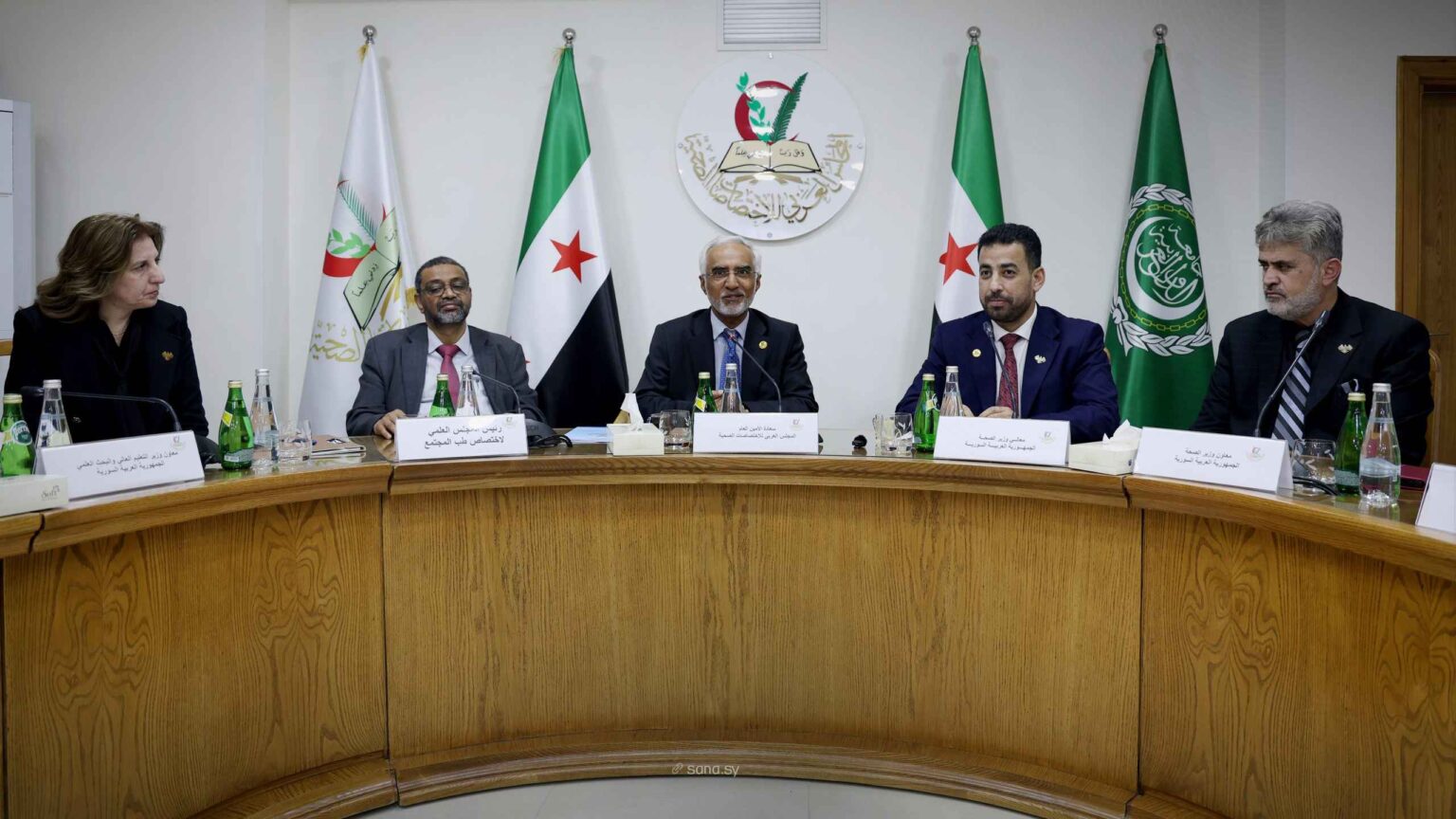
The Syrian Future Movement welcomes the convening of the Arab Board of Medical Specialties’ first scientific meeting in Damascus on Thursday, February 5, 2026, after a hiatus of more than 13 years. The meeting was attended by the Syrian Minister of Health, Dr. Musab Al-Ali, the Secretary-General of the Board, Dr. Omar Awad Al-Rawas, and members of the Scientific Council for Community Medicine. According to reliable media reports, Damascus has also announced it will host the meeting of the Board’s Supreme Council in April 2026.
The Syrian Future Movement views this event as a significant and positive step towards restoring Syria’s leading role in the Arab healthcare system. The Board is a long-established professional scientific body, founded in 1978 under the auspices of the League of Arab States. It focuses on unifying standards for specialized medical training, accrediting programs, administering examinations, and qualifying personnel in more than 20 specialties. Historically, it has contributed to awarding thousands of certificates to Syrian and Arab physicians, including more than 2,300 certificates to Syrian physicians over the years.
The Syrian Future Movement emphasizes the importance of this return in the context of rebuilding the Syrian health sector, which has been severely damaged by years of conflict. These meetings open avenues for exchanging Arab expertise, developing training programs, introducing new specializations such as those related to public health, enhancing scientific research, and keeping pace with the technological revolution and artificial intelligence in healthcare. This will improve the quality of medical services locally and regionally and contribute to attracting Arab support and investment for restoring the health infrastructure. This development also comes within the context of the accelerating normalization process with Syria following its reinstatement to the Arab League in 2023 and the anticipated fall of the Assad regime in late 2024, reflecting an Arab consensus on reintegrating Damascus into regional bodies.
The Syrian Future Movement appreciates the strengthening of joint Arab cooperation to reintegrate Syria into regional professional bodies, as evidenced by media publications highlighting the return of scientific activity to Damascus.
We also appreciate the support for training and developing the skills of Syrian medical personnel to meet international standards, while also empowering non-physicians through extensive training programs. The Syrian Future Movement emphasized the importance of reaffirming Damascus’s historical role as a center of Arab science and medicine, with the Secretary-General stressing that it “was and will remain the primary center.” This was linked to other cultural events, such as the recently opened Damascus International Book Fair, which saw broad Arab participation, reflecting a comprehensive revival.
At the same time, the Syrian Future Movement cautioned against the accompanying challenges, including:
- The need for profound structural reforms in the Syrian health system to ensure the sustainability of this return, including addressing the shortage of human resources and equipment.
- Addressing the economic and security challenges that could hinder the implementation of training and development programs on a large scale, especially in remote areas.
- The importance of linking these steps to a comprehensive national process that guarantees transitional justice, builds a state based on institutions, and strengthens trust among all Syrian communities, while ensuring the avoidance of any political interference that could affect the independence of scientific bodies.
The Syrian Future Movement recommended the following to the Syrian government and relevant authorities:
- Developing a comprehensive national plan for the reconstruction of the health sector, focusing on Arab and international partnerships, prioritizing the training of young professionals, distributing services equitably across geographical and social strata, and integrating modern technology to improve healthcare.
- Strengthening the independence of medical and scientific bodies from political interference to ensure the quality of training and international accreditation, while encouraging joint research with sister Arab states.
- Supporting Arab integration initiatives in public health, while adhering to the values of civil society, pluralism, and equality, so that the health sector becomes a model of national and regional unity, and linking this to other efforts such as promoting cultural events to strengthen Arab ties.
The Syrian Future Movement calls upon all national and Arab forces to support this step as part of the process of rebuilding Syria towards a future characterized by civil peace, sustainable development, and dignity for every citizen, inspired by the positive spirit that has emerged in public pronouncements about Damascus’s return as a beacon of science and knowledge.