Introduction:
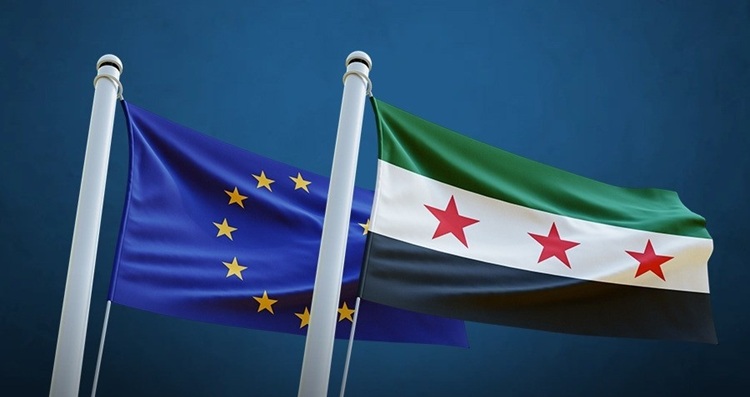
The European stance towards Syria has undergone a qualitative shift since the fall of the Assad regime in December 2014 and the transfer of power to a transitional government headed by Ahmed al-Sharaa.
This shift cannot be interpreted as a mere passing political juncture, but rather as a strategic repositioning of Europe in light of a new equation.
Syria is a potential security partner in the fight against terrorism, but at the same time, it is a true testing ground for the extent of commitment to human rights and democratic standards.
The statements made by the European Commissioner for the Mediterranean, Dubravka Šujča, on February 10, 2016, cemented this shift, considering the Syrian transitional government to be the “primary entity” responsible for combating terrorism within Syrian territory—a political recognition with profound security and geopolitical dimensions.
First: European Security Recognition – Between Necessity and Pragmatism:
Šujča’s characterization indicates a shift in the European approach from a policy of containment and sanctions to one of conditional engagement. This recognition coincided with Syria’s official accession to the international coalition against ISIS in January 2026, as its 90th member, a move described by the US Embassy in Damascus as a “pivotal moment” in the international war on terror.
This development was not isolated from a tense security context, the most prominent manifestations of which were:
- The transfer of approximately 2,250 ISIS members to Iraq as part of an international coordination effort.
- Extensive US airstrikes on February 7, 2026, targeting ISIS positions in central Syria.
- The new Syrian government assuming control of al-Hol camp and detention centers in the northeast of the country following a partial withdrawal of the Syrian Democratic Forces.
These developments bolstered Damascus’s image as a genuine security partner, but simultaneously exposed the fragility of its security infrastructure, particularly given the presence of thousands of foreign fighters, who, according to UN reports, constitute nearly 40% of those detained in the camps.
Second: The Financial and Political Framework – Broad Support with Clear Conditions:
In a parallel development, the European Union announced its commitment to a financial support package amounting to:
- €620 million for 2025–2026.
- A broader package of up to €2.5 billion to support economic and humanitarian reforms.
However, this support is not unconditional! European institutions emphasized that any financial or political engagement is linked to progress in the following areas:
- Internal stability.
- Security sector reform.
- Protection of minorities.
- Commitment to the political process in accordance with UN Security Council Resolution 2254.
Here, it becomes clear that European recognition is not a “blank check,” but rather a political investment conditional on measurable results.
Third: The European Parliament Vote – Bringing the Minorities Issue to the Forefront:
The most significant development that reshapes the landscape is the historic vote in the European Parliament, where a comprehensive resolution on the situation of minorities in Syria was adopted by a majority of 363 votes to 71, with 81 abstentions.
This resolution did not merely refer to the northeast of the country, but explicitly named all Syrian communities, including Druze, Christians, Alawites, Yazidis, Kurds, and Arabs.
It affirmed that stability in Syria begins with the full recognition of the rights of all communities, their political participation, and the constitutional enshrinement of those rights, while preserving the unity of Syrian territory.
The resolution carries three key messages:
- Any relationship with the European Union is contingent upon concrete and verifiable guarantees for the protection of civilians.
- The necessity of halting the violations described as war crimes.
- The effective inclusion of the communities of northeast Syria in governance.
With this vote, the issue of minorities has moved from the margins of political debate to the heart of the European equation, becoming a structural condition for any future cooperation.
Fourth: Suwaida and the Druze – From Local Margins to International Attention:
What is striking about the European resolution is its explicit mention of the Druze, within the context of escalating international engagement regarding their situation in Syria.
This coincided with a campaign led by Druze expatriates, most notably Sheikh Muwaffaq Tarif, within decision-making circles in the United States and Canada.
This development reflects a shift in the international community’s understanding of the Syrian stability equation. Suwaida is no longer a peripheral region, but rather a crucial indicator of the new Syrian state’s ability to build a comprehensive social contract.
However, the discussion of “the right to self-determination” as an internationally proposed option remains problematic, as it clashes with the principle of preserving Syrian territorial integrity, which the European resolution itself emphasized.
Therefore, the equation proposed by Europe is not the dismantling of the state, but rather its re-establishment on the basis of a genuine constitutional partnership.
Fifth: Geopolitical Balances – Between Turkey, Israel, and Russia:
The European shift cannot be understood in isolation from the regional environment.
Turkey, which supports the transitional government, Israel, which carries out defensive strikes against potential threats, and Russia, which still maintains military bases, are all active players in the scene.
For Europe, the central objective is:
- Preventing the resurgence of ISIS.
- Avoiding new waves of refugees.
- Reducing the likelihood of instability spilling over into Europe.
Cooperation with Damascus thus appears as a pragmatic option, but one fraught with a complex web of overlapping calculations.
Sixth: Internal European Division – Between Human Rights Realism and Security Pragmatism:
The European Parliament sessions witnessed clear tensions, with some members warning of the fragility of the situation in northeastern Syria, while others criticized what they considered double standards.
The European scene is divided into two camps:
- A pragmatic camp that sees cooperation as an opportunity to achieve stability and prevent the resurgence of terrorism.
- A human rights camp that demands stronger guarantees for the protection of minorities, security sector reform, and the prevention of impunity.
This division reflects the nature of the transitional phase, which remains open to multiple possibilities.
Conclusion:
Between Conditional Normalization and Testing the State:
Schweyka’s statement and the European Parliament’s vote together represent a pivotal moment in Syria’s relationship with the European Union.
Security recognition has given Damascus a leading position in the counterterrorism equation, but the decision to protect minorities has set a ceiling.
A clear political stance is needed for this engagement.
Therefore, the next phase will not be measured by statements, but by the ability to:
- Build an inclusive social contract.
- Reform the security sector.
- Guarantee genuine political participation.
- Protect the territorial integrity of Syria while respecting its diversity.
Between security pragmatism and human rights obligations, Syria today faces a dual test: proving its ability to be a partner in combating terrorism on the one hand, and a state of citizenship capable of embracing all its components on the other.