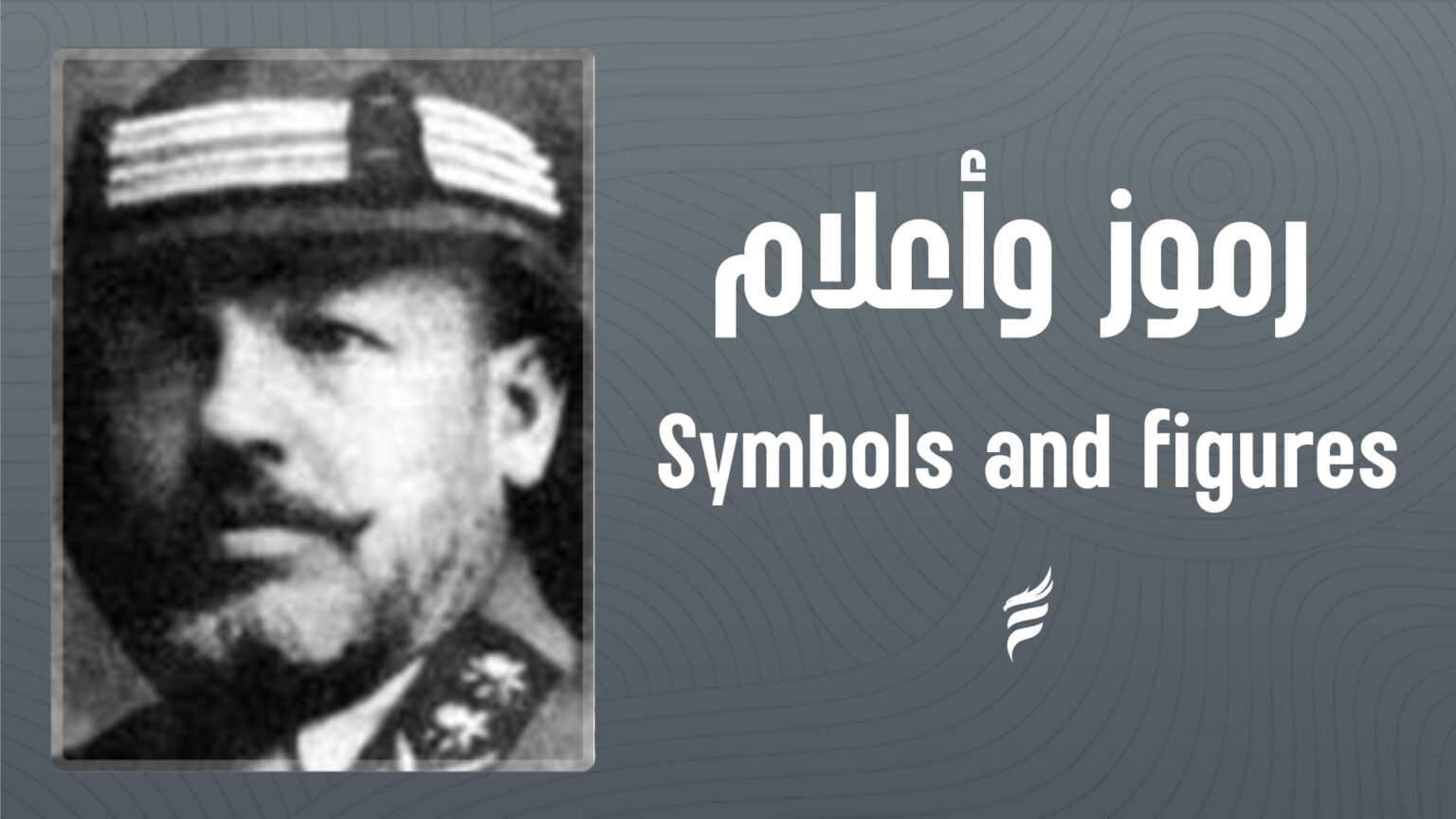
Ali Rida al-Rikabi is considered one of the most prominent Syrian statesmen during the founding period of the Syrian state, and one of the figures who combined administrative and military experience with a commitment to the Arab national project and a rejection of foreign occupation.
Ali Rida al-Rikabi was born in Damascus to a distinguished Damascene family whose members worked in trade.
He received his education at the Rashidiya School in Damascus, then joined the Military Academy in Istanbul, graduating as an officer in the Ottoman army, where he served in several leadership positions.
He held high military and administrative positions, being appointed military commander and governor of Jerusalem, then of Medina, before being transferred to Baghdad and then Basra, shortly before the outbreak of World War I in 1914.
Al-Rikabi was known for his outspoken opposition to the Ottoman Empire’s decision to enter the war, and publicly demanded neutrality, believing that involving the army in a European war would lead to disaster.
This stance cost him his military career, and he was forced into early retirement at the age of forty-six.
Al-Rikabi returned to Damascus, where Jamal Pasha sought to benefit from his experience, and he was appointed mayor of Damascus in 1915.
With the approaching end of Ottoman rule, Sharif Hussein bin Ali, on the eve of the fall of Damascus on September 26, 1918, entrusted him with the administration of the city and the raising of the flag of the Arab Revolt. However, the chaos that accompanied the Ottoman withdrawal led to Prince Muhammad Saeed al-Jazairi appointing himself governor without authorization.
After the British officer Thomas Lawrence entered Damascus, Prince al-Jazairi was removed from office, and Ali Rida al-Rikabi was appointed military governor of the city. Al-Rikabi took decisive measures to restore security, arresting Prince Muhammad Saeed al-Jazairi and erecting gallows in Marjeh Square to deter the looting and chaos that had plagued the city. On October 3, 1918, he pledged allegiance to Prince Faisal bin Hussein as the Arab ruler of Damascus and was tasked with forming a governing council that administered Syria until August 1919.
During this period, the city of Aleppo was liberated from Ottoman rule, while the Syrian coast fell under French occupation.
Nevertheless, Al-Rikabi secretly supported armed uprisings against the French in the north, the coastal region, and Antioch, believing in the necessity of resisting the occupation.
Al-Rikabi had a strong and trusting relationship with Prince Faisal, dating back to 1915 when they met at the home of Attallah al-Bakri and both joined the Young Arab Society, which secretly worked to overthrow Ottoman rule.
After the war, Al-Rikabi contributed to the reorganization of the society, alongside Ahmed Qadri and Nasib al-Bakri.
Among his most notable achievements were the Arabization of Syrian state institutions, the reopening of the Medical Institute in Baramkeh in 1919, followed by the Law Institute, and the establishment of Al-Asimah newspaper, the official government publication.
He also issued a decree abolishing Ottoman titles within state institutions, relinquishing his own title of Pasha.
His rule was characterized by social and religious openness. He showed concern for the plight of the Armenians affected by the massacres, exempting them from taxes, and also engaged with the Jewish community in Damascus. He included representatives from various religious communities in municipal and administrative councils, providing an early model of an inclusive national state.
On August 4, 1919, he formed a government of directors that included Muslim, Christian, and Druze figures, reflecting his vision of Syria as a single homeland for all its people. However, his disagreement with Prince Faisal escalated due to the latter’s conciliatory stance towards the British and his acceptance of the continued presence of their military forces. Al-Rikabi resigned on November 22, 1919, criticizing the Sykes-Picot Agreement and describing it as unjust to the country.
After the declaration of Syria’s independence and Faisal’s coronation as king on March 8, 1920, Al-Rikabi returned to form a new government. However, the French threats and their advance towards Damascus forced him to resign again on May 3, 1920, refusing to engage in an unequal war that would lead to the destruction of the Syrian army.
His assessment proved correct after the defeat at Maysalun and the occupation of Damascus in July 1920.
Al-Rikabi left Syria after a French warrant was issued for his arrest, and he moved to Egypt and then to the Hejaz, before being tasked with assisting Prince Abdullah bin Hussein in establishing the Emirate of Transjordan. He served as Prime Minister in 1922 and contributed to drafting the financial and administrative laws of the nascent state.
However, his disagreement with the British officer John Philby led him to resign and return to Damascus in 1923.
In Damascus, he founded the Royal National Party, advocating for the restoration of the Hashemite monarchy in Syria. He engaged in several political and electoral battles, most notably the presidential elections of 1932, but he lost and retired from political life permanently.
Ali Rida al-Rikabi died in Damascus on May 25, 1942, at the age of 74, after suffering a stroke that resulted in chronic paralysis. His son, Akram al-Rikabi, rose to prominence after him, assuming the position of Secretary-General of the Ministry of Agriculture at the beginning of the independence era.
The Syrian Future Movement’s Position:
We, in the Syrian Future Movement, as we remember the founding statesmen of Syria, recall Ali Reza al-Rikabi as one of the symbols of independence and a leading figure of the first Syrian state, a man who combined loyalty to the Hashemite project, rejection of occupation, and responsible national work during the founding period.
This article is part of a series on the symbols and leading figures of the Syrian state, within the framework of a documentation project that aims to connect our revolutionary present with a solid national past, and to revive the need to cultivate statesmen who will protect the homeland, preserve its achievements, and restore the Syrian state’s glory and prestige after decades of tyranny and corruption.