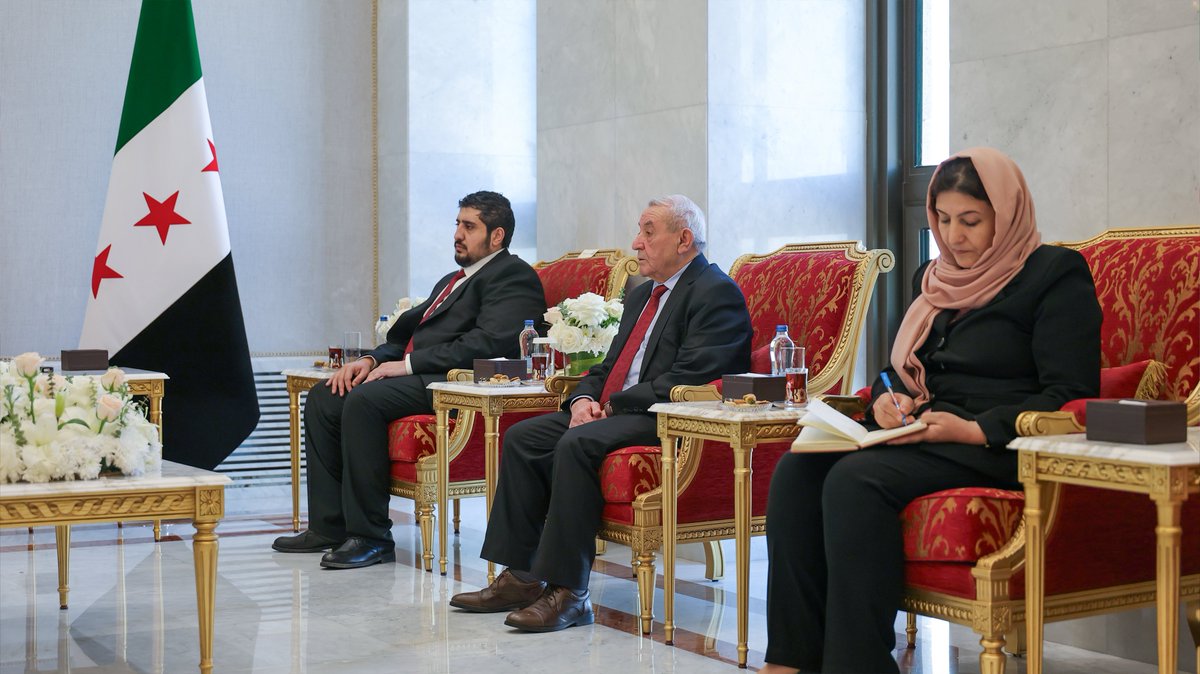
The Syrian Future Movement follows with deep appreciation and profound satisfaction the meeting between the leadership of the Kurdish National Council in Syria (ENKS) and President Ahmed al-Sharaa at the People’s Palace in Damascus on Tuesday, February 3, 2026.
The Syrian Future Movement is pleased to see the realization of its repeated and continuous calls for such direct and frank meetings between representatives of the Syrian components and the leadership of the transitional phase. This stems from a firm belief that comprehensive national dialogue, based on mutual respect, is the only way to overcome the legacy of tyranny and exclusion, and to rebuild a unified Syrian state founded on the principles of equal citizenship, the rule of law, and the constitutional rights of every citizen, regardless of their national, religious, or cultural affiliation.
The Syrian Future Movement considers the Kurdish National Council a fundamental strategic national partner in the project of a new Syrian renaissance.
The Council has demonstrated, throughout decades of peaceful political struggle, its unwavering commitment to the unity of Syria—its land, people, and institutions—and its defense of the national and cultural rights of the Kurdish people within the framework of a democratic, pluralistic, and inclusive state, far removed from any separatist projects or foreign dependency. We view this meeting as a significant and important step towards the official recognition of the Kurdish issue as a genuine Syrian national issue, especially after the issuance of Presidential Decree No. 13 of 2026 (dated January 16, 2026), which represents a historic shift by affirming that Syrian Kurdish citizens are an essential and integral part of the Syrian people, and that their cultural and linguistic identity is an inseparable part of the unified and diverse Syrian national identity.
The Council welcomed this decree, considering it a “positive and important step,” and called for its completion by clearly and explicitly including these rights in the new Syrian constitution, while guaranteeing equal citizenship, preserving cultural and social distinctiveness, and protecting Syrian diversity.
The Syrian Future Movement believes that this meeting comes within the context of a delicate and complex transitional phase, witnessing tangible progress in unifying state institutions and restoring control over Syrian territory, as evidenced by the Damascus agreement with the Syrian Democratic Forces (SDF) signed on January 30, 2026, and the entry of Syrian public security forces into the city of Qamishli and other areas in the northeast.
The meeting’s mutual emphasis on the need to address the historical grievances suffered by the Kurds, reject hate speech, build mutual trust, and commit to continuous dialogue as a fundamental tool for resolving disputes—as President al-Sharaa affirmed—strengthens the prospects for lasting stability and opens broad horizons for the effective and influential participation of the Kurdish component in the reconstruction process, economic development, and institutional reform at all levels.
In this sensitive context, the Syrian Future Movement calls for strengthening and expanding this positive dialogue process through the following steps:
- Convening a comprehensive national dialogue that includes all Syrian components (Arabs, Kurds, Assyrians/Syriacs, Turkmen, and others), leading to the drafting of a new constitution that guarantees the national, cultural, and linguistic rights of the Kurds and other components within the framework of a single, unified, and fully sovereign state.
- Forming joint national technical and legal committees to monitor the implementation of decrees and agreements (including Decree 13 and the Damascus-SDF agreement), while ensuring full transparency, civic participation, and a binding timetable.
- Strengthening confidence-building mechanisms on the ground by creating safe conditions for the return of displaced persons, protecting human rights, and rejecting any attempts to incite sedition or military escalation, while prioritizing the supreme national interest in the face of crippling economic challenges, the humanitarian crisis, and external and internal security threats.
The Syrian Future Movement reaffirms its full commitment to supporting every effort aimed at strengthening genuine national unity, comprehensive transitional justice, and building a modern, democratic, and civil state that respects the diversity of the Syrian people and guarantees the participation of all its citizens in shaping their shared future.
We believe that the Syria of the future, for which we strive, will only be complete with the participation of its Kurdish, Arab, Assyrian, and Turkmen partners, and all its components, in formulating its comprehensive national decision-making, based on dignity, justice, and equality.