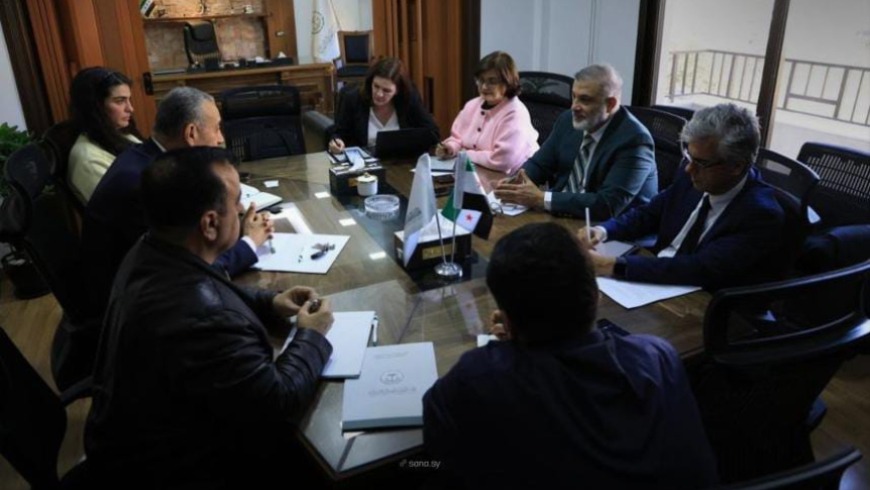
The Syrian Future Movement welcomes the establishment of a joint working group between the National Commission for Transitional Justice and relevant UN bodies, announced today, February 22, 2026, following a series of intensive meetings over the past week (more than seven international meetings, according to official statements).
The Syrian Future Movement views this announcement as a transition from the general political framework to practical implementation, a necessary and positive development given that nearly a year has passed since the issuance of Law No. 15 of 2025 on Transitional Justice, and in light of documented estimates indicating that the number of victims and those affected by grave violations exceeds 200,000 (including martyrs, missing persons, former detainees, and forcibly displaced persons, according to reports from international and national human rights organizations).
The Syrian Future Movement affirms that the success of the transitional justice process in Syria hinges on achieving a delicate balance between three interconnected dimensions:
- Preserving national sovereignty in strategic and executive decision-making.
- Adhering to international standards of transparency, impartiality, and professionalism, and protecting the rights of victims in accordance with international humanitarian law and human rights law.
- Building societal trust through tangible and measurable results in the lives of victims during the first three years of the transitional period.
The Syrian Future Movement draws inspiration from relatively successful international experiences in similar contexts, such as:
- The South African Truth and Reconciliation Commission (1995–2002), which focused on acknowledging the truth and providing moral and material reparations, rather than solely on criminal accountability.
- The Colombian Victims Fund (since 2011), which has successfully provided financial and moral compensation to more than 8 million victims through transparent mechanisms and community participation.
The Syrian Future Movement proposes that the joint team focus—during the next six months (until August 2026)—on achieving four practical priorities that can be monitored and evaluated:
- Launching an initial reparations program with defined criteria, amounts, and timelines, targeting in its first phase the families of martyrs, the missing, and documented victims of torture, while establishing an independent review mechanism that includes representatives of victims and civil society.
- Establishing a unified and secure national database for documentation (victims, witnesses, physical evidence), partially open to rights holders and subject to international data protection standards (GDPR-inspired).
- Developing a clear and publicly announced roadmap for reforming the justice sector (judiciary, public prosecution, prison administration, police), including an intensive training plan and transparent internal accountability mechanisms over the next two years.
- Establishing a permanent community-based consultative mechanism comprising genuine representatives from various social groups and affected areas, ensuring that the team’s recommendations are grounded in reality and not detached from it.
The Syrian Future Movement emphasizes that transitional justice is a profound political and social process aimed at redefining the social contract between the state and its citizens, and definitively closing the door to any return of tyranny or impunity.
The Syrian Future Movement expresses its full readiness to provide intellectual, advisory, and community support to any serious effort moving in this direction, and calls on all Syrian political and civil forces to overcome current differences and work to build a broad national consensus around common basic principles of transitional justice that protect everyone and ensure a stable and just future for Syria.