
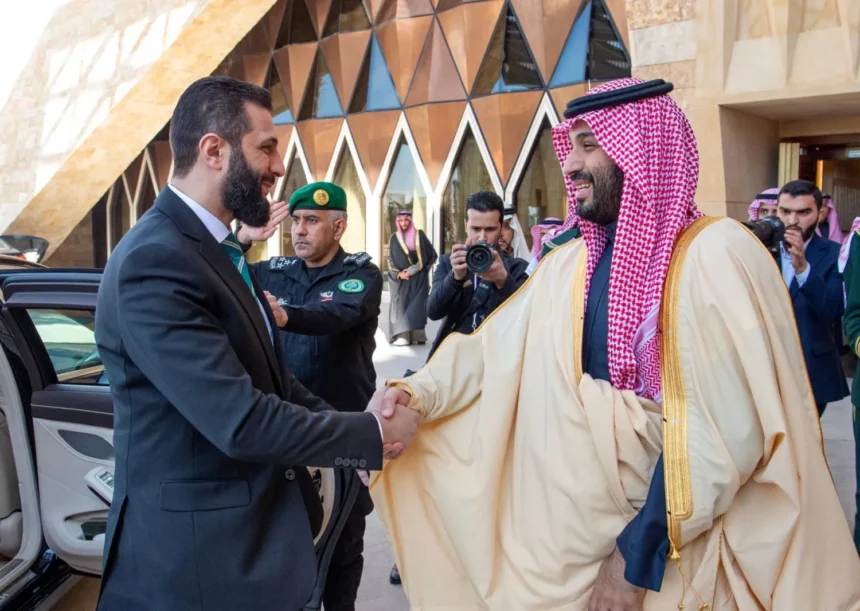
The Syrian Future Movement is following with keen national interest the remarkable acceleration in Syrian-Saudi relations, embodied in the signing of a major package of economic and development agreements on February 7, 2026, at the People’s Palace in Damascus, in the presence of President Ahmed al-Sharaa. This was followed on February 14, 2026, on the sidelines of the Organization of Islamic Cooperation’s Conference of Transport Ministers in Istanbul, by the signing of a roadmap for rail and road connectivity between the two countries.
Furthermore, February 15, 2026, witnessed the announcement of the commencement of the implementation phase of the partnership between the Saudi company “Elm” for digital solutions in Syria, indicating a rapid transition from the signing stage to the implementation stage on the ground.
The Syrian Future Movement views these developments as a historic opportunity to rebuild the Syrian economy on sustainable foundations. From our national perspective, we emphasize the following points:
- The Size and Strategic Importance of Investments:
The value of the agreements signed on February 7 reached approximately $5.3 billion, bringing the total value of Saudi investments and pledges announced to date to approximately $16 billion (60 billion Saudi riyals). We see these figures as a vote of confidence in the emerging Syrian economy following the political changes, and they should be treated as a key driver for job creation, infrastructure rehabilitation, and stimulating the local private sector. - Rail and road connectivity: Restoring Syria’s geo-economic role:
The preliminary agreement reached on February 14 lays the foundation for a railway project linking the Gulf to Europe via Syria, with a technical meeting planned for March 2026 in Saudi Arabia to discuss the details.
We view this project as an opportunity to reactivate Syria’s strategic geographic location as a logistical corridor between three continents, with the necessity of designing it to achieve balanced and decentralized development:
- Connecting Syrian ports to inland production areas.
- Establishing “development belts” around the terminals, encompassing logistics, industrial, and agricultural complexes that serve local communities.
The aviation sector: A qualitative leap in air and tourism connectivity:
The establishment of “Flynas Syria” in partnership with the Saudi company “flynas” (49% Saudi share, 51% Syrian share), with plans to begin operations in the fourth quarter of 2026, alongside a $2 billion investment to develop and operate Aleppo International Airport (capacity of 12 million passengers annually) and construct a new airport in the province.
These projects will reconnect Syrian expatriates with their homeland and open up opportunities for tourism and trade.
We also demand that the contracts include technology and knowledge transfer, and intensive training programs for Syrian personnel.
Digital sovereignty and water security: Vital strategic projects:
The “Silklink” project with the Saudi company STC (an investment of approximately $1 billion) to develop digital infrastructure and transform Syria into an international data corridor.
The “ACWA Power” agreement to establish a desalination plant with a capacity of 1.2 million cubic meters per day, with the transport of fresh water via the national carrier to the southern regions.
Here, the Syrian Future Movement emphasizes the necessity of protecting national sovereignty in these two areas through national cybersecurity and water security laws, and the establishment of a national center for digital and water innovation to gradually localize technology.
To ensure transparency, balance, and sustainability, and to maximize the national benefit from this partnership, the Syrian Future Movement proposes the following:
- Establishing an independent national committee for strategic partnerships, comprising economic and technical experts, and representatives from civil society and the private sector, to monitor implementation and publish transparent periodic reports.
- Requiring partner companies to employ at least 70% Syrian personnel in major projects, with mandatory training programs to transfer expertise.
- Establishing joint development funds to support local small and medium-sized enterprises (SMEs) linked to major projects.
- Expanding economic partnerships with other Arab countries (the UAE, Qatar, and Egypt) to achieve geopolitical and economic balance and avoid dependence on a single source.
- Conducting periodic geopolitical and economic risk assessments for each major project.
The Syrian Future Movement believes that the current Syrian-Saudi partnership represents a golden opportunity to rebuild Syria on strong and sustainable economic foundations.
Therefore, the Syrian Future Movement calls upon all national forces and economic and social actors to support this partnership, provided it is based on transparency, balance, and the supreme national interest.
The future of Syria is being built today by the minds and hands of its people, and through well-considered strategic partnerships that preserve sovereignty and promote comprehensive development.