
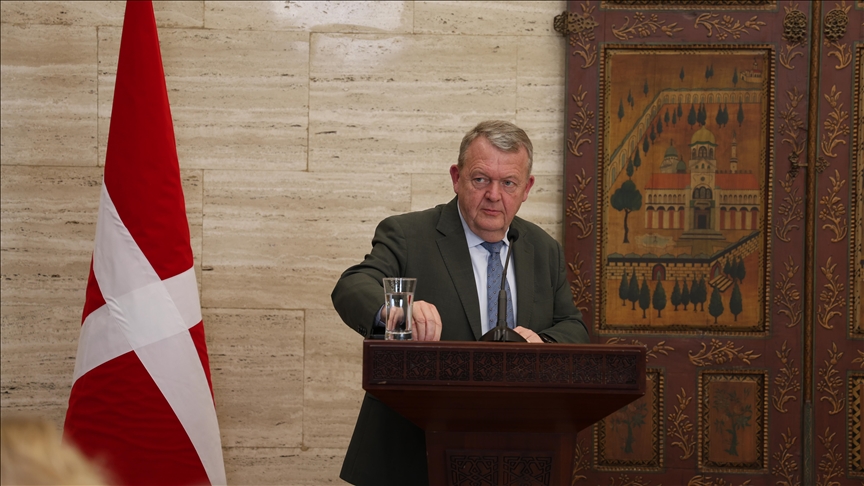
The Syrian Future Movement welcomes the official announcement issued by the Danish Ministry of Foreign Affairs on January 30, 2026, regarding the reopening of the Kingdom of Denmark’s embassy in Damascus this year, after a 14-year closure since 2012.
We view this decision, announced during a joint press conference attended by Foreign Minister Lars Løkke Rasmussen, Prime Minister Mette Frederiksen, Defense Minister Troels Lund Poulsen, and Minister for Immigration and Integration Rasmus Stoklund, as a significant diplomatic step reflecting a shift in European policy towards Syria in the post-conflict phase.
The Syrian Future Movement believes the Danish announcement highlights two clear main objectives: firstly, “to better and more positively follow developments in Syria,” as stated by Minister Rasmussen, indicating a desire to enhance direct monitoring of the political transition and stability.
Secondly, “to strengthen cooperation with Syria regarding repatriation issues” (the return of Syrian migrants and refugees), which is closely linked to internal Danish legal reforms aimed at facilitating the deportation of foreigners convicted of serious crimes.
The Syrian Future Movement views this announcement in a broader context as part of a gradual European trend towards “functional normalization” with the transitional Syrian authorities, driven by internal pressures related to migration and security, and not necessarily a radical change in the political stance on human rights or transitional justice. Some diplomatic analysts note that Denmark is seeking to be among the “first” in the European Union in this area, and its ambassador to Lebanon expressed his satisfaction with this, which may encourage other countries to take similar steps, but with the caveat that this could lead to a division of the previously unified European position.
The Syrian Future Movement believes that the decision raises questions about the balance between humanitarian and security interests.
While reopening the embassy could contribute to facilitating the safe and orderly return of refugees, it requires strong guarantees against forced repatriation to unsafe areas, in accordance with the 1951 Geneva Convention and its Additional Protocol.
Furthermore, the Danish focus on “repatriation” must be matched by parallel Syrian efforts in reconstruction and providing opportunities for voluntary return, while addressing the root causes of migration such as the economy and security.
The Syrian Future Movement considers this development an opportunity for Syria to strengthen its diplomatic relations with Europe, especially in the areas of humanitarian cooperation, reconstruction, and sustainable development, away from outdated political classifications.
We believe that reopening the embassy can open channels for dialogue on transitional justice, supporting development projects, and facilitating the dignified return of migrants, thus contributing to building mutual trust and supporting regional stability.
The Syrian Future Movement suggests the following to maximize the benefits of this step:
- Forming a joint Syrian-Danish committee to manage the migrant repatriation file, including experts in international humanitarian law, to ensure that the process is voluntary and safe, with joint field assessments of the areas concerned.
- Strengthening cooperation in development areas through European support programs for reconstruction in affected regions, focusing on energy, education, and health projects, to create favorable conditions for voluntary return.
- Maintaining balanced diplomatic oversight, including continuous dialogue on human rights and national reconciliation, to prevent cooperation from being used as a tool for unilateral pressure.
- Building Syrian diplomatic capacities through training specialized personnel in managing migration and asylum issues, to handle such developments efficiently and transparently.
The Syrian Future Movement views the reopening of the Danish embassy as a positive step towards normalizing international relations based on mutual respect and common interests, and calls for leveraging this development to serve the Syrian people and enhance national stability.
For our part, we remain committed to monitoring these developments and guiding them towards a path that achieves comprehensive peace and sustainable development.