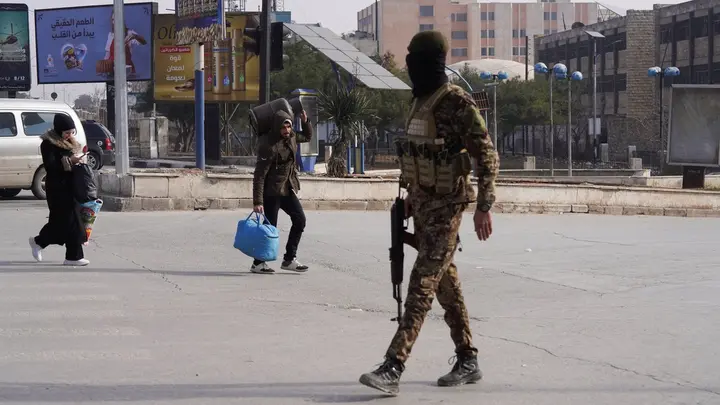
At a pivotal moment in the Syrian state’s recovery and restoration of its sovereignty, the Syrian government has managed to establish full control over the Sheikh Maqsoud, Ashrafieh, and Bani Zeid neighborhoods of Aleppo, thus securing the country’s second-largest city and closing a complex security chapter that had stretched for years, burdening the city’s residents, their livelihoods, and their stability.
The Syrian Future Movement believes that what transpired was not a preferred military option, nor a course the government initially sought. Rather, it was a response to a reality imposed by provocative actions and field pressures exerted by armed groups affiliated with the Syrian Democratic Forces (SDF), which placed civil security and social peace in Aleppo under escalating threat.
The security and military operation was executed with high precision and calculated speed, recognizing the sensitivity of the city’s demographic makeup and the danger of any slide into open confrontations with a regional or ethnic dimension.
We in the Syrian Future Movement believe that securing Aleppo today is not merely a security gain, but a strategic step towards rebuilding trust between the state and society, and launching a new phase characterized by stability, reconstruction, and the return of normal life to one of Syria’s most important cities.
The Syrian Future Movement congratulates the people of Aleppo—Arabs, Kurds, Syriacs, and Turkmen, Muslims and Christians—on the restoration of security in their city. We affirm that Aleppo has been and will remain a model of Syria’s creative diversity, not an arena for power struggles or a testing ground for projects that transcend national identity.
In this context, the Syrian Future Movement calls on the leadership of the Syrian Democratic Forces (SDF) to thoroughly and responsibly review its options and move from the logic of force and weapons to the logic of national partnership, the constitution, and institutions.
The new Syria cannot be built in closed areas, nor through ethnic alignments, nor by relying on external powers, but rather through the will of all Syrians under the umbrella of one homeland and one state.
The most serious threat to Syria’s future is the attempt to frame the conflicts as sectarian, regional, or ethnic.
The Syrian people did not launch their revolution to replace one form of tyranny with another, nor to divide their homeland into warring factions, but rather to establish a state of justice, equal citizenship, and full sovereignty.
The Syrian Future Movement affirms that what has been achieved in Aleppo must be the beginning of a comprehensive national process, not a victory for one side over another, but a step towards comprehensive national reconciliation, building a state of law, and eliminating all forms of weapons outside the control of state institutions.