
Introduction:
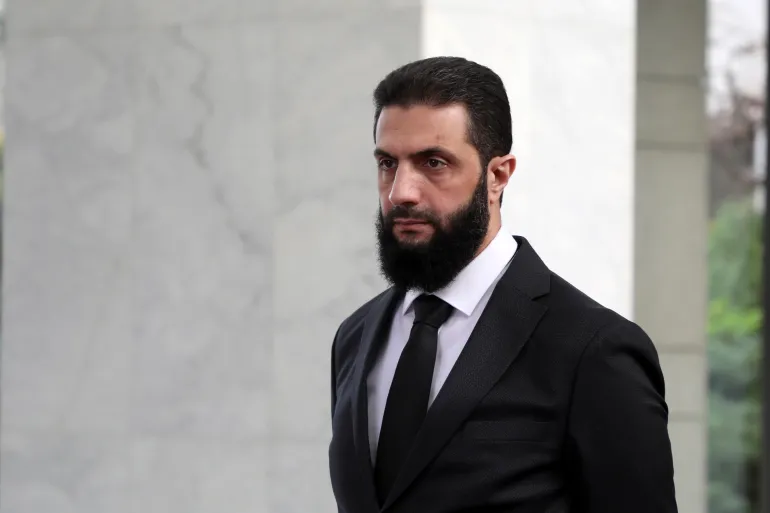
Syrian interim president Ahmed al-Sharaa (formerly known as Abu Muhammad al-Jolani) represents a historical turning point in the contemporary Syrian landscape.
After leading the military operations that led to the fall of Bashar al-Assad’s regime in December 2024, al-Sharaa became interim president in January 2025, attempting to unify and rebuild the country amidst immense security and political challenges.
However, his background as the former leader of Hayat Tahrir al-Sham (HTS), which was previously linked to Al-Qaeda, has made him a potential target for multiple threats, including assassination attempts from extremist jihadist groups, remnants of the former regime, or hostile regional powers.
This article aims to analyze the possibility of al-Sharaa’s assassination based on documented previous attempts since he assumed leadership of Jabhat al-Nusra in 2012 until January 2026, and to discuss the potential scenarios should such an operation succeed.
The article also focuses on the most important lesson from the Syrian experience: the necessity of moving beyond the personalization of power, as was the case under Hafez and Bashar al-Assad, towards building a strong state based on a comprehensive social contract and just laws.
Finally, it highlights how the recurring rumors of al-Sharaa’s assassination, despite often being denied, present a positive opportunity to reflect on the dangers of linking the future of the state to a single individual.
Several studies on political transitions in the Middle East after the fall of authoritarian regimes [1] have shown that in fragile post-conflict states, such as Syria, the assassination of leaders is a major factor in destabilization. As Syria transitions to a reconstruction phase, this threat becomes even more pressing, especially with the continued sectarian and regional tensions. History of Threats and Assassination Attempts Against Ahmed al-Sharaa:
Ahmed al-Sharaa’s career as a military leader began with the founding of Jabhat al-Nusra in January 2012 as a Syrian branch of Al-Qaeda, with initial support from what later became known as the Islamic State (ISIS) [2].
Since then, he has been the subject of repeated rumors of his death, particularly during the internal conflicts with ISIS after al-Nusra’s split from it in 2013-2014. For example, rumors of his death in clashes or airstrikes circulated during that period, but they were always proven false, reflecting the media war accompanying the conflict.
With the transformation of Jabhat al-Nusra into Hayat Tahrir al-Sham in 2017, and its separation from Al-Qaeda, al-Sharaa began to adopt a more pragmatic discourse, which increased the variety of threats against him.
However, the most serious threats came after the fall of the Assad regime in December 2024 and his assumption of the interim presidency in January 2025.
In March 2025, security forces thwarted a first assassination attempt in Damascus, with the help of Turkish intelligence, after detecting suspicious activity as he was leaving the presidential palace [3].
In June 2025, diplomatic reports indicated that al-Sharaa survived at least two attempts carried out by jihadist groups, including ISIS, due to his rejection of their extremist ideology and his rapprochement with the West [4].
A joint Syrian-Turkish operation also thwarted an attempt supported by Hezbollah and allegedly ISIS in Daraa in June-July 2025, although the Syrian government denied some of the details [5]. In July 2025, Israeli reports indicated that al-Sharaa had survived three assassination attempts during the first seven months of his rule, with Turkish assistance [6].
These threats culminated in November 2025, when Syrian authorities thwarted two separate ISIS assassination attempts, adding a personal dimension to al-Sharaa’s efforts to join the international coalition against the organization [7].
US envoy Tom Barrack also warned of the risks of assassination due to his rapprochement with the West, and an Israeli minister publicly called for his assassination in July 2025 [2].
Rumors in December 2025 and January 2026 included claims of shootings inside the presidential palace or assassination attempts against his advisor, but these were officially denied and considered part of disinformation campaigns [8].
These threats reflect the diversity of sources, ranging from jihadist (ISIS), regional (Hezbollah, Israeli threats), and internal (remnants of the regime or internal opponents).
Possible scenarios if al-Sharaa is assassinated:
If an assassination attempt succeeds, the repercussions would be devastating for Syrian stability, given the current concentration of power in al-Sharaa and his inner circle from the former Hayat Tahrir al-Sham.
First, a power vacuum could arise, leading to internal conflicts among the remaining faction leaders, similar to the divisions between al-Nusra and ISIS in 2014, plunging the country back into the chaos of civil war [9].
Second, ISIS or remnants of the former regime could exploit the vacuum to re-expand, especially in the eastern or coastal regions with sectarian tensions, where ISIS attacks decreased in 2025 but did not completely cease [10]. Thirdly, it could lead to greater regional interventions, such as by Turkey in the north or Israel in the south, deepening fragmentation and transforming Syria into a new arena for regional conflict.
Several studies on the impact of assassinating leaders in the region, such as the assassination of Rafik Hariri in Lebanon, indicate that such incidents often prolong instability and hinder state-building [1].
In Syria, this could lead to a resurgence of sectarian violence or the emergence of an unstable hybrid governance model, as seen in some areas after the fall of the Assad regime [11].
The necessity of moving beyond the personalization of power and building a state of institutions:
The regimes of Hafez al-Assad (1970-2000) and Bashar al-Assad exemplified the personalization of power, where security and military institutions were based on personal and sectarian loyalty, leading to the fragility of the state and its rapid collapse in 2024 [12].
“Assad’s Syria” ended with the collapse of the regime, without leaving behind resilient institutions, a situation that must be avoided in the current phase.
Instead, “the Syrian state” must be built on strong institutional foundations, including a unified national army, an independent judiciary, and administrative decentralization that respects sectarian and ethnic diversity.
Here, we note that recent reports confirm that the hybrid governance model that emerged after the fall of Assad – a mix of centralized and local authority – can serve as a basis for stability if it is reinforced by a transitional justice process and national reconciliation [11][13].
This requires a new social contract that guarantees equality and representation for all components, along with economic reforms that redistribute resources away from cronyism.
The diverse armed forces must also be integrated within a national framework, and free elections must be held, with a focus on transitional justice to address war crimes without inciting sectarian revenge [14].
Furthermore, avoiding a repetition of the “Assad’s Syria” model means rejecting reliance on a single charismatic leader and building a system that can withstand political shocks.
Rumors as an Opportunity to Reflect on Syria’s Future:
The recurring rumors, despite their negative nature, about Al-Sharaa’s assassination serve as a reminder that the future of any country cannot be tied to a single individual, regardless of their historical role [15].
These rumors, often part of an information war, provide an opportunity to raise awareness of the importance of institutions and to push political elites towards rapid reforms in governance and security.
Conclusion:
The possibility of Ahmed Al-Sharaa’s assassination remains high, given his long history of threats and the current tensions in post-Assad Syria.
The success of such an operation would likely lead to the country’s disintegration and prolong the chaos.
Therefore, the main lesson is the need for a rapid transition from the personalization of power to the building of a strong state based on institutions, a social contract, and just laws, to ensure Syria’s continuity as a unified and stable entity, regardless of individuals and titles.
References:
- [1] International Crisis Group, “Regional Perspectives on the House of Assad’s Fall”, December 2024.
- [2] Wikipedia, “Ahmed al-Sharaa”, updated January 2026.
- [3] Yedioth Ahronoth (via Turkish Minute), “Turkish security units helped Syrian president survive 3 assassination attempts”, July 2025.
- [4] L’Orient-Le Jour, “Exclusive: Sharaa has escaped two assassination attempts in recent months”, June 2025.
- [5] Reuters (via Enab Baladi), “Syria foiled Islamic State attempts to assassinate al-Sharaa”, November 2025.
- [6] Middle East Monitor, “Syrian President survives 3 assassination attempts in 7 months”, July 2025.
- [7] Reuters, “Exclusive: Syria foiled Islamic State plots on President Sharaa’s life”, November 2025.
- [8] Almodon, reports on rumors in Damascus, December 2025.
- [9] Carnegie Endowment for International Peace, “A Year Later, What is Your Assessment of the Assad Downfall?”, December 2025.
- [10] International Crisis Group, “Restoring Security in Post-Assad Syria”, December 2025.
- [11] Carnegie Endowment for International Peace, “Local Governance in Post-Assad Syria: A Hybrid State Model for the Future?”, July 2025.
- [12] International Crisis Group, “Priorities after Assad’s Fall”, December 2024.
- [13] Carnegie Endowment for International Peace, “Rebuilding the Syrian Nation: Impressions from the Ground”, April 2025.
- [14] Carnegie Endowment for International Peace, “Three Requisites for Syria’s Reconstruction Process”, May 2025.
- [15] Enab Baladi, “Al-Sharaa’s pragmatism threatens his assassination… Warnings and two attempts”, June 2025.