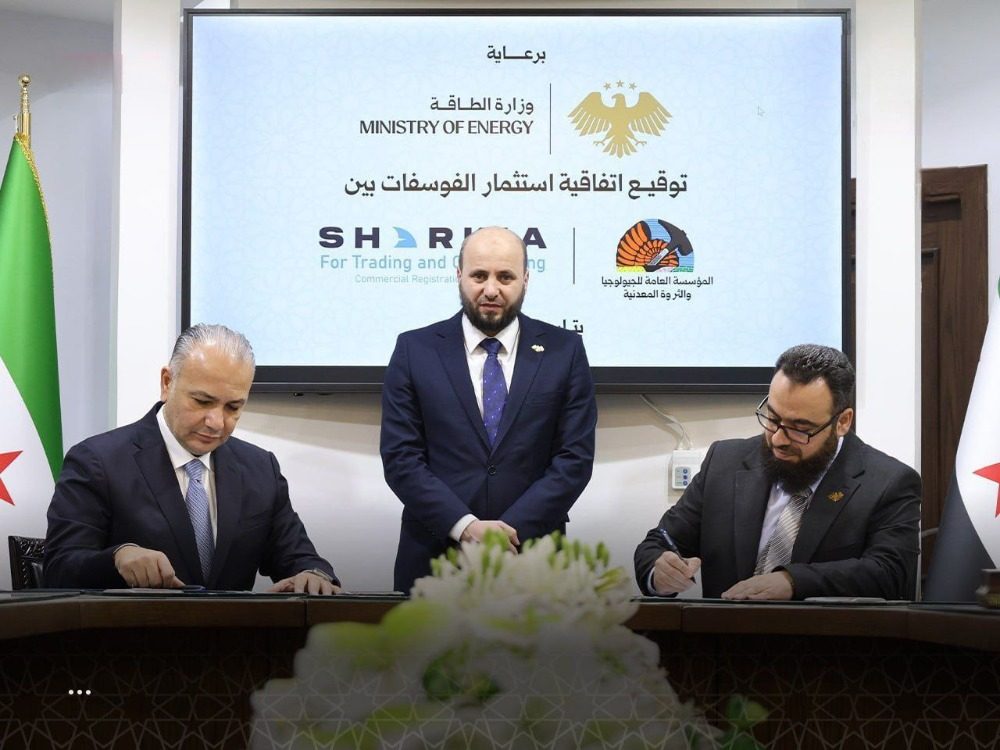
In the context of the rapid economic transformations Syria is undergoing as it nears full sovereignty over its territory, the Syrian Ministry of Energy announced on January 19, 2026, the signing of agreements with local and international private companies to invest in and market phosphate, a key strategic resource in the Palmyra, Khubaysah, and Jableh governorates. The aim is to develop the mines, improve extraction processes, and enhance global marketing to increase national revenues.
The Syrian Future Movement views these agreements as an initial step towards revitalizing the extractive sector. The official announcement emphasized that they are part of the state’s strategy to recover natural resources, focusing on increasing production, which reached approximately 1.5 million tons annually before the war. However, the agreements lack the necessary transparency regarding the details of the partnerships, such as the value of investments, revenue distribution percentages, and financial oversight mechanisms. This raises concerns about the risks of monopolies or the unbalanced exploitation of non-renewable resources.
The Syrian Future Movement closely links this announcement to the historic agreement with the Syrian Democratic Forces (SDF) of January 18, 2026, which provides a broader economic framework for resource exploitation. However, we note the absence of stringent environmental safeguards or mechanisms for equitable revenue distribution, particularly given the economic challenges such as high inflation and the cost-of-living crisis that hinder sustainable development.
The Syrian Future Movement calls for an immediate transition from a rentier economy model to a diversified, productive economy focused on the national interest. It emphasizes that phosphate investment can contribute to boosting GDP through the value chain, but it requires structural reforms to avoid the risks of the “resource curse,” which could exacerbate social inequalities if not managed financially efficiently.
The Syrian Future Movement asserts that the transitional phase necessitates a sound economic vision that considers challenges such as infrastructure deterioration and the environmental impacts of extraction. It calls for building trust through transparent measures, such as publishing periodic financial reports in accordance with international transparency standards (like the Extractive Industries Transparency Initiative – EITI). Furthermore, we criticize the ambiguity in the announcement, which could expose the economy to the risks of global price volatility in fertilizer markets.
The Syrian Future Movement proposes a set of economic recommendations to achieve sustainable growth:
- Establish an independent financial oversight body for the natural resources sector, comprising economic experts and representatives from local communities, to monitor investment partnerships and ensure the application of sustainable development principles, with a focus on Environmental Impact Assessments (EIAs) to mitigate pollution risks in extraction areas such as Palmyra.
- Develop an economic diversification strategy that utilizes phosphate revenues as initial capital to finance emerging sectors such as renewable energy and smart agriculture. This would be achieved through the establishment of a national sovereign wealth fund that invests in productive assets to generate long-term returns and reduce reliance on raw material exports.
- Launch specialized training and technology programs for young people in the fields of extraction and refining, in partnership with international universities. These programs aim to enhance the efficiency of the supply chain and establish local phosphate processing industries, thereby boosting employment and reducing economic migration. The programs should be linked to key performance indicators (KPIs) to measure productivity.
- Strengthening economic decentralization by allocating a percentage of revenues to local development in productive governorates, such as investing in green infrastructure projects, to achieve a balance in regional distribution and prevent economic concentration in the capital, with economic feasibility studies to ensure return on investment (ROI).
- Building strategic international partnerships with organizations such as the World Bank to secure transitional financing, focusing on public-private partnership (PPP) models that safeguard national sovereignty, and conducting periodic reviews of fluctuations in global commodity prices to adjust fiscal policies.
The Syrian Future Movement warns against the dangers of foreign interference in the resources sector and affirms its commitment to supporting national efforts to build a resilient and globally competitive Syrian economy based on citizenship and economic justice. We call on all parties – the government, businesses, and civil society – to engage in this path to transform challenges into opportunities for sustainable growth.