
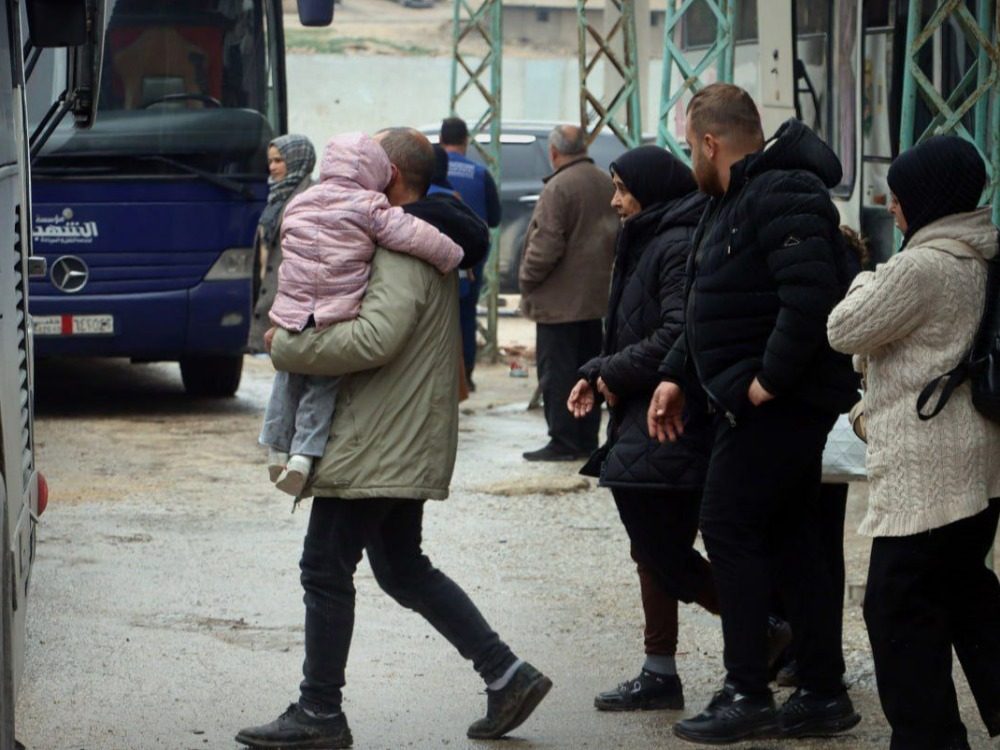
The Syrian Future Movement expresses its deep welcome for the return of displaced persons to the Ashrafieh and Sheikh Maqsoud neighborhoods of Aleppo, considering this step a positive indication of the possibility of restoring stability and normalcy after a period of security and military tensions.
We also emphasize that the safe and dignified return of all Syrians to their homes is a fundamental pillar of the comprehensive peace process, and we call for strengthening these efforts to ensure that the violations that led to forced displacement are not repeated, while respecting the ethnic and cultural diversity that constitutes the essence of the Syrian people.
The Syrian Future Movement meticulously reviews the historical context of events. In March and April 2025, an agreement was signed between representatives of the Kurdish self-administration and the interim government, stipulating the integration of predominantly Kurdish areas within the framework of the Syrian state, while guaranteeing cultural and administrative rights. However, tensions escalated on January 6, 2026, with violent clashes erupting between the Syrian Democratic Forces (SDF) and government forces in the Sheikh Maqsoud and Ashrafieh neighborhoods, resulting in the forced displacement of approximately 140,000 people to the Afrin region and the northern Aleppo countryside. The last SDF fighters withdrew from the area on January 10, 2026, ending military operations and paving the way for demining and clearing tunnels, thus facilitating the return of residents.
The Syrian Future Movement commends the efforts made in the first phase of the return of displaced persons on January 12, 2026, to the Ashrafieh neighborhood, and the second phase on January 13, 2026, which included approximately 750 families to both neighborhoods, under the supervision of the Aleppo Central Response Committee and the Afrin Administration. We view these operations as reflecting civil and administrative cooperation that should be built upon to ensure the sustainability of peace. However, they require independent monitoring mechanisms to verify the safety of the areas and prevent any attempts to manipulate the demographic composition, while adhering to the principles of non-discrimination guaranteed by international obligations.
The Syrian Future Movement calls for preventing any form of forced demographic change in Kurdish-majority or other areas. We base this on the prohibition of such practices under international humanitarian law, particularly Article 49 of the Fourth Geneva Convention of 1949, which prohibits the forced transfer, whether individual or mass, and the deportation of protected persons from occupied or conflict-affected territories, unless absolutely necessary for temporary security reasons. We also emphasize the need to protect private and public property, in accordance with Article 17 of the Universal Declaration of Human Rights of 1948, which states that “everyone has the right to own property, individually or in association with others,” and prohibits the arbitrary deprivation of property.
The Syrian Future Movement calls for the formation of independent investigative committees comprised of Syrian civil society groups to monitor the implementation of these protections and to compensate those affected by any losses resulting from the clashes.
The Syrian Future Movement affirms the right of all Syrians to voluntarily return to their homes without ethnic or sectarian discrimination, based on Article 13 of the Universal Declaration of Human Rights, which guarantees everyone the “right to freedom of movement and residence within the borders of each state,” as well as Rule 129 of customary international humanitarian law, which prohibits the forced displacement of civilians due to armed conflict except in exceptional circumstances related to their safety or imperative military necessity.
In this context, we call on the transitional government to implement these principles immediately by strengthening joint security mechanisms and ensuring the participation of minority representatives in the return and reconstruction processes.
The Syrian Future Movement calls on the transitional government to protect all Syrians without exception, including ethnic and religious minorities, through full adherence to the 1949 Geneva Conventions and their 1977 Additional Protocols, particularly Additional Protocol I, which focuses on the protection of civilians in international and internal armed conflicts.
We also urge the implementation of Security Council resolutions calling for a comprehensive political process in Syria that includes the protection of human rights and the prevention of violations, including forced displacement.
We further call on international organizations, such as the United Nations High Commissioner for Refugees (UNHCR), to provide technical and monitoring support to ensure the implementation of these commitments.
The Syrian Future Movement warns of the dangers of failing to adhere to these international standards, which could lead to regional escalation and undermine confidence in the transitional process. It calls for a comprehensive national dialogue to rebuild trust among all Syrian communities.
In this way, the new Syria will become a model of respect for human rights and international law, built on the principles of unity and justice that guarantee a secure future for all.