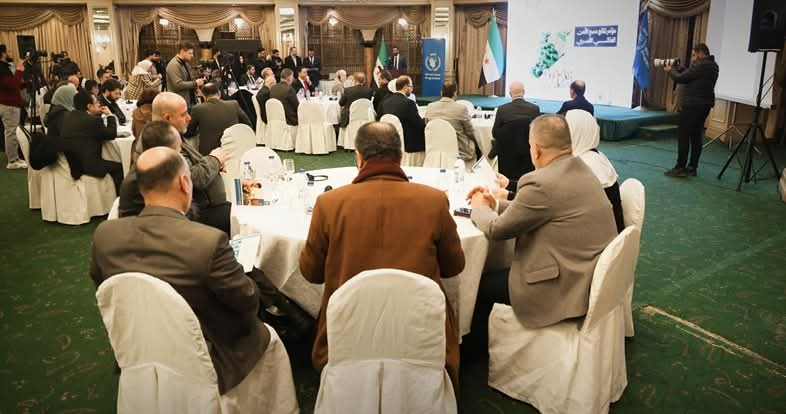
The Syrian Future Movement, in line with our unwavering commitment to building the Syria of the future on the foundations of freedom, social justice, equal citizenship, and sound institutions, and inspired by our reformist vision that places transparency and comprehensive national dialogue at the heart of the transitional phase, follows with strategic interest the announcement by the Syrian Planning and Statistics Commission, in partnership with the World Food Programme (WFP), of the results of the ninth phase of the 2025 Household Food Security Survey, which was officially unveiled on January 11, 2026, during a press conference at the Cham Hotel in Damascus.
This survey, based on a large field sample of 34,820 households outside camps and 2,429 households inside camps, distributed across 267 geographical areas, provides an accurate and scientifically accurate picture of the situation: the percentage of food-secure households reached 18.4% outside camps (a significant improvement from 11.1% in 2024) and 4.2% inside camps. This means that more than 81.6% of households face varying degrees of food insecurity, with clear social and geographical disparities revealing a deep structural vulnerability resulting from the cumulative effects of conflict, exceptional drought, and ongoing economic challenges.
The Syrian Future Movement believes that this announcement, within the context of Syria’s transitional phase, which necessitates a radical shift towards stability and comprehensive reconstruction, represents a significant step towards transparency in the management of national and humanitarian resources. It identifies the food assistance needs of over 14.5 million people (9.1 million of whom are in critical condition), reveals a wheat production gap of 2.7 million tons, and estimates the need for an additional $335 million to bolster the humanitarian response, which currently covers only 1.5 million people monthly.
We see these findings as an opportunity to strengthen evidence-based policies, focusing on supporting vulnerable groups (women and families, representing 12%; internally displaced persons, representing 11.8%; and people with disabilities), and to strengthen the national economy by supporting small and medium-sized enterprises and responsible economic openness.
The Syrian Future Movement emphasizes the necessity of transforming this survey into the foundation for a comprehensive national strategy that links food security with sustainable development and economic sovereignty. The relative improvement in governorates like Tartous (29.9%) and Rural Damascus (27.6%) reflects the potential for recovery, while the decline in the east (Raqqa 4.2%, Hasakah 4.6%) highlights the impact of the worst drought in decades, which threatens self-sufficiency and exacerbates rural unemployment and internal migration.
We also emphasize our belief that addressing this crisis requires an innovative vision that combines technological innovation with sustainable international partnerships, such as developing smart, drought-resistant agricultural systems (precision drip irrigation, hydroponics and vertical farming, and the use of resistant seeds), establishing digital “national food networks” that connect farmers to markets and consumers to reduce waste and promote a circular economy, and launching training programs for rural youth in sustainable agriculture and agricultural entrepreneurship, while leveraging partnerships with the WFP and other organizations to transfer expertise and secure funding.
The Syrian Future Movement calls for expanding food aid to reach a wider audience, integrating it into long-term programs to build resilient social protection systems. These systems should include conditional cash transfers, support for local production to reduce reliance on imports (which currently reach 76%), and a gradual lifting of subsidies through well-considered social protection mechanisms to prevent exacerbating poverty. We also call for this strategy to include the establishment of a “National Council for Food Security and Sustainable Agriculture,” bringing together the government, civil society, the private sector, and international experts. This council would be tasked with developing a 5-10 year national plan focused on increasing agricultural production by 30-40% during the transition period, while ensuring transparency in resource allocation and combating all forms of corruption in the sector.
The Syrian Future Movement expresses a balanced position, welcoming the governmental and international efforts in conducting this survey as a scientific diagnostic tool, while also urgently calling for fundamental reforms. These reforms should include the redistribution of resources to benefit affected areas, increased investment in agricultural infrastructure, and the involvement of civil society in monitoring and implementation.
The Syrian Future Movement calls upon all Syrians – both within the country and in the diaspora – to actively participate in building sustainable food security based on innovation, cooperation, and justice, as an essential part of the reconstruction and national reconciliation process during the transitional phase.
We will continue our efforts to offer practical proposals and field programs, inspired by our reform vision, to achieve together a strong, free, and progressive Syria that guarantees the dignity of every citizen.