
Introduction:
The export sector stands out as one of the most prominent pillars for reconstruction and economic recovery as Syria enters 2026, following the United States’ lifting of most comprehensive sanctions on Syria – including Executive Order EO 14312 issued on June 30, 2025, which terminated the comprehensive Syrian sanctions program effective July 1, 2025, and the complete repeal of the Caesar Act within the National Defense Authorization Act for Fiscal Year 2026 (NDAA FY2026) on December 18, 2025.
However, structural obstacles, primarily administrative bureaucracy, remain the biggest internal challenge, even outweighing the lingering effects of previous sanctions.
In his official statements to the Hashtag platform on January 22, 2026, the Director General of the Export Development and Support Authority, Manhal Fares, confirmed that “bureaucracy” is the most prominent obstacle to exports, pointing to complex administrative procedures as a major impediment, with ongoing coordination with relevant ministries to overcome them.
He also highlighted that concluding trade agreements with neighboring countries and the European Union represents an effective alternative to direct aid, while striving to reactivate agreements that have been dormant for 15 years in the areas of cooperation, customs transit, and transit.
This approach reflects a strategic shift towards an open economy that relies on creating a conducive legislative and institutional environment, rather than direct financial subsidies, especially given the pressures on the public budget.
This article aims to provide an in-depth analysis of these obstacles, supported by recent data and official statements, comparing them to Rwanda’s successful post-conflict experience, and drawing practical recommendations that include proposed timelines and implementation mechanisms.
Main obstacles to Syrian exports in 2026:
Administrative bureaucracy constitutes the primary and most prominent structural obstacle. Delays in issuing licenses, the continued reliance on paper-based systems in statistics and customs, and overlap between relevant entities—such as the Export Development and Support Authority, the Ministry of Foreign Trade, and the Land and Sea Ports Authority—significantly increase export costs, particularly for perishable agricultural and food products. The Director General of the Authority confirmed that these obstacles outweigh the effects of previous sanctions in terms of their actual impact on competitiveness, making Syrian products less attractive compared to those from neighboring countries like Turkey and Jordan.
The delay in issuing export statistics for 2025—due to reliance on a paper-based system—also contributes to weak strategic planning and decreased confidence among trading partners.
Despite the lifting of most comprehensive sanctions, including the issuance of the GL 25 General License in May 2025 to facilitate transactions with Syrian institutions, financial and logistical challenges remain. These include difficulties with international bank transfers, full access to European markets, and the ongoing review of Syria’s designation as a state sponsor of terrorism.
These effects are being studied in cooperation with the Ministry of Foreign Trade, with initial correspondence with the European Union regarding tariff reductions.
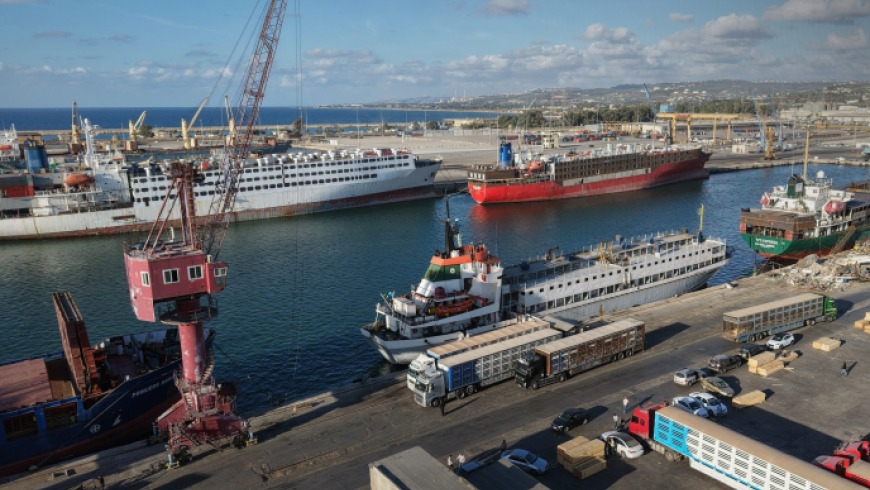
On the other hand, logistical challenges remain significant. Syria relies on a limited number of land crossings, such as Nassib with Jordan and Bab al-Hawa with Turkey, where customs delays lead to spoilage and increased costs.
The shortage of energy and water exacerbates production costs, making Syrian products less competitive compared to regional rivals.
Turning to Trade Agreements as a Strategic Alternative:
The shift towards an open economy necessitates a gradual move away from direct subsidies—which at times reached 15-20%—and a focus on trade agreements that reduce tariffs and facilitate transit.
In the current context, progress is being made on reactivating transit agreements with Turkey. A memorandum of understanding was signed in June 2025, and a transit agreement in November 2025 eliminates reloading at the border. A plan is also underway to operate a full land corridor linking Turkey to Syria, then Jordan, and finally the Gulf States by the end of 2026. Furthermore, a Joint Economic and Trade Committee (JETCO) with Turkey was established in August 2025 to update the 2004 Free Trade Agreement. Preliminary discussions are also taking place with the European Union regarding tariff reductions, with meetings expected this year.
These agreements appear poised to significantly reduce transportation costs—from weeks via the Suez Canal to days via land routes—and will enhance access to the Gulf and Jordanian markets, opening new horizons for Syrian products.
Post-Conflict Experiences: Lessons from Rwanda (1994-2025):
Rwanda’s experience provides a successful model for economic transformation following the 1994 genocide. Rwanda has achieved sustainable GDP growth of 8-9% annually over the past two decades.
In 2022, exports reached $2.99 billion (a 38.5% increase from 2021) and rose to $3.58 billion (a 19.73% increase) in 2023. In the fourth quarter of 2024, domestic exports increased by 69.7% compared to the previous year.
The “Made in Rwanda” campaign also contributed to a 50% increase in revenue for participating companies, a 30% increase in permanent employment, and a 10 percentage point increase in export potential within just two years (through the Export Growth Fund (EGF) between 2016 and 2022).
Rwanda relied on digitizing administrative procedures, establishing special economic zones, and forging international partnerships to attract investment, while diversifying its exports towards agriculture (coffee and tea), minerals, and tourism. Service exports surged by 171.3% in 2022. In the Syrian context, Rwanda’s lessons can be applied by launching a national “Made in Syria” campaign to improve product quality and international marketing, establishing special economic zones in Latakia or Tartous to facilitate maritime exports, and digitizing customs and statistical procedures to reduce delays.
Assessing the Potential Impact of Reforms:
If the current situation continues without significant, fundamental reforms, a limited increase in the value of exports can be expected, reaching $0.5-1 billion annually by 2028, primarily driven by existing transit agreements.
In a medium-term scenario that includes digitizing procedures and concluding agreements with the European Union, an increase of $2-3 billion annually can be anticipated, through a 20-30% reduction in costs within 18-24 months.
In an optimistic scenario that combines the “Made in Syria” campaign, the establishment of special economic zones, and attracting foreign direct investment, the increase could exceed $4 billion annually, provided that fundamental reforms are implemented and effective international partnerships are established.
Conclusion:
Based on the above, we at the Economic Office of the Syrian Future Movement recommend the following:
First, initiating a radical bureaucratic reform within 12-18 months, including the complete digitization of customs and statistical procedures, unifying the powers of the relevant bodies, and reducing the number of administrative procedures by at least 50%.
Second, accelerate the conclusion and implementation of trade agreements during 2026-2027, prioritizing the full operation of the land transit corridor between Turkey, Syria, Jordan, and the Gulf States by the end of 2026, and finalize correspondence with the European Union to reduce customs duties.
Third, provide indirect support through five-year tax incentives and specialized training programs on quality standards and international certifications.
Fourth, diversify exports by supporting the agricultural and manufacturing sectors and establishing special economic zones in coastal areas.
Fifth, strengthen international partnerships by attracting investments from the Gulf States and obtaining technical support from United Nations organizations for infrastructure development.
The obstacles to Syrian exports, primarily structural bureaucracy, necessitate a fundamental shift towards an open economy based on effective trade agreements and a stimulating business environment.
The Rwandan experience provides practical proof that rapid institutional reform and strategic openness can transform a post-conflict state into a successful development model. We also see that by implementing the proposed recommendations in a coordinated manner and according to clear timelines, Syria can achieve sustainable export growth that supports relative self-sufficiency, enhances economic stability, and builds a solid foundation for a strong economic future that restores the country’s role in the region and the world.
References:
- Export Development and Support Authority, statements by Manhal Fares, January 22, 2026 (syria.tv).
- Office of Foreign Assets Control (OFAC), Executive Order 14312 and the repeal of the Caesar Act, 2025-2026.
- World Bank reports, Rwanda National Statistics Office (NISR), and Rwanda Development Board (RDB) annual report 2022-2024.
- Transit agreements: Turkish Minute, Gulf News, Enab Baladi, 2025.