
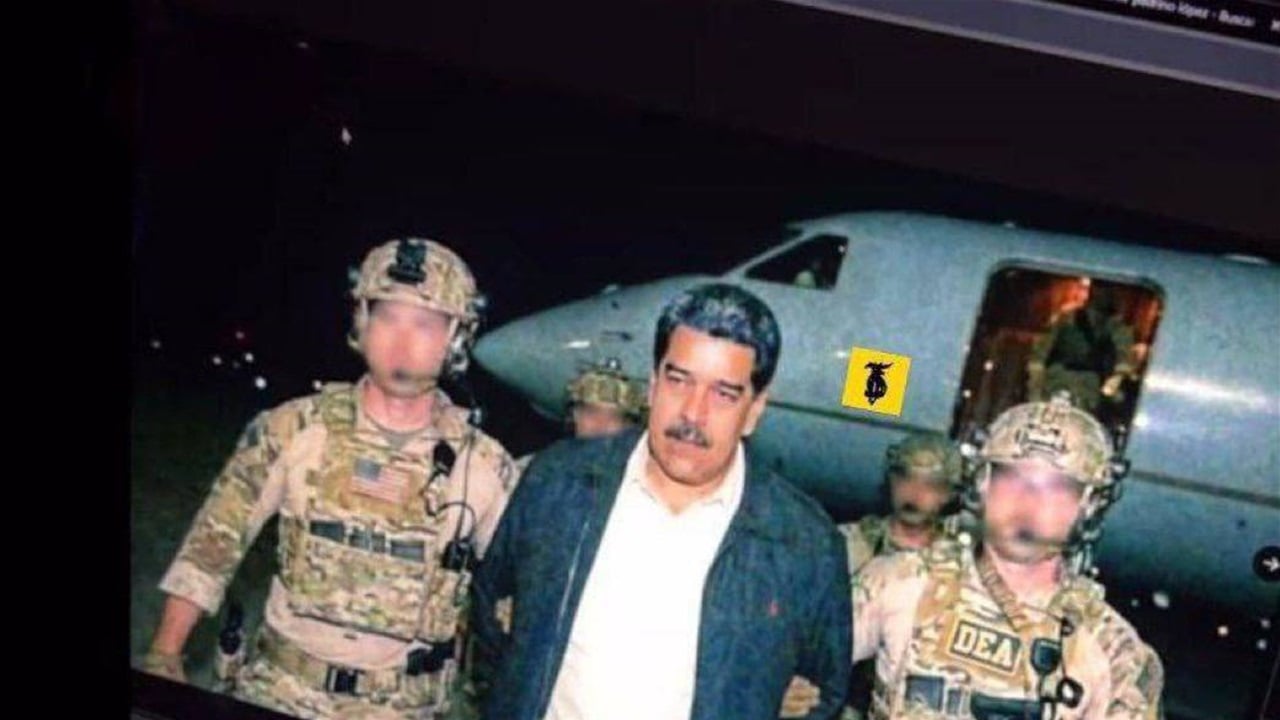
The circulating indications of an intention, or even a mere threat, to arrest Venezuelan President Nicolás Maduro were not isolated incidents within a broader context of international politics. Rather, they emerged as part of a dangerous pattern in the management of relations between states—a pattern in modern political memory associated with the mindset of US President Donald Trump, based on the principle of humiliation instead of containment, threats instead of diplomacy, and posturing instead of institutions.
Trump’s experience in dealing with world leaders has served as a stark example of this approach.
Perhaps what happened with the Ukrainian president is a particularly glaring example, where the American presidential discourse shifted from the language of diplomacy to one of ridicule and personal threats, a precedent unprecedented in modern international norms.
The objective was not to manage a crisis, but rather to shatter an image and send a message that the balance of power justifies everything, even violating the dignity of nations and their symbols.
In the Venezuelan case specifically, the threat of arresting President Nicolás Maduro cannot be separated from the purely Trumpian view of Venezuela as an open market and a untapped resource rather than a sovereign state.
With the world’s largest proven oil reserves, in addition to its wealth of gas and rare minerals, Venezuela has always been, in the eyes of Trump and his inner circle, a wasted economic opportunity that must be “liberated” by political force, not through international agreements or respect for the will of the people.
Within this mindset, changing the leadership in Venezuela is not seen as a democratic process or a sovereign transition, but rather as a market restructuring that will ultimately produce a more compliant president, one more likely to implement Washington’s desired oil, economic, and geopolitical policies. At various stages, ready-made political alternatives were promoted, including female figures marketed internationally as a “legitimate option,” not as expressions of Venezuelan national consensus, but as instruments of transition that would directly re-establish Caracas’s subservience to the American will.
This model, based on replacing a “rebellious” president with a “compliant” one, does not aim to reform the Venezuelan state, but rather to forcibly reintegrate it into the system of American interests, particularly in the energy sector, serving the interests of major corporations and redrawing the map of influence in Latin America.
This confirms that the issue is not one of values or democracy, but rather one of oil, markets, and political allegiance.
Trump’s mindset was not that of a great power with its institutions and traditions, but rather that of a “deal” driven by a businessman who sees the world as a bargaining table and heads of state as adversaries in an auction, not partners in an international system. This is a mindset that weakens international stability instead of strengthening it, accumulates resentment instead of resolving conflicts, and pushes besieged regimes toward further intransigence rather than compromise.
The arrest of a head of state, regardless of the nature of their regime, does not topple regimes; rather, it destroys what remains of the prestige of international law and plunges the world into the logic of the political jungle, where relations are governed by the logic of naked power, not legitimacy.
From this perspective, we in a national political movement clearly warn against any Syrian leadership’s tendency to emulate Trump’s mentality in managing foreign or domestic policy.
A state emerging from a long conflict is not built on force and posturing, nor is it governed by a logic of crushing and humiliating adversaries, nor is its prestige restored by imitating the worst aspects of international experience.
Adopting this model, however tempting it may seem in the short term, will, in the long run, sow international isolation, latent internal tensions, and a gradual loss of trust between the state and its neighbors.
What Syria needs today is a state-centric mindset, not a leader-centric one; a policy of containment, not one of elimination; and moral and legal legitimacy, not merely the legitimacy of force.
Global experience has proven that states that chose the path of humiliation ultimately disintegrated, while those that chose the path of wisdom, even in the harshest circumstances, were able to establish themselves and regain their role.
The warning against replicating the Trump mentality is not an ideological stance, but a realistic assessment of a political trajectory that has proven its moral and strategic failure.
We do not need a “new Trump” in our region, but rather statesmen who understand that political dignity is not weakness, and that true strength lies in the ability to build stability, not in boasting about crushing others.
In this context, we add a crucial warning: the new leadership in Syria must recognize the fundamental difference between the American state as a system of institutions and the person of Donald Trump and his inner circle as a transient political phenomenon, characterized by personal, impulsive, and self-serving motives.
Building relationships with the United States through individuals rather than institutions is a fatal strategic error. Recent history has demonstrated its disastrous consequences for countries and regimes that have relied on the leader instead of the administration, on rhetoric instead of law, and on deals instead of strategies.
The American administration, with its deep-rooted institutions, internal balances, and oversight mechanisms, is the true safeguard for any possible political or diplomatic success. It is the sole guarantor of the continuity of relations and their independence from the whims of electoral or personal moods.
Betting on Trump and his circle, however, is betting on a vindictive, not diplomatic, impulse; on a deal rather than a state; and on personal whims rather than institutional commitment.
This makes any relationship built on such a foundation fragile, temporary, and liable to collapse at any moment.
If the new Syria wants to solidify its international standing, it must deal with Washington as a state of institutions, not as an arena for political posturing, and it must protect its national trajectory from being held hostage by divisive figures within America itself, let alone abroad. Sound international relations are built not with individuals, but with states.
They are not protected by images and promises, but by law, mutual interests, and institutions.