
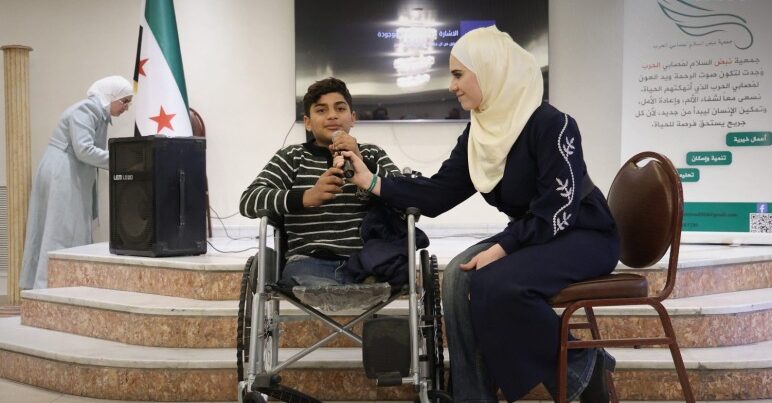
The Syrian Future Movement expresses its deep appreciation for the launch of the “Pulse of Peace” Association in Damascus on January 6, 2026. This non-profit humanitarian initiative focuses on supporting and rehabilitating those injured in the Syrian revolution, whose numbers are estimated at approximately 800,000 according to official statements.
We view this step, announced at a ceremony held at Dar al-Saada for the Elderly and attended by humanitarian actors, as a strategic shift in the post-liberation phase, where the focus moves from armed conflict to building a society based on the principles of sustainable peace and social solidarity.
The Syrian Future Movement emphasizes the importance of expanding the association’s work to include all victims of the former regime, including civilians affected by indiscriminate bombing, arbitrary arrests, and forced displacement in various Syrian regions, and not limiting it to military casualties within the ranks of the revolution.
We believe that, within the context of transitional justice, such initiatives must be inclusive to promote national unity, drawing on successful international models such as the Truth and Reconciliation Commission in South Africa or the rehabilitation programs in Rwanda, where inclusivity has led to reduced social tensions and fostered long-term stability. The Syrian Future Movement emphasizes the necessity of integrating psychological and emotional support into the organization’s programs, with a focus on Post-Traumatic Stress Disorder (PTSD), which affects millions of Syrians as a result of years of conflict.
We believe it is essential for the organization to collaborate with specialists in social psychology and public health to develop rehabilitation protocols supported by scientific studies, such as those published in specialized journals on the impact of group support on recovery. This will contribute to building a more psychologically and socially resilient society in the new Syria.
The Syrian Future Movement calls for enhanced transparency and governance in aid management through the establishment of independent oversight mechanisms that ensure the fair and effective distribution of resources, along with the publication of regular reports on activities and expenditures.
In this context, blockchain technology or digital platforms can be utilized to track donations, as is the case with international humanitarian organizations such as the Red Cross, to ensure the absence of corruption or discrimination and to strengthen trust between local and international donors.
The Syrian Future Movement believes that international cooperation is essential for the success of such projects and calls on the association to build partnerships with organizations such as the United Nations Office for the Coordination of Humanitarian Affairs (OCHA) or the World Health Organization (WHO) to secure funding and technical expertise in the fields of prosthetics and vocational rehabilitation.
We believe this cooperation should focus on technology transfer and training, ensuring that programs are adapted to the Syrian cultural and economic context to achieve long-term sustainability.
The Syrian Future Movement reiterates its commitment to supporting every initiative that contributes to building a new Syria and calls on the transitional government to launch a comprehensive national plan for transitional justice that includes truth-seeking about violations, holding perpetrators accountable, and compensating victims.
We emphasize that such steps will strengthen civil peace and pave the way for free and fair elections, thus guaranteeing a prosperous future for all Syrians.