
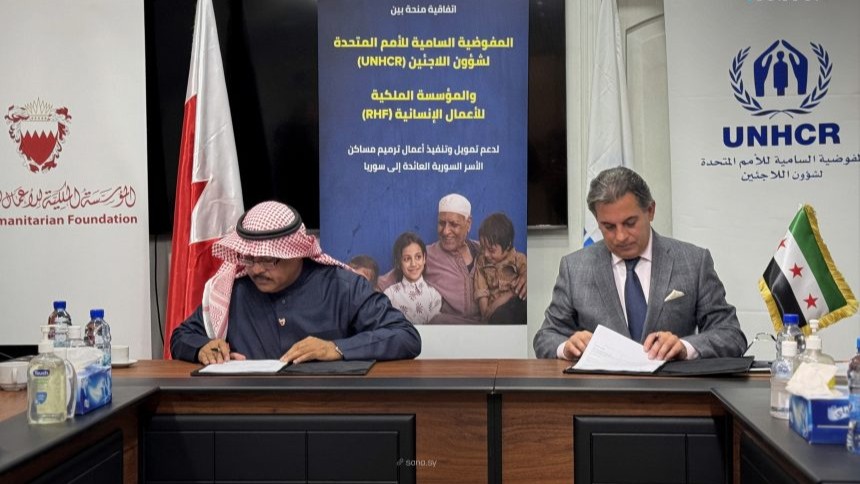
The Syrian Future Movement welcomes and commends the agreement signed by the Royal Humanitarian Foundation of the Kingdom of Bahrain with the United Nations High Commissioner for Refugees (UNHCR) in Syria, which provides a grant of US$2 million to support the reconstruction and rehabilitation of damaged housing in Syria.
This announcement, made on January 29, 2026, aims to improve housing conditions for returning families, promote social stability, and provide a safe and dignified living environment in areas severely affected by the years of conflict.
The Syrian Future Movement appreciates this noble humanitarian initiative from the Kingdom of Bahrain and expresses its gratitude to UNHCR as a trusted implementing partner. The project will contribute to the rehabilitation of approximately 470 damaged apartments, benefiting around 2,350 people, with special priority given to female-headed households and people with disabilities.
The project encompasses the Al-Zarba area in rural Aleppo and the city of Harasta in rural Damascus. It includes essential work such as repairing walls, roofs, and foundations, in addition to providing solar-powered lighting, rehabilitating water and sanitation facilities, installing solar water heaters, and improving pipe networks.
The Syrian Future Movement views this grant as a positive and tangible step towards supporting the return of displaced families and restoring normalcy to the affected areas. This aligns with the priorities of the transitional phase in building a new Syria based on social justice, human dignity, and sustainable stability.
The Syrian Future Movement also emphasizes the importance of such contributions in strengthening trust between Syrians and the international community, and in encouraging more brotherly and friendly nations to participate in relief and reconstruction efforts.
While welcoming this initiative, the Syrian Future Movement calls for enhancing its effectiveness through the following measures:
- Complete transparency in project implementation, by publishing lists of beneficiaries, selection mechanisms, and periodic progress reports to ensure that support reaches those who deserve it without favoritism or exclusion.
- The geographic scope should be gradually expanded to include other severely affected areas, such as eastern rural Damascus, southern rural Idlib, rural Homs, and other areas in the north and east, with a focus on areas with high population density of returnees.
- Restoration should be linked to comprehensive plans for rehabilitating adjacent infrastructure (electricity, water, sanitation, schools, and health centers) to ensure the sustainability of returns and stability.
- Local partnerships should be strengthened, and Syrian civil society organizations and local personnel should be involved in implementation to ensure cultural relevance and efficiency, and to create temporary employment opportunities for youth and returnees.
- A joint periodic archaeological assessment should be conducted by donors, UNHCR, and the Syrian government, with the results made public to encourage further international funding.
The Syrian Future Movement calls on all brotherly nations and international organizations to redouble their humanitarian efforts at this critical juncture, emphasizing that rebuilding homes represents a restoration of human dignity and a foundation for sustainable social peace. We also believe that the new Syria is being built by its own people, with the support of its brothers and friends, and every house restored is a step towards a homeland where its children deserve to live in safety and dignity.