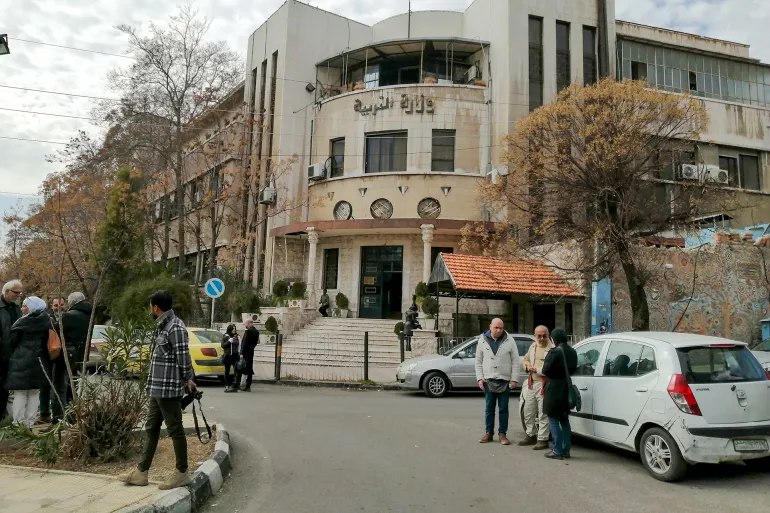
The Syrian Future Movement welcomes the decision issued by the Ministry of Education on January 28, 2026, to accept internal and external transfer requests for teaching staff in the governorates of Raqqa, Deir ez-Zor, and Hasakah, as well as the Deir Hafer and Maskana areas in the Aleppo countryside. We believe this decision contributes to ensuring the continuity of the educational process, achieving equitable job distribution, addressing imbalances in staffing, filling teaching vacancies, and implementing a policy of localizing education according to objective criteria that take into account the realities on the ground and available resources.
The Syrian Future Movement appreciates the humanitarian and patriotic aspects of this decision, which allows teaching staff dismissed due to the revolution to return to their jobs, contributes to regularizing their employment status, and enables them to utilize their expertise in service of the educational mission. Furthermore, it facilitates the commencement of programs to rehabilitate approximately one thousand damaged schools in the Raqqa and Deir ez-Zor governorates and to provide the necessary school supplies.
The Syrian Future Movement views this decision as a positive step towards rectifying the accumulated imbalances in the education sector in newly liberated areas. We consider it an opportunity to reinstate qualified teachers to their original positions and enhance educational stability in areas that have suffered from a severe shortage of staff.
However, we express concerns regarding the necessity of ensuring complete transparency in the review and decision-making process for applications, avoiding favoritism or administrative interference, and prioritizing the actual needs of students above all other considerations.
The Syrian Future Movement emphasizes that the success of this decision requires reinforcing it with the following measures:
- Absolute transparency at all stages of the process, including the publication of lists of available vacancies in each directorate, clear ranking and priority criteria, and the announcement of the decision results with objective justification for each case.
- A joint oversight mechanism comprising representatives from teachers’ unions, civil society organizations, and independent educational bodies to monitor the implementation of the decision and receive complaints.
- Transitional support for transferred teachers, including temporary housing assistance, support for relocating their families, and training programs to adapt to the new reality in the targeted areas.
- The decision is linked to a comprehensive plan for the reconstruction of education in northeastern Syria, which includes rehabilitating schools, providing books and supplies, and strengthening educational programs for children affected by displacement and war.
- A periodic assessment of the decision’s impact on the quality of education and educational stability will be conducted throughout the academic year, with the possibility of adjusting policies based on field results.
The Syrian Future Movement calls on the Ministry of Education to continue this reform approach, emphasizing that the future of education in Syria depends on rebuilding trust between educational staff and administration, and ensuring that the student’s best interests and the quality of education are paramount. We also stress that Syria needs a fair and stable education system that restores hope to its generations, and this decision—if implemented transparently and efficiently—can be a significant step in that direction.