Introduction:
On November 27, 2025, President Ahmed al-Sharaa made a televised appeal to the Syrian people to take to the streets the following day “to commemorate the first anniversary of the Battle of Deterring Aggression and to demonstrate national unity in the face of attempts at partition.”
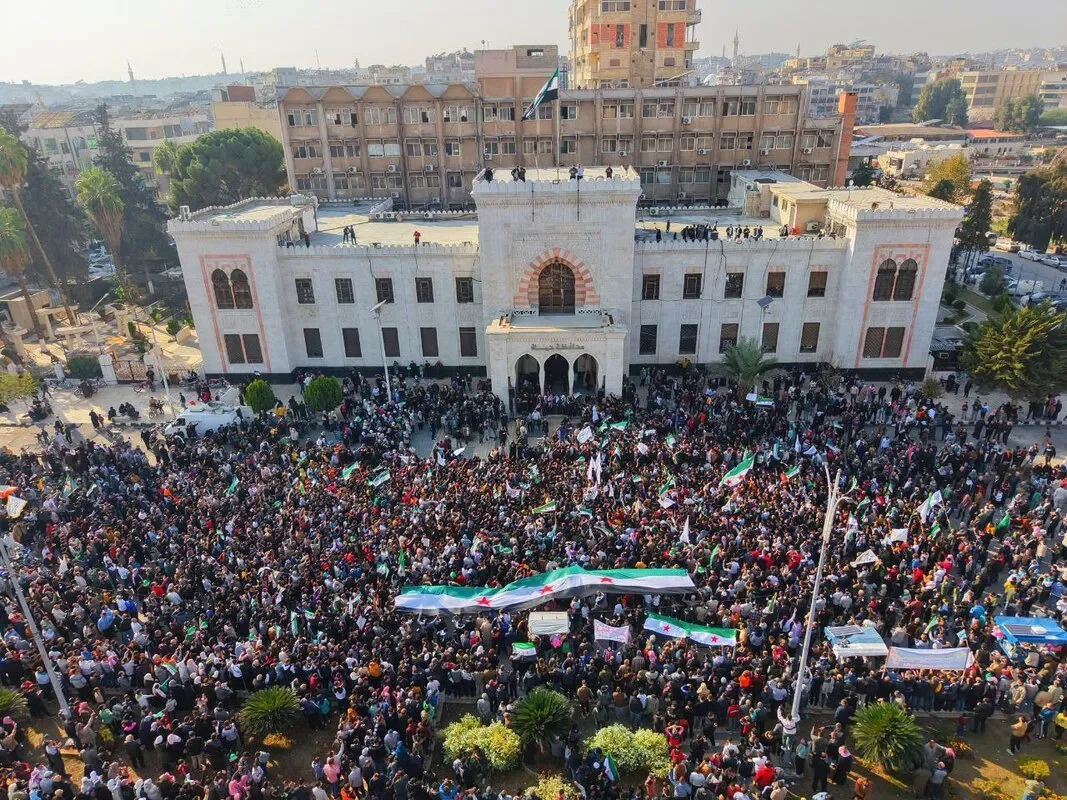
Hundreds of thousands responded in nearly every province, from the Umayyad Mosque in Damascus to Sabaa Bahrat Square in Idlib, and from Qubtan al-Jabal in Aleppo to the squares in the heart of Latakia.
However, this appeal was not merely a commemorative event. It came at a highly sensitive time, less than a week after Alawite demonstrations demanding federalism, amidst an unprecedented escalation of government media attacks against the Syrian Democratic Forces, and the announcement of the suspension of negotiations with the Autonomous Administration.
This paper aims to analyze this appeal as a political tool to gauge President al-Sharaa’s popularity and mobilize public opinion during a fragile transitional phase, focusing on its sectarian and regional implications.
Immediate Historical Context:
The Battle of Deterring Aggression began on November 27, 2025, and the regime of Bashar al-Assad fell on December 8 of the same year. Ahmed al-Sharaa assumed the presidency of the transitional phase on January 29, 2025, and on March 10, 2025, he signed an institutional integration agreement with SDF commander Mazloum Abdi, issuing a transitional constitution for a five-year term.
However, tensions quickly resurfaced! From the events in the coastal region, then Suwaida, to the events in Homs in November 2025 (the killing of a couple in the Zaydal neighborhood and the burning of one of their bodies), which ignited a wave of sectarian violence, came the coastal demonstrations of November 28, called for by the Alawite Sheikh Ghazal Ghazal, demanding federalism.
The presidential call, its text and implications:
Al-Sharaa stated verbatim in his speech on the evening of November 27:
“I call upon you, free sons of Syria… to take to the streets tomorrow… to tell the world that Syria is one united people, army, and destiny, and we will not allow anyone to divide us.”
The choice of this timing and language seems to carry three overlapping messages:
- A national mobilization against “attempts at partition” (a direct reference to the demands of the Alawite federalists and the forces of Druze Sheikh Hikmat al-Hijri).
- A test of the president’s ability to mobilize support outside his traditional strongholds (Idlib and western Aleppo).
- Transforming the memory of the military victory into personal political capital. The popular response, both quantitative and qualitative:
SANA estimated the participation of more than two million people across Syria, while independent sources estimated the number between 800,000 and 1.5 million (Al Jazeera Mubasher 2025).
More important than the numbers is the geographical and sectarian distribution:
- Damascus and its countryside:
450-550, the largest gathering from the Umayyad Mosque to Umayyad Square. - Aleppo:
300-400, a symbolic start from Qubtan al-Jabal. - Idlib:
250-300, a strong traditional base. - Daraa:
150-200 people – the first large public turnout since 2024. - Latakia:
40-60 people – a notable Alawite turnout, but less than expected. - Tartous:
30-50 people – a symbolic turnout amid tight security measures.
These figures confirm the success of the mobilization in predominantly Sunni areas, and a limited but present response on the coast, meaning the call was successful as a test of public support, but at the same time revealed the limits of sectarian trust.
The escalation against the SDF: The timing is not coincidental:
On the same day (November 28), Information Minister Hamza Mustafa said in an interview with Syrian TV:
“There are reckless parties acting as if they are a small empire in the northeast… Their bets are wrong and will have consequences.”
The following day, Kurdish leader Aldar Khalil confirmed to Al-Monitor that negotiations had completely stalled after the Sharaa-Trump meeting in Washington, pointing to “Damascus’s attempts to buy time and circumvent the agreement.”
This escalation, coinciding with the Popular Mobilization Forces, suggests a two-pronged strategy: mobilizing public opinion domestically as a cover for potential military and political pressure on the SDF.
The Coastal Challenge and Federal Demands:
The November 25 demonstrations in Latakia, Tartus, Jableh, and Homs featured slogans such as “Federalism… Federalism” and “The Alawites will not be humiliated.” However, the limited participation of coastal residents in the November 28 march demonstrates that a segment of the Alawite community still relies on the “centralized state” as a guarantee, while another segment sees federalism as the only solution.
Conclusion:
In light of Max Weber’s theory, Ahmed al-Sharaa still relies on charismatic legitimacy (as the savior of the nation from Assad). The November 28 call appears to have been an attempt to transform this charisma into legal-rational legitimacy by demonstrating the ability to mobilize broad popular support. It has been partially successful, but the continued sectarian and regional tensions mean that this legitimacy remains fragile and conditional.
President al-Sharaa’s call on November 28, 2025, proved a significant test of his popularity, but it also revealed the depth of the sectarian and regional challenges, highlighting the need to transform this temporary success into lasting stability.
Therefore, we in the Syrian Future Movement recommend the following:
- An immediate resumption of negotiations with the Autonomous Administration based on the March 2025 agreement, with a clear timetable.
- The initiation of a comprehensive national dialogue, including representatives from the coast, the east, and the center, to discuss the form of the state (broad decentralization without partition).
- A conditional general amnesty for detainees from all communities, with guarantees.
- The formation of a constitutional committee that is balanced in terms of sectarian and regional representation before the end of 2026.
It seems that if al-Sharaa succeeds in translating the popular mobilization into genuine political reforms, he could become the architect of a new Syria.
If he fails, the memory of “deterring aggression” may become merely a fleeting moment in the history of a country still searching for its unity.
References:
- Syria TV. 2025. “President Ahmed al-Sharaa’s Speech, November 27.”
- Syrian Arab News Agency (SANA). 2025. “Millions of Syrians Celebrate the First Anniversary of the Battle to Deter Aggression.” November 28.
- Al Jazeera Mubasher. 2025. “Special Coverage: First Anniversary Demonstrations.”
- AFP. 2025. “Alawite Demonstrations Demand Federalism on the Syrian Coast.” November 26.
- DW Arabic. 2025. “Sectarian Tension in Homs and the Coast After the Killing of an Alawite Couple.”
- Al-Monitor. 2025. “Kurdish Leader: Negotiations with Damascus Have Completely Stopped.” November 29.
- Enab Baladi. 2025. “Hamza Mustafa Attacks the SDF.”
- Weber, Max. 1978. Economy and Society. University of California Press.