

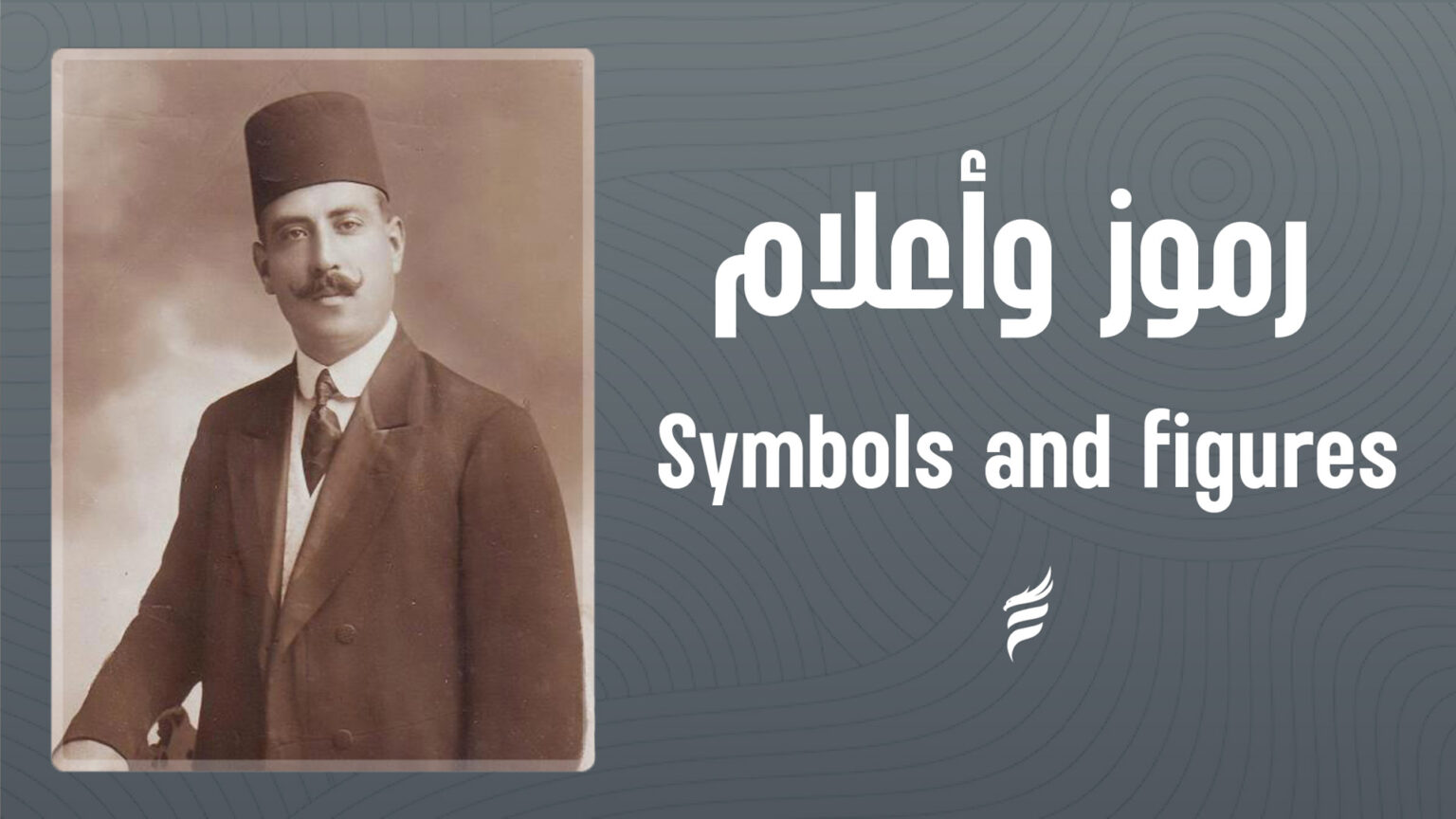
Early Life and Family Background:
Nasib al-Bakri was born in Damascus in 1888 into a prominent Damascene family with a distinguished social and political presence.
His father was Ata Allah Pasha al-Bakri, one of the most prominent Arab figures who served in the Ottoman court during the reign of Sultan Abdul Hamid II in Constantinople. He also wielded considerable influence in the Damascus District Council between 1890 and 1914.
Nasib was the second of five children.
The al-Bakri family adhered to the Sunni branch of Islam, tracing their lineage back to the Prophet Muhammad (peace be upon him) on their mother’s side and to the Rightly Guided Caliph Abu Bakr al-Siddiq on their father’s side. The family were major landowners, owning houses and shops in the Shaghour and Qaboun neighborhoods of the Ghouta countryside, as well as land in Jaramana. They also maintained close ties with local Druze leaders.
Early Political Shift and Relationship with the Hashemites:
After the deposition of Sultan Abdul Hamid II following the Young Turk Revolution of 1908, Ata Allah al-Bakri lost the support of the central authorities due to his close ties to the deposed sultan and his criticism of the revolutionaries.
From then on, the al-Bakri family tended to support the Arab nationalist movement and rejected the Turkification policies in the Arab provinces.
The family maintained close relations with the Hashemites in the Hejaz, and in 1909, Ata Allah al-Bakri hosted Sharif Hussein bin Ali, his brother Nasser, and Abdullah bin Hussein at his home in Damascus.
Education and Intellectual Formation:
Nasib al-Bakri received his primary and secondary education at the Maktab Anbar School in Damascus, which produced a large number of Arab nationalist elites. He then moved to the Sultanic School in Beirut, where he continued his studies in Turkish, graduating in 1912.
The Young Arab Society and the Beginnings of Nationalist Action:
Nassib and his brothers Fawzi and Sami joined the Young Arab Society, a secret society that sought Arab independence from the Ottoman Empire.
Nassib assumed the position of Secretary of the Society.
When Prince Faisal bin Hussein visited Syria in early 1916, he stayed at the Al-Bakri family home in Qaboun. Nasib invited him to join the Young Arab Society and introduced him to a select group of its members, including Shukri al-Quwatli, Ali Rida al-Rikabi, Arif al-Shihabi, and Abdul Ghani al-Arisi.
His Role in the Great Arab Revolt:
Nassib al-Bakri agreed with Prince Faisal on a coded telegram to initiate the Great Arab Revolt.
When the revolt began in 1916 in Mecca, led by Sharif Hussein bin Ali, al-Bakri moved to the Hejaz and acted as a liaison between the Society in Damascus and the Hashemite leadership.
In 1917, he sent a famous letter to Sultan Pasha al-Atrash informing him of the advance of the Arab Army and the Allied forces, calling for Arab unity.
Entry into Damascus and the Establishment of the Arab State:
In 1918, Nasib al-Bakri was among the first to enter Damascus with the Arab Army.
After the establishment of the Kingdom of Syria, he was appointed Second Secretary of the Royal Court, while Ihsan al-Jabiri was Chief Secretary of the Palace.
He also participated in the founding of the Independence Party in 1917 and was elected to the General Syrian Congress, representing Damascus.
Confronting the French Occupation and Exile:
After the French occupation of Syria and the fall of the Kingdom in 1920, al-Bakri left for the Emirate of Transjordan.
In 1921, he became an advisor to King Abdullah bin Hussein before returning to Syria following a French pardon.
The Great Syrian Revolt and His Field Role:
With the outbreak of the Great Syrian Revolt in 1925, Nasib al-Bakri joined its ranks and contributed to spreading the revolution to Damascus and the Ghouta region. He led military and organizational operations and maintained a close relationship with Commander Hassan al-Kharrat.
Despite the failed attempt to liberate Damascus and the bombardment of the city, al-Bakri was among the few members of the Damascene elite who participated directly in the fighting.
Death Sentence and Political Pardon:
After the end of the revolution in 1927, al-Bakri was sentenced to death in absentia and fled to Palestine.
In 1928, he received a French pardon, despite his nationalist influence and close ties to the Hashemites.
Constitutional and Parliamentary Work:
He co-founded the National Bloc with Hashim al-Atassi.
He was a member of the Constituent Assembly in 1928 and contributed to drafting the Syrian Constitution.
He was elected as a representative for Damascus in 1932, 1936, 1943, and 1947.
Government and Diplomatic Positions:
Nassib al-Bakri held a number of positions, most notably Governor of Jabal Hauran.
Minister of Justice in 1939.
Minister of National Economy and Agriculture in 1941.
Syrian Ambassador to Jordan after independence.
Retirement and Death:
After leading the People’s Party and failing to expand its popular base in Damascus, he retired from political life in 1957.
He died in 1966 and was buried in the Al-Bakri family cemetery in Damascus.
Decorations and Honors:
The Syrian Order of Merit, First Class.
The emblem of the Syrian Arab Republic from the Moral Guidance Directorate of the Syrian Army.
A street in the Al-Rawda neighborhood of Damascus was named after him.
The Syrian Future Movement’s Position:
The Syrian Future Movement believes that commemorating the life of Nassib Al-Bakri is a national duty towards the founding generation of the modern Syrian state.
The Movement affirms that his legacy of struggle constitutes a call to complete the project of a national state based on diversity, freedom, justice, knowledge, political participation, and the building of strong institutions in the new Syrian era.
The biography of Nasib al-Bakri, with all its merits and demerits, remains a profound national lesson in the path of political transformation and state-building on the foundations of freedom, dignity, and the rule of law.