
Executive Summary:
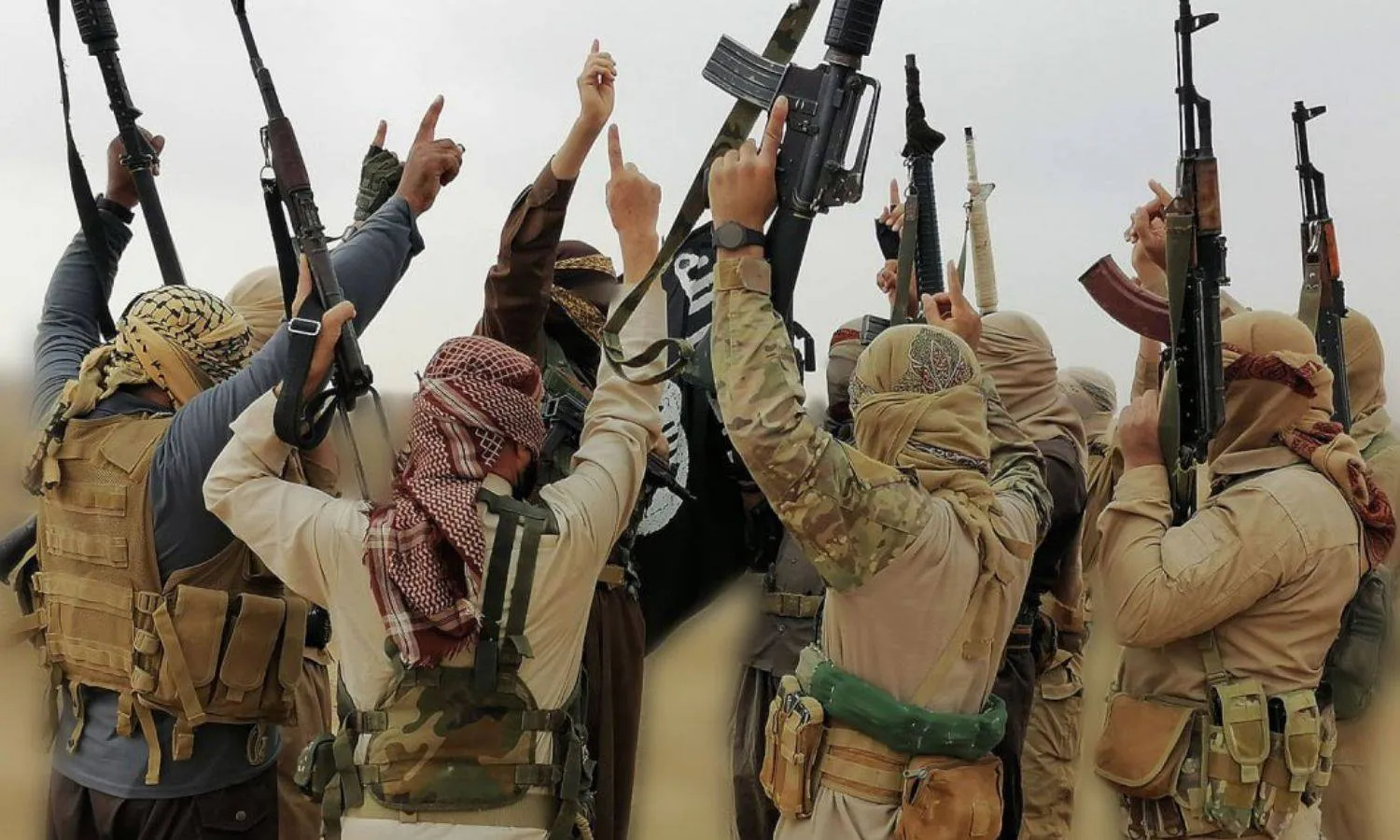
The escalation of ISIS activity in Syria following the fall of the Bashar al-Assad regime on December 8, 2024, poses a major security challenge for the transitional government.
This report provides a detailed chronology of attacks, an objective analysis of their causes and effects, and projected scenarios. It also discusses the impact of these threats on Syrian development, focusing on how the government’s enemies exploit the ISIS card. Strengthening international cooperation and internal reforms are recommended to ensure stability, while considering justice and cultural aspects to support sustainable development.
Introduction:
Following the fall of the Bashar al-Assad regime on December 8, 2024, Syria underwent a radical political transformation with the formation of a transitional government under the leadership of Ahmad al-Sharaa (formerly known as Abu Muhammad al-Julani), who sought to integrate former factions and establish a system based on international cooperation.
However, this security vacuum allowed ISIS to regroup and begin directly targeting the new government starting in May 2025.
This study relies on documented data from international and Arab sources, such as Al Jazeera and security observers. It aims to provide an accurate chronology of attacks, along with an objective analysis of their causes and effects, and potential scenarios for confronting ISIS in the transitional government.
It also discusses how the government’s adversaries (such as Iran, Russia, and the Syrian Democratic Forces – SDF) exploit ISIS as a tool for pressure or weakening.
The Timeline of Attacks:
The timeline is divided into two periods:
Before Syria joined the international coalition against ISIS (November 11-13, 2025), and after.
During the first period, attacks were limited and focused on rebuilding capabilities, while the second period witnessed an escalation in response to Syrian-American cooperation.
ISIS had recorded approximately 117 attacks in Syria by August 2025, most of them in the northeast.
First, the period before joining (December 2024 – November 10, 2025):
- May 22, 2025: An armed attack in the Deir ez-Zor countryside resulted in the deaths of four soldiers belonging to the Syrian Interim Government.
This is considered the first direct attack after the fall of Assad, focusing on exploiting the security vacuum in the eastern regions. - May 30, 2025: ISIS claimed responsibility for a bomb attack on a military vehicle in the Homs countryside, which killed two personnel. The organization declared this to be “the first attack on the Syrian Interim Government forces,” indicating the beginning of a new campaign against “apostasy.”
- June 23, 2025: A suicide bombing in Damascus resulted in injuries among government security forces, killing three. ISIS claimed responsibility for the attack as retaliation for “cooperation with the infidels.”
- May 17, 2025 (addition from subsequent investigations): A raid on an ISIS hideout in Aleppo uncovered official uniforms of government security forces, suggesting attempts to infiltrate or stage attacks to be blamed on the government.
- August 18, 2025: A suicide bombing near a bakery in the Maysar neighborhood of Aleppo killed two security personnel. ISIS claimed responsibility for the attack, citing its ongoing campaign against “apostasy.”
- August 20, 2025: A senior ISIS leader was killed in a US operation, but attacks continued, with a total of 117 attacks recorded by the end of August.
- September-October 2025: Sporadic attacks occurred on the M5 highway between Aleppo and Idlib, including ambushes that resulted in casualties among government forces. There was also an increase in activity exploiting tensions with the SDF.
Second, the period following Syria’s accession (November 11, 2025 – December 14, 2025):
Joining the international coalition (of which Syria became the 90th member) led to an escalation, with a focus on shared objectives with US forces.
- November 25 – December 2, 2025: An attack in Saraqib (eastern Idlib) resulted in the death of a Syrian government soldier. ISIS claimed responsibility as retaliation for Syria’s accession.
- December 2–9, 2025: Attacks on the M5 highway, including targeting former Assad militias, resulted in the death of one member.
- December 13, 2025: An ambush in Homs targeted a joint meeting of US and Syrian government forces, resulting in the deaths of two US soldiers and injuries to Syrians. The US president announced a strong response at the time.
- December 14, 2025: An attack on a highway security group near Maaret al-Numan (southern Idlib) resulted in the deaths of four members. ISIS is believed to have been responsible, in the context of the escalation following the Homs attack. Objective Analysis:
The escalation reflects a strategic shift by ISIS from focusing on the SDF to targeting the central government, especially after joining the coalition, which is perceived as an existential threat.
Reasons for the escalation include:
(1) Exploiting the security vacuum created by the integration of previously unreliable militias.
(2) A reaction to Syrian-international cooperation, which resulted in 22 joint operations in November 2015.
(3) Attempts to incite sectarianism to weaken national unity, as seen in infiltration attempts disguised as government forces, both on the coast and in As-Suwayda.
The effects include increased casualties (approximately 20 government fatalities to date) and destabilization, hindering economic and political reforms.
Objectively, the escalation demonstrates that ISIS remains adaptable, but is weaker than at its peak in 2014-2017, relying on ambushes and bombings rather than territorial control.
Impact of the Threats on Syrian Development:
The impact of ISIS activity extends beyond security, impeding economic and social development.
In a transitional context, the escalation of violence delays reconstruction projects, such as the restoration of infrastructure in central regions, exacerbating unemployment and poverty. It also threatens transitional justice by fueling sectarianism, hindering the integration of diverse communities and weakening a shared national culture.
According to international and Arab reports, this could lead to a decrease in foreign investment of up to 30%, with a negative impact on education and health, as attacks force the closure of schools and hospitals in affected areas. This necessitates development strategies focused on social justice and the preservation of cultural heritage to strengthen Syrian unity.
Expected scenarios for the transitional government:
- Positive scenario (40% probability): Enhanced international cooperation leads to the defeat of ISIS, with US support including training and intelligence, reducing attacks by 50% by 2026. This requires internal security reforms to prevent infiltration.
- Neutral scenario (35% probability): Limited attacks continue in rural areas, with a balance between international strikes and ISIS regrouping, leading to a war of attrition that lasts for years.
- A negative scenario (25% probability): Escalation to large-scale urban attacks if reforms fail, leading to sectarian divisions and government collapse, especially if ISIS exploits tensions with the SDF or Israel.
Expect the government’s enemies to exploit the ISIS card:
The government’s enemies, such as Iran (which supports former Assad militias) and Russia (which has partially withdrawn but maintains influence), might exploit ISIS to weaken the transition.
For example, Iran might facilitate ISIS infiltration between Iraq and Syria, and its former areas of influence to the east, to sow chaos, potentially justifying its return as a “protector of the Shiites.”
Russia might also spread rumors about the government’s “failure” to combat terrorism to support the return of someone close to Assad or an ally.
The SDF might also exploit the attacks to bolster its demands for autonomy, further dividing Syria.
This exploitation relies on a “useful enemy” strategy, where ISIS is used as an indirect tool for political pressure, increasing the risk of internal collapse. Conclusion:
The analysis shows that ISIS poses a persistent threat to the transitional government, but this threat can be mitigated through international cooperation and internal reforms.
It is recommended to strengthen intelligence agencies and national unity to avoid negative scenarios, while monitoring for exploitation by external adversaries and integrating development aspects such as justice and culture into security strategies.
This paper is based on data up to December 14, 2025, and may evolve with new developments.
References:
- Al Jazeera. (2025, December 8). One year since the fall of Bashar al-Assad: A timeline. Al Jazeera.
https://www.aljazeera.com/news/2025/12/8/one-year-since-the-fall-of-bashar-al-assad-a-timeline - CBS Austin. (2025, October 23). Islamic State resurgence: ISIS attacks spike as Syria’s power vacuum persists. CBS Austin.
https://cbsaustin.com/news/nation-world/timeline-islamic-states-attempts-to-regain-power-after-being-pushed-out-of-syria-isis-assad-regime-overthrown-middle-east-terrorism - Council on Foreign Relations. (n.d.). Conflict in Syria. Retrieved December 14, 2025, from
https://www.cfr.org/global-conflict-tracker/conflict/conflict-syria - Fortune. (2025, December 14). U.S. troops have been in Syria for over a decade: Here’s a timeline of the mission. Fortune.
https://fortune.com/2025/12/14/us-troops-syria-mission-history-deadly-islamic-state-attack/ - Karam Shaar Advisory LTD. (2025, October 31). The evolution of ISIS after Assad’s fall.
https://karamshaar.com/syria-in-figures/isis-syria-evolution-trends-2025/ - KFOX. (2025, October 23). Islamic State resurgence: ISIS attacks spike as Syria’s power vacuum persists. KFOX.
https://kfoxtv.com/news/nation-world/timeline-islamic-states-attempts-to-regain-power-after-being-pushed-out-of-syria-isis-assad-regime-overthrown-middle-east-terrorism - Middle East Institute. (2025, April 14). ISIS is on the ropes in Syria: A successful transition in Damascus could deliver the knockout blow. Middle East Institute.
https://www.mei.edu/publications/isis-ropes-syria-successful-transition-damascus-could-deliver-knockout-blow - UK Government. (2025, September 16). Country policy and information note: Security situation, Syria (July 2025).
https://www.gov.uk/government/publications/syria-country-policy-and-information-notes/country-policy-and-information-note-security-situation-syria-july-2025-accessible - U.S. Congress. (2025, September 5). Syria: Transition and U.S. policy (CRS Report No. RL33487).
https://www.congress.gov/crs-product/RL33487 - Wikipedia. (n.d.). Timeline of the Syrian civil war. Retrieved December 14, 2025, from
https://en.wikipedia.org/wiki/Timeline_of_the_Syrian_civil_war