
The moment the head of the Syrian political hierarchy (the president) chose to pursue a policy of appeasement toward the Zionist entity, it was not a fleeting choice or a sign of weakness in the national discourse. Rather, it was a calculated political decision aimed at safeguarding internal stability and ensuring the continuation of regional and international support for the transition process, along with the subsequent economic, security, and military stability.
The current phase is sensitive, and any repercussions—even a seemingly ill-considered statement—could influence the positions of supporting countries and entities, casting a shadow on highly sensitive issues such as lifting sanctions, repealing the Caesar Act, reconstruction, and Syria’s reintegration into its Arab and international environment.
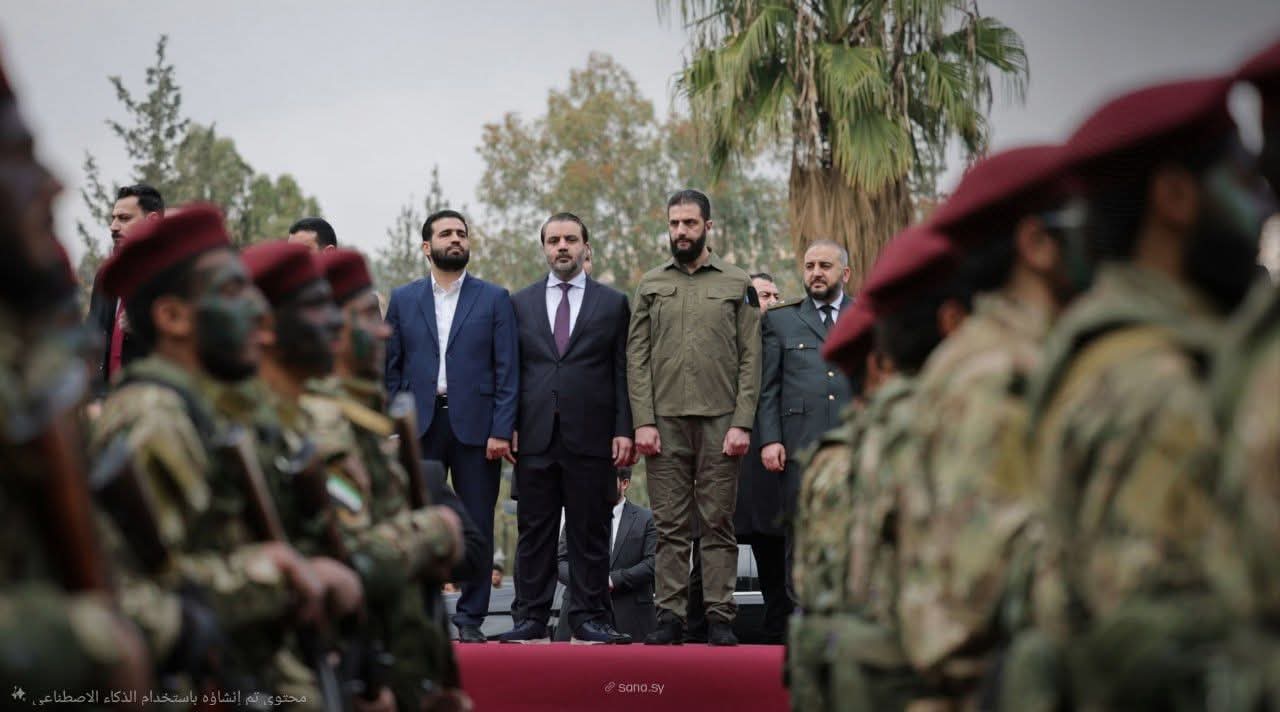
However, what transpired during the military parade on Liberation Day, which the president attended, raises questions that warrant consideration. The military establishment, in a moment of heightened patriotism, chanted slogans and slogans in support of Gaza and against Israel.
Despite the nobility of those slogans and the justness of the cause, politics is not always a direct reflection of emotions. It is, in fact, a complex balancing act of interests, timing, and messaging.
What happened leaves a serious impression on two levels:
First, a breakdown of discipline within the military establishment. A military parade is not a space for free expression, but rather a space for discipline, for unity in the state’s decision-making, and for projecting an image of organized power to the people and the world.
When this institution loses its ability to adhere to the parameters of the “political appeasement” led by the president during this sensitive period, it raises a fundamental question: Does the military establishment possess a unified command structure? Or are there factions within it seeking to send parallel messages?
Second, a direct impact on the course of political stability! Such chants—despite their justification—are not only interpreted by the Syrian public, but also by international partners such as the United States, Europe, international organizations, Arab powers supporting the stability process, and institutions currently discussing the fate of sanctions and their lifting.
Therefore, the military’s departure from official messaging may give the impression that the state lacks a unified voice and that its positions remain volatile or subject to popular and emotional impulses. This immediately impacts the difficulty of repealing the Caesar Act (which is what we fear), the fragility of international confidence during the transitional phase, the suspension or freezing of funding pledges, and fears of a return to unchecked militarism in the political arena.
What happened was not a protocol error or a passing outburst! Rather, it indicates a dangerous gap between the political leadership’s decisions and the military’s behavior.
In the post-regime era, Syria needs more than ever to rein in the military, unify official messaging, prevent any impromptu pronouncements, and maintain the image of a “rational and balanced” state before the world. The existence of two voices—a conciliatory political voice and an impulsive military one—is a dangerous recipe for any country taking its first steps toward stability.
To avoid further confusion, I want to state, in principle, and from a national and emotional standpoint, that we all stand with Gaza, reject the occupation, and support the Palestinian cause. But governance is a responsibility, and the path to stability in Syria today requires wisdom, careful consideration of messages, especially at specific times, and consistent follow-up.
Raising a slogan at an inopportune moment could deprive the Syrian people of the lifting of sanctions, the opening of economic crossings, the launch of reconstruction projects, the stabilization of the currency, and the ability of the new government to fulfill its duties. When slogans conflict with the interests of the people, the duty becomes to prioritize the interests of the state and the people.
In short: what is required today is not to extinguish the national spirit within the military establishment, but rather to guide it within the framework of discipline, so that it reflects the unity of political decision-making, not the contradictions between institutions. Syria has triumphed, yes, but the building of the state has now begun, as President al-Sharaa stated. There is no state without discipline, and no stability without wisdom.