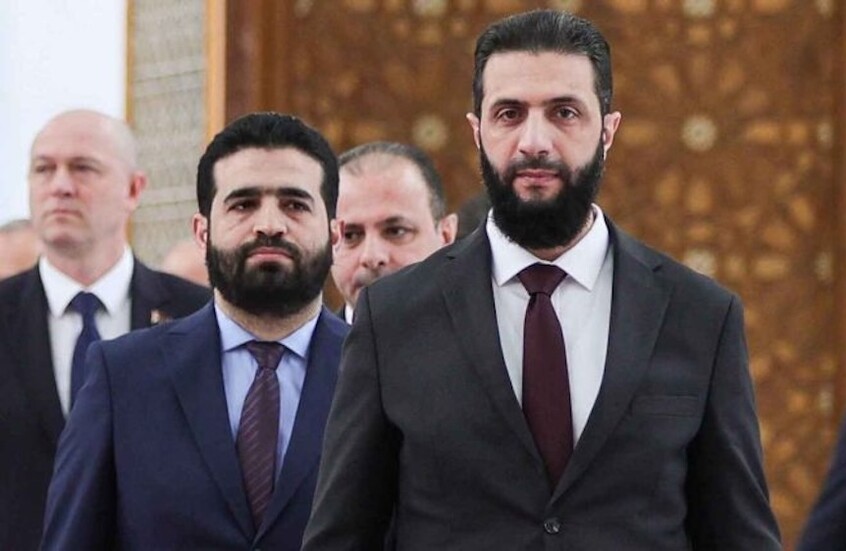
In recent days, widely circulated Arab media outlets, including Al-Quds Al-Arabi newspaper, reported that the UN Security Council had adopted a new resolution “under Chapter VII of the UN Charter” lifting sanctions on Syrian interim President Ahmed al-Sharaa and his Interior Minister Anas Khattab.
The news was presented as containing an explicit text including the phrase “Acting under Chapter VII,” which implies “implemented under Chapter VII,” giving it the impression of a comprehensive international mandate or a new phase of UN intervention in Syria.
However, verification with official sources and research in the Security Council archives and independent research centers reveals a completely different picture.
The resolution was indeed issued… but its full text has not yet been published.
As of the writing of this article, the UN has not published the full official text of Resolution S/RES/2799 (2025) on its official documents website (undocs.org). What is available so far is a press release from UN Headquarters in New York (SC/16214) announcing the adoption of the resolution by a vote of 14 in favor and one abstention (China), and confirming that the Council decided to remove the names of al-Sharaa and Khattab from the sanctions list related to ISIS and al-Qaeda (resolutions 1267, 1989, and 2253). In essence, the resolution is an administrative amendment to the list of individuals included in the terrorism sanctions regime, and not a new political decision directed against or in favor of the Syrian state.
Where did the reference to “Chapter VII” come from?
The sanctions regime referred to (1267/1989/2253) was originally established in 1999 under Chapter VII of the Charter. Therefore, all its amendments—including Resolution 2799—automatically fall within the legal framework of Chapter VII, even if this is not explicitly stated in the preamble.
However, this does not mean that the resolution itself included the phrase “acting under Chapter VII,” nor that it granted the Council a new mandate to take coercive measures, impose embargoes, or use force. Chapter VII here is a general legal framework, not an executive tool against a specific state.
Chapter VII does not apply to the Syrian state:
Extending the application of the UN sanctions mechanism “under Chapter VII” does not mean that the Syrian state is now subject to Chapter VII. Rather, it means that the committee responsible for implementing sanctions against ISIS and al-Qaeda continues its work under this legal framework.
That is, the resulting international obligations do not fall on the Syrian state as a political entity, but specifically on the individuals and entities whose names are listed, including – previously – Ahmed al-Sharaa and Anas Khattab, whose names have now been removed from the list.
The Chinese position: Clarifying the scope of Chapter VII:
During the discussions preceding the vote, China expressed significant reservations about some paragraphs of the initial draft, particularly those that could be interpreted as extending the umbrella of Chapter VII to include the Syrian state itself. The Chinese delegation requested that the wording be amended to clarify that the resolution pertains exclusively to organizations and individuals listed on terrorism lists, and that the provisions of Chapter VII do not apply to the Syrian government or the state as a whole.
After these clarifying amendments were adopted, China abstained from voting instead of using its veto, indicating its acceptance of the general framework while maintaining reservations on some technical details and the removal of the names of al-Sharaa and Khattab. China essentially wanted to ensure that Chapter VII would not be used against Syria as a state.
The UAE’s position: Focus on accountability and oversight:
The United Arab Emirates supported the general direction of the resolution but, as stated in the “What’s In Blue” draft, requested the inclusion of explicit references to the importance of respecting international law and ensuring transparency and accountability in any financial transfers or technical assistance provided under the exceptions related to reconstruction or demining.
It also stressed the need for clear oversight mechanisms to prevent these exceptions from being diverted to illicit channels. These observations were taken into account in the second draft of the “What’s In Blue.”
What did the drafts actually contain?
According to the Security Council Report – What’s In Blue, the original US draft was amended twice before the vote, after several members objected to clauses in the first version that included carve-outs from the sanctions regime. These carve-outs included allowing funding for reconstruction projects or providing mine-clearing equipment without considering it a violation of the ban on terrorist groups. These clauses were later narrowed and clarified so as not to imply that the Syrian state itself was subject to or targeted by the sanctions regime.
The final version contained only two practical clauses: removing the two names and updating the lists by the relevant committee.
Did the resolution impose any measures on al-Sharaa or Khattab?
The answer, according to the blue draft, is “no.”
The final blue draft – as reported by What’s In Blue and Reuters – does not include any obligations or follow-up measures concerning Ahmed al-Sharaa or Anas Khattab after their removal from the list. In other words, there are no financial or political conditions or follow-up reports imposed on them personally; they are simply considered outside the scope of the international sanctions regime as of the date of the resolution’s adoption.
Between Media Hype and Legal Reality
The frequent talk in some newspapers about a “UN resolution under Chapter VII that changes Syria’s status” is an exaggeration based on a confusion between the general legal framework of the sanctions regime and the content of the resolution itself. Resolution 2799 neither imposes nor lifts sanctions on the Syrian state as a political entity; rather, it deals exclusively with removing the names of two individuals from a list linked to terrorist organizations. To date, the full official text has not been released, making it unclear whether it contains any other provisions.
Conclusion:
The current stage requires a calm reading of international resolutions, setting aside sensational headlines. Within the UN system, there is a significant difference between “referring to Chapter VII” as a legal framework and “acting upon it” as an executive tool. Resolution 2799, according to all available reliable sources, falls into the former category, not the latter.
References
- United Nations Press Release SC/16214 (6 Nov 2025)
- Security Council Report – What’s In Blue (6 Nov 2025)
- Reuters – UN Security Council removes sanctions on Syria’s president and interior minister (6 Nov 2025)
- UN Security Council – Resolutions 2025 (Official Archive)
Political Bureau
Independent Researchers Section
Alaa El-Din Al-Khatib