
Abstract:
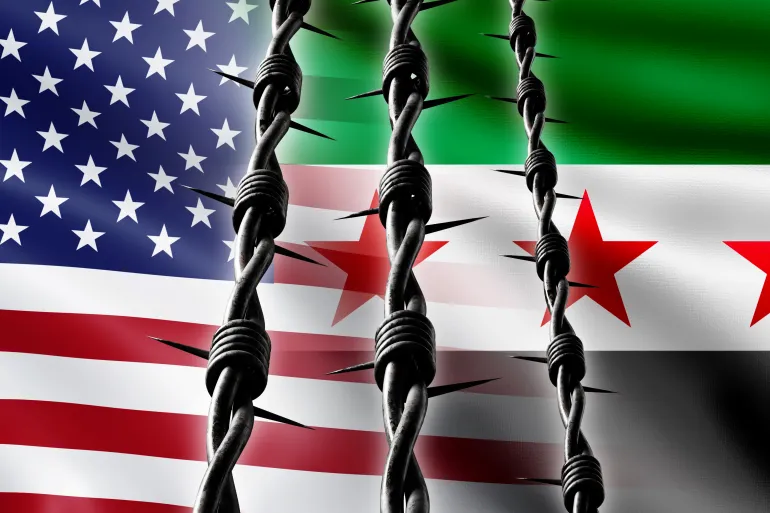
This research paper examines developments in US sanctions against Syria up to November 10, 2025. It emphasizes that while the US administration officially announced that the comprehensive sanctions program against Syria would cease to exist as of July 1, 2025 (1), specific pressure tactics remain in place and are being exerted on individuals and entities.
The study aims to detail the legal framework and analyze the practical implications.
Introduction: A wide range of US sanctions were imposed on Syria over the past two decades to pressure the previous Syrian regime (2).
With the changing political and military landscape in Syria, the US administration moved to modify its punitive policy. The Office of Foreign Assets Control (OFAC) of the US Treasury Department issued a statement indicating that the United States “no longer maintains comprehensive sanctions on Syria” as of July 1, 2025 (3), representing a turning point in Syria’s relationship with the international financial and trade system.
However, this change does not mean the end of all sanctions, but rather their reallocation and focus on specific targets.
2. The Legal Framework for Implementing US Sanctions on Syria:
2.1 Legislation and Executive Orders:
- Several US executive orders have been used to control Syrian assets and prohibit transactions with them, including: E.O. 13338 (2004); E.O. 13399 (2006); E.O. 13460 (2008); E.O. 13572 (2011); E.O. 13573 (2011); and E.O. 13582 (2011) (4).
- Then, the Caesar Syria Civilian Protection Act (2019) was introduced by the US Congress, imposing secondary sanctions on any person or company that deals with or supports the Syrian regime. This act can only be amended by legislation from Congress (5).
2.2 Recent US Decisions:
- – On May 23, 2025, OFAC issued a General License (General License 25 – GL 25) authorizing “transactions that were prohibited under the Syria Sanctions Regulations” (6).
- – On June 30, 2025, the White House issued an Executive Order entitled “Providing for the Revocation of Syria Sanctions,” effective July 1, 2025, which terminated the comprehensive sanctions program against Syria, while maintaining individual sanctions against Bashar al-Assad and associated entities (7).
- – In its FAQ document dated June 30, 2025, OFAC stated that “the United States no longer maintains comprehensive sanctions against Syria, effective July 1, 2025” (8).
2.3 Remains in Legal Standing:
- Individual sanctions: Those listed under the Specially Designated Nationals (SDN) against individuals/entities linked to human rights abuses, Captagon trafficking, support for terrorism, or weapons proliferation activities (7)(8).
- Syria’s designation as a “State Sponsor of Terrorism” (SST) was not officially removed as of November 10, 2025, thus maintaining some automatic restrictions (9).
- Export controls remain in place at the Bureau of Industry and Security (BIS) for a number of dual-use or security-related goods (10).
- Analysis of Practical Implications:
3.1 Opening the Syrian Economy to Finance and Trade:
- With the lifting of the comprehensive program, financial transactions with Syrian institutions (excluding individuals listed on the SDN) are now permitted, including opening correspondent bank accounts, transfers, and investments (8).
- This represents an opportunity for reintegration into the global financial system and stimulates foreign investment.
3.2 Persistent Risks:
- Despite the easing of sanctions, international banks remain highly cautious due to the risk of a sudden reimposition of sanctions or dealings with previously listed entities.
- Furthermore, the Caesar Act remains a legislative instrument held by Congress, which could be reactivated in the future (5).
3.3 Political and Regional Message:
- The US administration’s decision signals its belief in a transitional phase in Syria, focused on reconstruction, while ensuring accountability for past perpetrators.
- This reflects a shift from a policy of comprehensive punishment to one of integration and oversight.
3.4 Implementation Challenges on the Ground:
- The need for a Syrian government that is considered a legitimate governing body and not a continuation of the previous regime, guarantees the protection of minorities, and ensures compliance with counterterrorism and anti-narcotics measures—conditions mentioned in the US documents (6).
- The need for international legal and financial coordination and ensuring that entities associated with the old regime are excluded from transactions.
- Concerns that lifting economic sanctions precedes a genuine accountability phase, which could significantly undermine the confidence of donors and investors.
- Recommendations of the Syrian Future Movement:
4.1 Establishing a National Unit to Monitor Sanction Removal:
- The Movement proposes the formation of a “Sanction Removal Monitoring Unit” comprising international legal and economic experts, as well as representatives from the Syrian private sector.
- The unit’s mission: To develop a comprehensive roadmap for removing individuals from the sanctions lists and disentangling the economy from listed individuals.
4.2 “Transparent Reconstruction Trust Fund”:
- Establish an international fund, under the supervision of Syria, the Arab League, and the World Bank or a regional bank, dedicated to reconstruction and infrastructure. This fund would require the implementation of clearly defined projects, full transparency, and the participation of the international private sector, with weekly reports published.
- We believe this would signal to investors that Syria has entered a post-sanctions phase.
4.3 “Smart Syrian Compliance” Program:
- Launch a national initiative called “Compliance Syria” aimed at enabling Syrian companies to obtain international compliance certificates (AML, KYC, Anti-Drug Trafficking) which would be used as a marketing tool to attract foreign investment. We believe this program would encourage the Syrian economy to move towards a new global standard.
4.4 Diversifying Investment Partnerships through the “Gulf-Syria Bridge”:
- The integration of the Syrian state with investors from the Gulf States (UAE, Saudi Arabia, and Qatar) within a joint project called the “Gulf-Syria Bridge for Investment and Construction” encompasses investments in renewable energy, reconstruction, and tourism. This project, backed by US legal guarantees (thanks to the lifting of sanctions), is presented as a model initiative.
4.5 An Accountability Roadmap for Listed Entities:
- Despite the lifting of the comprehensive program, a “national accountability roadmap” is essential. This roadmap should include investigations and asset recovery related to corruption or drug trafficking practices from the previous period. Such a roadmap is necessary to ensure that Syria is perceived as a location that prioritizes good governance before attracting investment.
4.6 Dialogue with the United States and the European Union on Removing the Caesar Act:
- Effective diplomatic channels should be opened that go beyond traditional rhetoric, toward a “Syrian–US Caesar Act Removal Initiative” that includes clear Syrian commitments (an independent human rights court, protection of journalists, and strengthening of democratic institutions) to be presented as a basis for a US Congressional review of the law.
Conclusion:
The legal shifts initiated by the United States in 2025 represent a turning point in the history of Syrian-American relations, moving from comprehensive sanctions to selective targeting. This opens valuable opportunities for reconstruction and international integration.
However, this opportunity requires Syria—and its political actors—to invest in it transparently and wisely, ensuring that it does not devolve into a recovery without reform, or reconstruction without accountability.
In this context, implementing the recommendations of this paper is a strategic step toward a stable, open, and investment-friendly Syria that can capitalize on the end of the era of comprehensive sanctions.
References:
- Office of Foreign Assets Control, U.S. Department of the Treasury. Frequently Asked Questions: Syria Sanctions – FAQs 1220-1223. 30 June 2025. Available at: https://ofac.treasury.gov/faqs/added/2025-06-30 (Accessed 10 Nov 2025).
- White House. Fact Sheet: President Donald J. Trump Provides for the Revocation of Syria Sanctions. 30 June 2025. Available at: https://www.whitehouse.gov/fact-sheets/2025/06/fact-sheet-president-donald-j-trump-provides-for-the-revocation-of-syria-sanctions/ (Accessed 10 Nov 2025).
- U.S. Department of State. Ending the Syria Sanctions Program for the Benefit of the Syrian People. 30 June 2025. Available at: https://www.state.gov/releases/office-of-the-spokesperson/2025/06/ending-the-syria-sanctions-program-for-the-benefit-of-the-syrian-people/ (Accessed 10 Nov 2025).
- U.S. Department of the Treasury, Office of Foreign Assets Control. Press Release: Treasury Implements President’s Termination of Syria Sanctions. 30 June 2025. Available at: https://home.treasury.gov/news/press-releases/sb0183 (Accessed 10 Nov 2025).
- U.S. Department of the Treasury, Office of Foreign Assets Control. Press Release: Treasury Issues Immediate Sanctions Relief for Syria – GL 25. 23 May 2025. Available at: https://home.treasury.gov/news/press-releases/sb0148 (Accessed 10 Nov 2025).
- JDSupra. Kahvazadeh N., McClafferty E., Mince W. White House Terminates Most Syria Sanctions. 2 July 2025. Available at: https://www.jdsupra.com/legalnews/white-house-terminates-most-syria-6403704/ (Accessed 10 Nov 2025).
- Hunton & Williams. US Terminates Comprehensive Sanctions on Syria and Eases Trade Restrictions. July 2025. Available at: https://www.hunton.com/insights/legal/us-terminates-comprehensive-sanctions-on-syria-and-eases-trade-restrictions (Accessed 10 Nov 2025).
- Thompson Hines SmarTrade. Treasury Relaxes U.S. Economic Sanctions on Syria. May 2025. Available at: https://www.thompsonhinesmartrade.com/2025/05/treasury-relaxes-u-s-economic-sanctions-on-syria/ (Accessed 10 Nov 2025).
- Office of Foreign Assets Control. Syria Sanctions – Inactive and Archived. 2025. Available at: https://ofac.treasury.gov/sanctions-programs-and-country-information/syria-sanctions-inactive-and-archived (Accessed 10 Nov 2025).
- Reuters. Trump will sign executive order to terminate Syria sanctions, White House says. 30 June 2025. Available at: https://www.reuters.com/world/middle-east/trump-will-sign-executive-order-terminate-syria-sanctions-white-house-says-2025-06-30/ (Accessed 10 Nov 2025).