
Executive Summary:
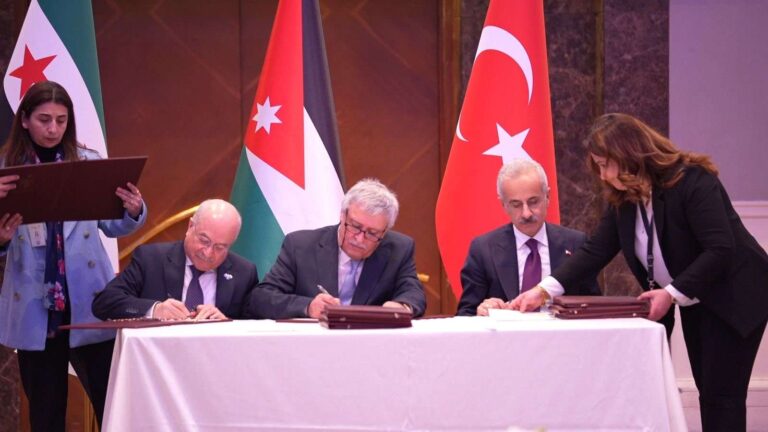
On November 26, 2025, the Syrian Ministries of Health and Finance signed the National Health Charter, a strategic document declaring the transitional government’s commitment to achieving universal health coverage for every Syrian citizen by 2030.
This paper assesses that the Charter represents, for the first time since the fall of the former regime, a comprehensive national project that transcends political and geographical divisions and establishes the principle of “health as an inalienable constitutional right.”
The paper recommends that political forces adopt support for the Charter as a top political priority and form a special follow-up committee to ensure its implementation, as it constitutes the true test of the new state’s ability to provide equitable and comprehensive public services.
Historical and Temporal Context:
- The collapse of the Syrian health system was one of the most prominent consequences of decades of tyranny and war: 60% of public hospitals were destroyed or out of service, more than 70% of doctors had emigrated, and health services were fragmented among more than 28 local and international entities.
- The absence of a unified national framework was the primary reason international support remained within the framework of “humanitarian aid” rather than “budget support,” thus preventing any structural reform.
The Charter’s Political and Strategic Significance:
- The first official document signed jointly by the Ministries of Health and Finance, signifying an unprecedented financial and political commitment.
- The first explicit declaration that health is a right for every citizen “anywhere on Syrian territory,” a direct message to areas outside central control that the door is open for them to join without preconditions.
- The first framework to transform international organizations from “providers of alternative services to the state” to “partners in state-building,” the only way to channel hundreds of millions of dollars annually into direct budget support.
Content Assessment:
- The main objective (universal health coverage by 2030) is ambitious but achievable if 4-6% of GDP is allocated to health (compared to 1.5% in 2024).
- The proposed funding mechanisms (state budget + phased mandatory health insurance + international partnerships) follow the successful model in post-conflict Rwanda and Ghana.
- Establishing a “Supreme National Health Committee” co-chaired by the two ministries ensures policy continuity regardless of government changes.
Potential Risks and Their Solutions:
- Insufficient Initial Funding → Solution: Redirect 30-40% of current grants through the “Sector Support” mechanism instead of “Project Support.”
- Weak Administrative Capacities → Solution: A rapid training program for 500 health administrators in cooperation with the World Health Organization.
- Politically Contested Areas → Solution: Establish a “Health Corridor” separate from the political corridor, starting with joint projects (vaccines, infectious diseases, maternal and child health).
Recommendations:
Based on the above, we in the Syrian Future Movement recommend the following:
- Issuing an immediate official statement welcoming the Charter and declaring its full and unconditional support by all national and civil forces for such agreed-upon national, service-oriented, and state-level decisions.
- Forming a “National Health Charter Follow-up Committee” comprising health and economic experts and representatives of the diaspora.
- Launching an awareness campaign titled “Health is the Right of Every Syrian” targeting expatriates to encourage their return and participation in rebuilding the health sector.
- Launching in international forums to shift support from “humanitarian” to “developmental” through the Charter as a framework.
- Proposing the addition of a clause to the new constitution that explicitly stipulates “the right of every citizen to access comprehensive healthcare without discrimination.”
Conclusion:
The National Health Charter is the first real test of the meaning of the “new state.”
If we succeed in implementing it, we will have proven that the Syrian revolution was not only about overthrowing a tyrant, but also about building a state that restores dignity to its citizens through their most basic and fundamental right: health.
If we fail, we will have lost the most precious opportunity to rebuild trust between Syrians and their state.
Now is the time for full support, not reservation or doubt.
Health is the bridge that can reunite Syria before any other.