Introduction:
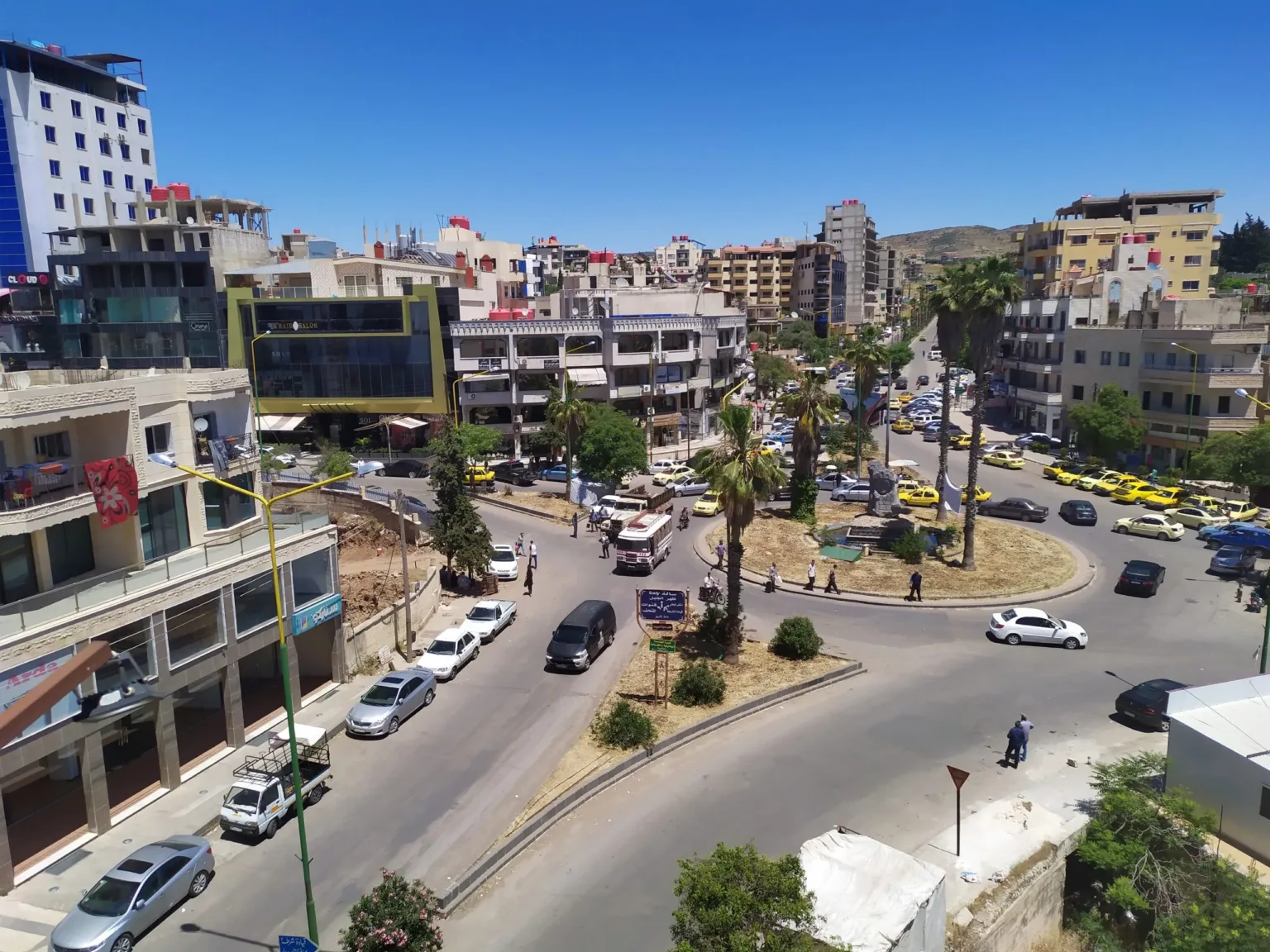
In late 2025, the transitional Syrian state appeared to be facing its first real existential test of its new national project: the Suwaida Governorate, or “Jabal al-Bashan,” as it has been officially called in statements by Druze factions since November 14, 2025. Suwaida was no longer merely a local conflict zone; it had transformed into a political-military enclave that rejected any settlement with Damascus. It even renamed itself using pre-modern Syrian state names, raised Israeli flags in some of its demonstrations, and openly declared that “there will be no dialogue or negotiation except on the basis of separation or full autonomy.”
This symbolic and practical transformation leads us to the question: Are we witnessing the birth of the first “frozen conflict” in post-Assad Syria? And if so, what is the most accurate explanatory model for predicting its future?
We propose here that the Western Sahara model, with all its geopolitical, legal, and symbolic complexities, is the most capable of explaining what is happening in Suwaida, not because the similarities are perfect, but because the fundamental dynamics are almost identical:
- Consistent and relatively low-cost external support (Algeria for the Polisario Front, Israel for the Druze factions).
- Explicit rejection by the local parties of any political settlement (the Polisario Front rejects Moroccan autonomy, the Jabal al-Bashan factions refuse any dialogue with Damascus).
- The ability of the central state to continue without collapse despite losing effective control over part of its territory (Morocco administers 80% of the Sahara, Syria administers 97% of its territory—if it succeeds in implementing its agreement with the SDF—but has effectively lost Suwaida).
- International freezing of the conflict through repeated UN resolutions without a resolution (MINURSO since 1991, and a similar monitoring mission is likely in Suwaida if the situation continues).
Western Sahara as a Classical Model of Frozen Conflicts in the 21st Century:
The Western Sahara conflict is the longest-standing example of a frozen conflict in the Arab world and one of the most studied by international political scientists.
Since the signing of the 1991 UN-brokered ceasefire agreement, there has been no open war, but neither has there been peace. Algeria continues to fund and host the Polisario Front in the Tindouf camps, while Morocco continues to consolidate its administrative, military, and economic control over the territory it occupies. Meanwhile, the mandate of MINURSO is renewed annually without any progress toward a referendum or a final settlement.
In October 2025, the Security Council renewed the mandate for the thirty-fourth time under Resolution 2797, reaffirming that the Moroccan autonomy plan is the “only realistic option,” but it did not obligate either party to implement it, effectively perpetuating the stalemate indefinitely. This freeze appears to transcend mere international inaction, revealing a deliberate strategy by the external backer (Algeria) to prevent its rival (Morocco) from achieving a decisive victory, and by the central state (Morocco) to prevent its rival from gaining any political advantage.
Jabal al-Bashan 2025: A Replication of the Model with Local Details:
In Suwayda, we observe almost the same elements:
- A complete breakdown of trust between the central government and the region following the events of July–August 2025 and the subsequent documented violations by both sides.
- The emergence of military-political factions that reject any dialogue with Damascus (statements by the Men of Dignity, the Free Men of Jabal al-Bashan, the Army of Bani Ma’ruf, and the Druze National Guard).
- The renaming of the region with pre-state historical names (Jabal al-Bashan, Jabal al-Druze, and the Land of Bani Ma’ruf) as an attempt to erase the shared Syrian identity.
- Clear and low-cost external support from Israel: humanitarian aid, light weapons, selective airstrikes, and public statements by Israeli Druze leaders that “the security of the Druze of Syria is a red line.”
- The Syrian transitional government’s inability to regain control militarily without incurring a heavy political and international cost has effectively led to its acceptance of a “no war, no peace” status quo.
There is no prospect of a political settlement similar to the SDF-Damascus agreement of March 2025, in which the SDF agreed to integrate its institutions in exchange for broad decentralization guarantees, while the leaders of Jabal al-Bashan refuse even to discuss any form of decentralization within the Syrian state. Why does this freeze succeed?
From the perspective of offensive realism, as developed by John Mearsheimer, this freeze is not seen as a failure, but rather as “the logical outcome of an anarchic international system in which every actor seeks to maximize its relative security.” Algeria does not want Morocco to become a dominant regional power, and Israel does not want a strong, unified Syria to become a strategic threat on its northern border. Both use low-cost support for a local group to achieve a larger strategic objective: preventing the adversary from achieving complete stability.
On the other hand, Francis Fukuyama argues that frozen conflicts are symptoms of “state-building failure” during the transitional phase, where institutions capable of integrating sub-identities into a unified national identity are absent.
Syria in 2025 suffers precisely from this deficiency:
There is still no new constitution, no elections, and no national project agreed upon by all Syrians. Consequently, it becomes easy for any ethnic or sectarian group to choose to withdraw from the national process if it finds external support.
Samuel Huntington would have added that what we are witnessing in Suwaida is one of the small “civilizational fault lines” within Islamic civilization itself, where the Syrian Druze, with Israeli support, become a tool in a broader conflict between the West and the Islamic world, just as Algeria used the Western Sahara issue as a tool in its conflict with Morocco, which is allied with the West.
Looking ahead to the future of Jabal al-Bashan in the medium term (2026-2035):
Based on the Moroccan model, three possible scenarios can be outlined, ranked from most likely to least likely:
A delayed settlement scenario (low probability): Strong American-European pressure on Israel, countered by Russian-Turkish pressure on Damascus, leading to a broad decentralization formula similar to the SDF agreement.
This scenario requires a radical shift in the Israeli position, which is unlikely at present.
The Long-Term Freeze Scenario (Most Likely): The current situation persists for a decade or more. Damascus treats Jabal al-Bashan as a de facto autonomous region without formal recognition. Israel continues to provide limited support, and the UN maintains a small monitoring mission.
The region becomes similar to Iraqi Kurdistan before 2017: de facto independent but not internationally recognized.
The Escalation and De facto Partition Scenario (Distant but Possible): In the event of a major regional or even internal war (a war with the SDF), or a complete collapse of the Syrian state, Jabal al-Bashan could transform into an independent Druze entity under direct Israeli protection, similar to what occurred in southern Lebanon between 1982 and 2000.
Practical Recommendations for Syrian Decision-Makers:
First, Strategies to Prevent a Freeze:
- Open informal channels of dialogue with Druze leaders in Israel (Muwafaq Tarif, Ayoub Kara) to alleviate Israeli pressure, with a clear message: any support for secession will be met with a full-scale war that no one desires.
- Launching a major development project in Suwaida (Damascus-Suwaida-Jordan highway, a free industrial zone, and agricultural support) to connect the interests of the local population with the central government.
- Establishing a “Regional Consultative Council” comprising representatives from each governorate, so that the Druze feel they have a voice in shaping the future decentralized system.
Secondly, if the freeze is achieved, containment strategies include:
- Implicit recognition of broad administrative autonomy while maintaining the symbols of sovereignty (army, foreign ministry, currency).
- Transforming the region into a joint special economic zone with Jordan and Lebanon to reduce the appeal of secession, or considering the possibility of imposing an economic blockade.
- Working to isolate Israel diplomatically through the Arab League and the Security Council on charges of interfering in internal affairs.
Conclusion:
Jabal al-Bashan is the first real test of the new Syria’s ability to survive as a unified state in a world where the international system encourages freezing conflicts rather than resolving them.
The Western Sahara experience teaches us that a stalemate can last half a century without either side collapsing, but it deprives the central state of a portion of its sovereignty, dignity, and future.
The question now is not whether a stalemate will occur, but when will decision-makers in Damascus realize that time is not on their side, and that every day of delay in building a comprehensive national project increases the likelihood of Jabal al-Bashan becoming Syria’s first “Western Sahara”?
References for further reading:
- Jacob Mundy, “The Geopolitical Functions of Frozen Conflicts”, Geopolitics, Vol. 28, No. 4, 2023
- John J. Mearsheimer, The Tragedy of Great Power Politics (updated edition, 2014)
- John J. Mearsheimer, “The Causes and Consequences of the Ukraine War”, lecture at the European University Institute, June 2023
- Francis Fukuyama, State-Building: Governance and World Order in the 21st Century (2004)
- Francis Fukuyama, “Thirty Years of The End of History”, American Purpose, 2019
- Samuel P. Huntington, The Clash of Civilizations and the Remaking of World Order (1996)
- UN Security Council Resolution 2797 (2025) on Western Sahara
- International Crisis Group, “Time for a New Western Sahara Peace Bid”, Report N°243, 12 October 2023
- Carnegie Middle East Center, “Syria’s Druze: From Revolution to Rebellion to Frozen Conflict?”, November 2025
- Al Jazeera Arabic, coverage of Suwayda clashes, July–November 2025
- Reuters Special Report: “Israel’s Quiet Bet on Syria’s Druze”, 18 October 2025