
On November 3, 2025, the Syrian scene witnessed a significant administrative and diplomatic development when media outlets reported that the Syrian Ministry of Foreign Affairs had decided to reinstate nineteen diplomats who had been absent from or defected from service, more than a decade after leaving their posts.
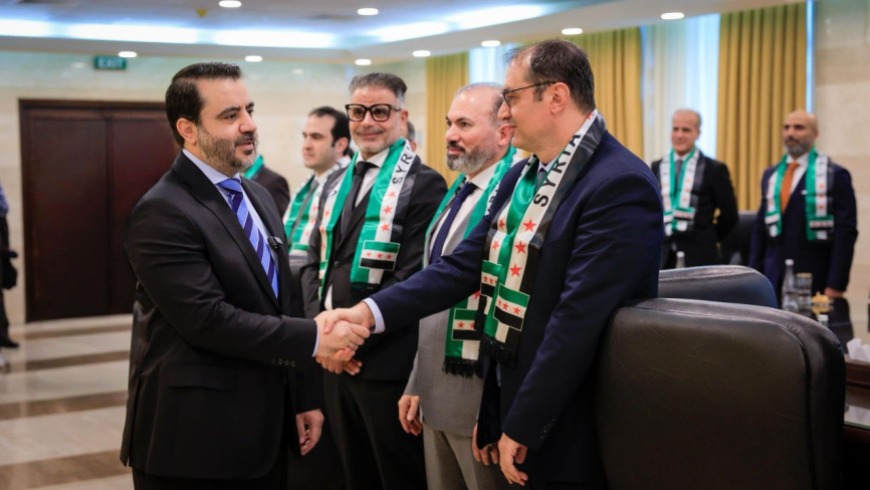
The names of these employees were mentioned, and it was noted that Minister Asaad al-Shaibani met with them at the ministry building to prepare for their return to work in missions in Beirut, Riyadh, Berlin, Dubai, Istanbul, and New York.
This news sparked widespread discussion within political and media circles, raising questions about the implications and significance of this step in light of the current transformations in Syria and the transitional phase following the end of the previous regime.
First: Description and Sources:
This paper relies on a report published by several Syrian media outlets on November 3, 2015, as its primary source. It also reviews the archives of diplomatic defections from 2012 to 2014, particularly those of well-known figures mentioned in the report, such as Khaled al-Ayoubi, the former Syrian chargé d’affaires in London, who announced his resignation in July 2012, as well as Maher al-Jammaz, Basel Niazi, and Khaled al-Saleh. As for the remaining fifteen names, there is insufficient published information regarding their previous positions or new appointments, necessitating waiting for the official announcement to document the details.
The Research and Studies Department of the Scientific Office of the Syrian Future Movement chose to address this event from both its political and administrative dimensions, avoiding accusations or justifications, recognizing the importance of the diplomatic file in building the new Syrian state and restoring its image in the eyes of both domestic and international public opinion.
Second: Administrative and Institutional Implications:
From an administrative standpoint, the reinstatement of these employees represents an attempt to fill the chronic void in the diplomatic corps, which has been severely impacted by defections, sanctions, and the freezing of relations with a large number of countries.
After more than a decade of isolation, the Ministry of Foreign Affairs finds itself facing a network of understaffed missions burdened with consular responsibilities, struggling to obtain visas, update records, and attend to the interests of Syrians in the diaspora.
Undoubtedly, the reinstatement of these diplomats allows, even if only superficially, for the restoration of a portion of the lost institutional memory and the retrieval of past expertise in languages and relations—a vital matter in managing a transitional phase that demands experienced professionals in addition to political loyalties.
However, the lack of transparency in announcing the decision and the failure to clarify the conditions of their return raise questions about the nature of the process. Is it a genuine return to active diplomatic posts or merely a symbolic reinstatement? Has the Ministry completed the legal and financial procedures for their reappointment, or is the decision more of an administrative measure with ulterior motives? These are fundamental questions that no institutional reform process can ignore, because building trust in the new state rests first and foremost on transparent procedures and respect for the principle of equal opportunity within the civil service.
Third: The Political Dimension of the Decision:
Politically, the decision carries a dual message.
On the one hand, it can be interpreted as a sign of a desire to turn the page on division and reintegrate some of the qualified individuals who left the state during the national collapse that preceded Bashar al-Assad’s policies in 2011. This step—if its intentions are genuine—is consistent with the philosophy of transitional justice and national reconciliation that civil forces have been advocating for years.
From the perspective of the Syrian Future Movement, the state must be inclusive of all its citizens and rebuild its institutions on the basis of citizenship, not loyalty.
On the other hand, the decision could be interpreted as a political maneuver to project an image of a “stable and inclusive state” at a time when the legal framework for the transitional phase is still incomplete. If transparency is lacking in announcing the criteria for reinstatement and investigating employee conduct during the years of absence, the move could be exploited to whitewash the records of certain officials without accountability, or to recycle loyalties in a new guise.
This underscores the importance of civil and media oversight undertaken by the Syrian Future Movement and other independent national forces.
Fourth: External Impact and International Relations:
On the external front, the decision faces another challenge: the reactions of the host countries where some of these diplomats previously served.
The reinstatement of individuals who have already defected could create diplomatic confusion, particularly in European Union countries that have not yet fully restored relations with Damascus. These countries might refuse to receive diplomats who were on their soil and then severed ties with their former missions.
On the other hand, redeploying them to new missions, such as those in Istanbul or Dubai, could reflect a practical desire to revitalize consular services for large Syrian communities. This could be beneficial if implemented within a transparent administrative framework subject to oversight by the transitional government.
Foreign policy is not a field for settling scores, but rather an arena for building trust and redefining the interests of the Syrian state in accordance with the requirements of regional peace and economic openness. This necessitates a new, professional diplomacy built on competence and integrity.
Fifth: The Social and Symbolic Dimension:
The decision also carries a symbolic dimension of no less importance: it tests the credibility of the national discourse surrounding the “return of minds and expertise.”
Syrian society, exhausted by war and displacement, needs a new vision that restores the public service to its rightful place as a service to the citizen, not as a privilege of power.
The return of the estranged diplomats could become a success story if it is based on merit and professional commitment, not on political compromises.
However, it could turn into a negative message if it is interpreted as a process of polarization or a realignment of tribal and regional factions within state institutions.
Herein lies the moral responsibility, first and foremost, of the Ministry of Foreign Affairs, and then of the entire transitional government, to affirm that belonging to the Syrian state is not measured by a history of loyalty to a previous or subsequent regime, nor by the extent of defection from it, but rather by the degree of commitment to the law and the public interest.
Sixth: The National Maqasid Approach:
From the perspective of the Maqasid school of thought in Islamic political thought—which has long inspired the Syrian Future Movement—rebuilding institutions is not based on revenge or exclusion, but rather on the objectives of justice, public interest, and reform.
As the scholars of Maqasid have said, “Justice is the foundation of governance,” and there can be no justice without equitable settlement among the citizens of the same nation.
Integrating those who were forced to leave their jobs under compelling circumstances, after verifying their integrity, aligns with the principle of redressing grievances and restoring trust between the state and society.
However, leniency towards those who committed violations or abused their positions in the past undermines the objective of preserving rights and lives, and fundamentally destroys the transitional justice project.
Therefore, the Syrian Future Movement calls for a distinction between “institutional reintegration,” which is based on competence and accountability, and “political reintegration,” which is exploited to polish the image of the regime or settle old scores.
Seventh: Towards a Future Vision:
It is important to include this incident within a broader national dialogue on rebuilding the Syrian diplomatic corps during the transitional phase.
The corps, which was once a mirror of the old regime, must become the face of the new state in every sense of the word—a state of law, pluralism, and openness.
The Ministry of Foreign Affairs should commit to the following steps to ensure the credibility of the reform process:
Publish the full official decision and its criteria.
Subject returning diplomats to independent professional and financial audits.
Establish a new code of conduct for diplomats that links foreign service to national values, not personal loyalty.
Involve civil society organizations and the Syrian diaspora in evaluating the performance of consular missions.
Implement training and qualification programs for new and returning diplomats on the concepts of transitional justice and human rights.
Restructuring the Ministry of Foreign Affairs is part of a comprehensive national project to rebuild the state on the foundations of integrity and accountability.
In a modern state, diplomacy is the voice of the nation, and those who speak on its behalf must carry its ethical and political project, not the legacy of its old regime.
Conclusion and Recommendations:
The reinstatement of nineteen Syrian diplomats is an indicator of the form the state is taking shape today during the transitional phase.
It is an early test of the new government’s commitment to the principles of transitional justice and its ability to separate holding perpetrators accountable from integrating qualified individuals. The Syrian Future Movement, while welcoming every step that contributes to rebuilding state institutions on the basis of citizenship, calls for these decisions to be placed within a clear legal framework and for a national dialogue to be opened regarding the reform of the diplomatic corps, as it represents the dignity of Syrians abroad.
Without a new diplomacy that reflects the conscience and aspirations of the people, the image of a just and free Syria, to which we all aspire, will remain incomplete.