Introduction:
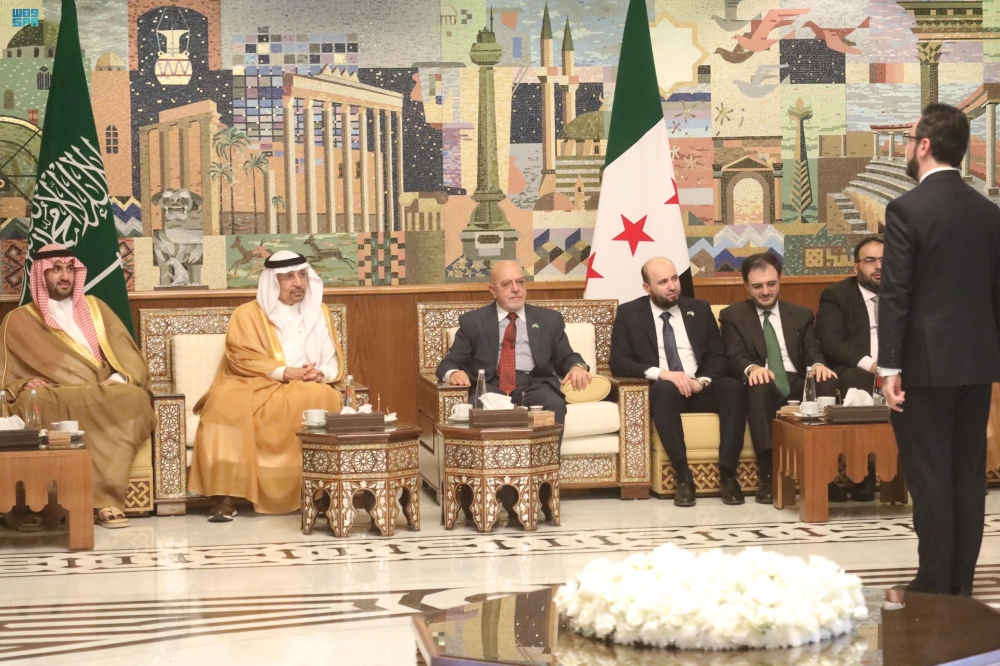
In light of the radical transformations taking place in Syria following the fall of the Bashar al-Assad regime in December 2024, diplomatic and economic visits from sister Arab countries have become a focus of political and strategic analysis. Among the most prominent of these visits was the arrival of a high-level Saudi delegation to Damascus in July 2025, headed by His Excellency Minister of Investment Khalid al-Falih and including more than 130 businessmen and investors.
The official objective of this visit was to sign economic and development agreements valued at approximately $4-6 billion, covering the energy, infrastructure, agriculture, and cement sectors.
This step comes within the context of Arab openness to the new Syria under the leadership of President Ahmad al-Sharaa. However, it raises fundamental questions about whether it represents a real opportunity for sustainable development or carries political risks, especially in light of ongoing security and regional challenges. This analysis, issued by the Political Bureau of the Syrian Future Movement, provides an objective assessment of the pro- and anti-regime positions, claiming that the visit represents a positive step toward reconstruction, provided strategic caution is exercised to preserve national sovereignty.
Methodology:
To ensure scientific accuracy and objectivity, the analysis relied on a modern research methodology that combines qualitative content analysis and digital data exploration.
First, a comprehensive web search was conducted using advanced search engines to collect news and analytical sources from reliable platforms such as Al Jazeera, The Washington Institute, and Bloomberg, focusing on the period from December 2024 to September 2025 to capture the most recent developments. Fifteen key sources were selected to represent a diversity of opinions, with filters applied to verify neutrality and date.
Second, social media analysis (Platform X) was used through advanced keyword searches (such as “Saudi delegation Damascus agreements since: 2024-12-01”) to collect 20 recent posts, sorted chronologically, and a semantic analysis of an additional 15 posts was performed to measure emotional trends (such as welcome or concern).
Artificial intelligence tools were used to classify content into categories (pro, anti, neutral) based on indicators such as the number of likes and retweets, while adhering to ethical standards to avoid bias.
This hybrid methodology, inspired by contemporary digital research models such as those from the Pew Research Project, allows official data to intersect with public opinion to draw a comprehensive and objective picture.
Supportive Positions: An Opportunity for Regional Development and Stability:
The visit received widespread support from official and popular parties, viewed as a fundamental step toward Syria’s reconstruction. From the Saudi side, the delegation reflects the Kingdom’s commitment to supporting regional stability, as His Excellency Minister Khalid Al-Falih emphasized in his statements regarding “major projects” including a cement factory and an investment forum. This support comes under the direction of His Royal Highness Crown Prince Mohammed bin Salman and is seen as an extension of Riyadh’s efforts to strengthen Arab partnerships, especially following the lifting of US sanctions on Syria.
On the Syrian front, the new government welcomed the visit, considering it a strengthening of bilateral relations and support for sustainable development. SANA also reported the signing of 47 memoranda of understanding worth 24 billion riyals.
Popular welcome is clearly evident on social media, as in posts like those from @ibrahim_ghassan and @FAHD44747, which express enthusiasm for the “return of Arabism” and investment opportunities, with likes reaching hundreds of thousands, reflecting popular optimism about improved living conditions after years of conflict.
Analysts like Diaa Qaddour also supported, in television interviews, the visit as a “strong Saudi contribution to reconstruction.”
Regionally, this is seen as part of a broader Gulf alliance, with similar visits from the UAE and Qatar, promoting stability and limiting Iranian influence.
Opposition or Cautious Positions: Fears of External Influence and Economic Feasibility:
Despite the prevailing support, there are cautious or opposing voices focusing on the political and economic risks. Some Syrians fear that the agreements are a means of expanding Saudi influence, especially in light of President Ahmed al-Sharaa’s former background with Hay’at Tahrir al-Sham, which was designated a terrorist organization.
On the X platform, some posts we monitored expressed concern that the investments come at a time when Gaza is suffering from famine, considering them a “slap in the face.”
A semantic analysis of other posts also indicates concerns about the lack of immediate economic feasibility, as the agreements may not directly impact living conditions in light of ongoing security challenges.
Regionally, there are reservations from parties such as Iran or supporters of the former regime, who view the Saudi-Syrian rapprochement as a threat to their interests.
Reports also indicated that the visit comes despite the “recent round of violence,” raising questions about stability.
In semantic analysis, some publications highlight concerns about “economic colonialism,” such as those related to the Development Fund, which is seen as a tool of control.
The movement’s assessment: A balance between development opportunities and strategic caution:
The Syrian Future Movement views this visit as a strategic opportunity for Syria to emerge from its isolation, supported by tangible investments that contribute to sustainable development, as emphasized in the 47 agreements.
However, the movement emphasizes the need to preserve national sovereignty through balanced conditions to avoid transforming partnership into dependency. The adopted methodology demonstrates that positive support outweighs caution, but security challenges require continuous monitoring and transparency in implementation.
Conclusion:
The Saudi delegation’s visit represents a gateway to effective Arab cooperation, but its success depends on transparent and comprehensive implementation. Accordingly, the Research and Studies Department of the Political Bureau of the Syrian Future Movement is conducting future studies focusing on the impact of these agreements on the Syrian economy, while calling for a comprehensive national dialogue to ensure that all Syrian components benefit.
Based on the above, the Political Bureau of the Syrian Future Movement recommends, based on the movement’s supportive positions for strengthening Syrian-Saudi relations, as emphasized in its official statements, such as our statement issued on September 7 of this year and published on our official website under the title “Signing of Service and Development Agreements between the Kingdom of Saudi Arabia and Syria,” the movement recommends the following to ensure the success of the visit and strategic partnership:
- Strengthening security and economic cooperation: Focusing on combating terrorism and Iranian influence through information exchange, while supporting Saudi investments in reconstruction amounting to hundreds of billions, particularly in infrastructure and energy, to achieve mutual benefits.
- Confronting external challenges: Resolving international sanctions through dialogue with the United States and Europe, facilitating the flow of unrestricted investments, while preserving Syrian sovereignty in the face of regional rivalries.
- Ensuring transparency and inclusiveness: Involving all components of the Syrian people in implementing agreements, with oversight mechanisms to ensure a fair distribution of economic benefits, and enhancing cooperation in education and health to support coexistence.
- Building a long-term strategic partnership: Expanding cooperation to include regional issues such as Lebanon and the Palestinian conflict, while adhering to the principles of the Syrian revolution to achieve regional stability that serves the interests of both countries.