Amid the rapid transformations taking place in the region, the Syrian issue has emerged as an arena for redrawing regional balances, where the interests of major powers intersect with local security challenges.
This comes in the context of a notable return of the Russian role in Syria, accompanied by the possibility of coordination with Turkey to confront the Israeli escalation. This “new equation,” as described by observers, is not merely a passing diplomatic interaction, but rather reflects a strategic shift that could reshape the geopolitical map of the Middle East.
In this article, we will discuss the political dimensions of this equation, drawing on the historical context and current developments, with a focus on the role of Moscow and Ankara in confronting what is considered increasing “Israeli aggression.”
Historical Context: From Russian Retreat to Strategic Return
Since the outbreak of the Ukrainian war in 2022, the Russian role in Syria has witnessed a significant decline, allowing Israel to expand its military operations without strong deterrence. Moscow had previously maintained a “deconfliction” mechanism with Tel Aviv and sponsored local settlements that kept Iranian militias away from the southern Syrian border, contributing to a temporary calm. However, the Russian retreat has created a security vacuum that Israel has exploited to strengthen its influence, particularly in southern Syria. Today, with Russian Deputy Prime Minister Alexander Novak’s visit to Damascus on September 9, 2025, and Syrian Foreign Minister Asaad al-Sheibani’s visit to Moscow last August, Russia appears to be reinvesting in its presence. These visits are not merely economic—despite their focus on energy and infrastructure—but also carry clear security and military dimensions, aiming to restore balance in the face of Israeli escalation.
Politically, this return reflects Moscow’s desire to restore its regional influence, especially after Syria became the “new Syria” following the fall of the Assad regime in 2024. It also coincides with Russian fears of Israeli hegemony, which could tear Syria apart and threaten Russian interests in military bases such as Hmeimim and Tartus. In this context, observers believe that Russia does not view Syria as a limited strategic interest, but rather as a haven for strengthening its partnerships with other parties, such as Turkey, to confront common challenges.
Russian-Turkish Coordination: Shared Interests or Fragile Alliance?
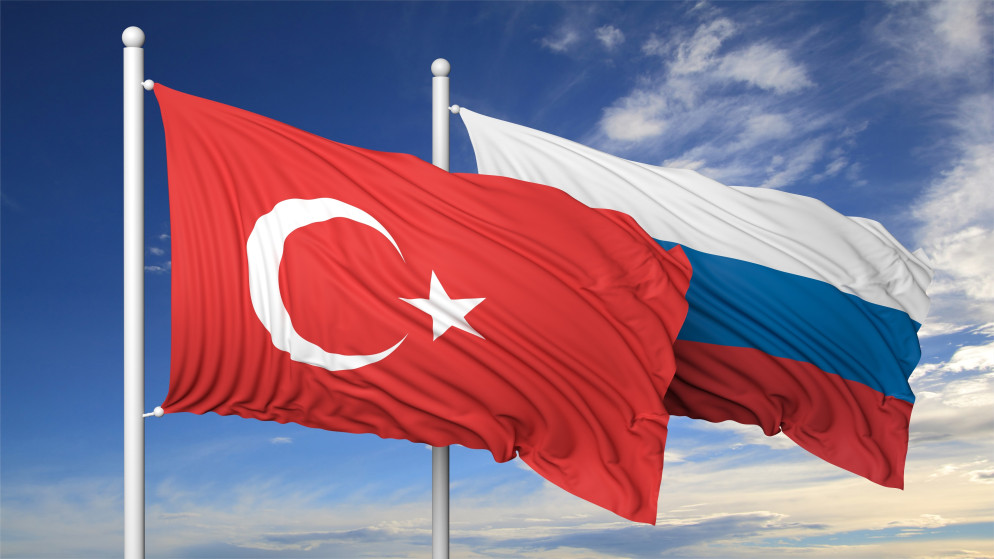
Potential cooperation between Moscow and Ankara emerges as a key element in this new equation.
Turkey, which controls northern Syria, views the Israeli escalation as a direct threat to its national security, especially with the increase in Israeli airstrikes and ground incursions. For its part, Russia has expressed its willingness to cooperate with Turkey in the field of air defense without restrictions, indicating the possibility of joint security coordination. This coordination is not new; Russia has previously sponsored regional understandings with Turkey, but today it is taking on a broader dimension in the face of “Israeli unilateralism.”
Politically, this coordination is based on shared interests: Russia seeks to maintain a balance in southern Syria through flexible arrangements, while Turkey seeks a broader negotiating space with Damascus and Tel Aviv. However, this alliance remains fragile due to regional complications, such as disagreements over the SDF (Syrian Democratic Forces), which has received Israeli promises of protection in exchange for provocations against Damascus, complicating the Turkish position. Some analyses also indicate that Russian actions may be partly guided by Israel’s compass, aiming to prevent the expansion of Turkish influence, adding a layer of complexity to this equation.
At the same time, the Syrian side rejects any Russian military support as an alternative to Turkish support, welcoming Moscow’s role in reconstruction and security, provided it is transparent and respects Syrian sovereignty. This position reflects Damascus’s concern for a balanced relationship, relying on multiple partnerships to avoid dependency.
The Israeli Challenge: Between Escalation and the Need for De-escalation
Israeli escalation is the main motivating factor for this new equation. Israel, which continues its airstrikes, sees the Syrian vacuum as an opportunity to enhance its security. However, this raises regional concerns. Analyses indicate that Israel may be forced to adapt to growing Turkish influence in Syria, especially given Ankara’s support for Syrian stability. However, communication between Turkey and Israel through intelligence channels indicates the possibility of a de-escalation, despite Turkish warnings against exploiting the situation.
Politically, Russian-Turkish coordination may lead to a temporary de-escalation, as Moscow possesses unique negotiating capabilities with Israel. However, the fragility lies in the Israeli-Turkish rivalry, which extends beyond Syria to broader issues such as Palestine and the regional economy.
Conclusion: Towards a Sustainable Regional Balance?
This new equation presents an opportunity for Syria to restore its stability, provided that partnerships are based on shared interest and sovereignty.
Russia and Turkey, despite their differences, can form a united front against the Israeli challenge, strengthening Syria’s role in the region. However, success requires overcoming fragility through international understandings that ensure non-escalation.
Ultimately, the new Syria needs a balanced foreign policy that transforms challenges into opportunities for development, away from dependency and external conflicts.