
Contextual introduction:
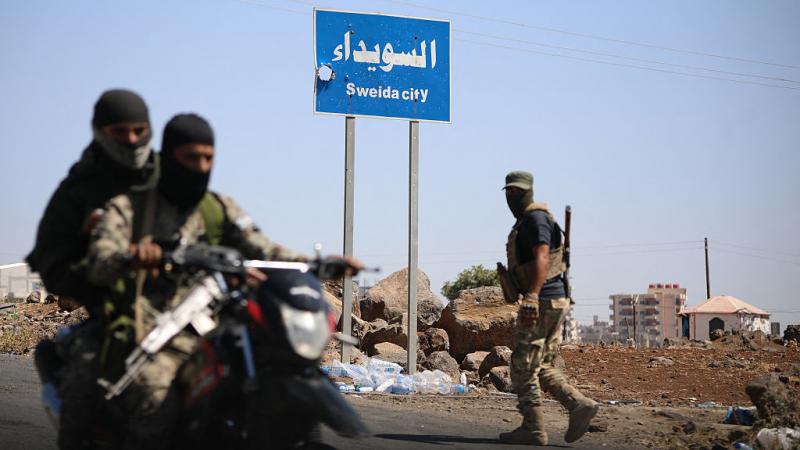
In mid-July 2025, the United Nations Office for the Coordination of Humanitarian Affairs (OCHA) recorded an unprecedented mass displacement from As-Suwayda Governorate, with the number of displaced persons exceeding 93,000, following a sharp escalation in armed clashes and a widespread deterioration of services and infrastructure. This shift, while seemingly a localized crisis, represents a focal point for a deeper analysis of the disintegration of state institutions and the emergence of informal patterns of social organization and response. This makes As-Suwayda a model for studying changes in the relationship between state and society amidst the institutional and political imbalance in Syria.
Fragile security structure:
The past few months have been marked by escalating tensions between local armed groups, some of which are tribal in nature, others linked to former security agencies of the former regime, or informal networks with sectarian and political affiliations. This security fragmentation reveals a new positioning of local actors as an alternative to the formal state, which calls for an examination within political theories that address the disintegration of sovereignty and the devolution of power to the peripheries.
This pattern of conflict is linked to what Charles Tilly described as the shift from a “monopoly of legitimate violence” to a “multiplicity of centers of control,” whereby the central state’s ability to impose its authority weakens, and peripheral areas become open spaces for conflict between multiple informal actors.
Despite the virtual absence of state institutions in confronting the crisis, local communities—particularly civil and religious initiatives—have emerged as primary providers of support and services, through reception centers and collective shelters, as in Daraa and areas of Sweida itself. This interaction aligns with Johann Arendt’s argument that societies can create patterns of organization in moments of political vacuum. However, this organization remains temporary, fragile, and lacking legal and institutional legitimacy. The shutdown of hospitals, water, and electricity lines also indicates a collapse not only in services but also in the foundations of the “social function of the state,” which in classical thought formed the basis of modern legitimacy, as in Hobbes’s theory of “protection versus obedience.” With the loss of this protection, the justification for obedience to authority is negated, opening the door to a local redefinition of authority.
From center to margin, the crisis of the state and the concentration of the local:
Since 2012, the Syrian state has suffered from a gradual loss of its sovereign functions, ranging from security and service provision to weak political and social representation in the peripheries. The case of Sweida, in light of recent events, clearly embodies this phenomenon, despite the fall of the Assad regime. The central state abandoned direct responses due to the Israeli intervention in support of Sheikh al-Hajri’s forces, and instead issued general media statements about a “gradual plan” to restore security and services, without any actual presence of its institutions on the ground.
This regression is linked to the concept of the “failed state,” as developed by Fareed Zakaria and Francis Fukuyama, which is defined as a state that loses the ability to control borders, provide services, and enforce the law equally. In the Syrian case, an additional element stands out: some state institutions deliberately reproduce marginalization as a tool of control through abstention rather than intervention.
In place of the absence of a central authority, local forces—civil, religious, and armed—have emerged to attempt to fill the institutional void, whether by organizing displacement centers or supervising services. Despite the spontaneity of this local concentration, it reproduces a new concept of authority based on direct societal legitimacy, rather than legal or institutional authorization.
In this context, Syrian researcher Hassan Nizam al-Din, in his study on local governance in southern Syria, notes that since 2020, Sweida has developed quasi-institutional forms of local coordination between sheikhs, civil society organizations, and public figures, without a clear legal or representative framework.
This model is similar to Noam Chomsky’s notion of “horizontal authority in the absence of a center,” which arises from cohesive but informal networks and is subject to moral legitimacy rather than legal legitimacy.
However, the absence of any local elections or mechanisms for selecting community representatives reveals a deeper crisis in the concept of legitimacy.
Despite the rise of local voices, they remain confined within the logic of “symbolism,” not “representation.” This means that they are acquired through history or sect, not through contracts or ballot boxes. This is linked to contemporary Arab thought, particularly that of Burhan Ghalioun, who believes that the Syrian crisis reveals the contradiction between “society as a source of authority” and “the state as a monopoly of control,” creating a legitimacy vacuum when the state fails and no organized societal alternative emerges.
Legitimacy and the Social Contract between Classical Theory and Local Experience in Sweida:
Legitimacy is one of the most critical concepts during moments of central authority’s collapse, as it detaches from formal law and reshapes itself within the fabric of society. Within this context, the paper draws on three intersecting philosophical approaches:
The classical Western approach, in which Thomas Hobbes presents a conception of authority as a response to the human need for security and stability, and thus the state’s legitimacy is based on its ability to protect. Jean-Jacques Rousseau redefines legitimacy from a social contract perspective, considering the people, not the ruler, as the source of sovereignty.
- The modern approach, as held by Hannah Arendt, holds that legitimacy is built through collective action and public deliberation, not merely through law or monopolized violence. This theoretically enables societies to regain their legitimacy through horizontal organization and public communication. The Islamic and traditional approach: In the Islamic context, the concept of legitimacy is based on allegiance, consultation, and the achievement of objectives, particularly the preservation of religion, life, and reason. In his book “Al-Ahkam Al-Sultaniyya,” Abu Ya’la Al-Farra’ presented the idea that the imam is appointed through two methods: textual or contractual, emphasizing that preserving public interests is the essence of legitimacy, not the ruler himself.Today, Sweida is witnessing a power vacuum that is redefining who has the right to rule and who can represent, in the absence of a central state, following the empowerment of the diaspora by the Israeli entity and the multiplicity of actors. In this context, the experience can be viewed as an attempt to recreate local legitimacy based on:
- Civil and historical representation, through the elders of reason and traditional figures, resembles the form of “general allegiance,” but lacks the tools of consultation and institutions, making it vulnerable to isolation or elitism.
- Humanitarian response and community solidarity embody the principle of “public welfare” in Islamic thought, whereby the public interest is considered the basis of legitimacy, regardless of the form of government. If these actors succeed in protecting lives and providing food and services, they become closer—from the perspective of Islamic political jurisprudence—to the function of legitimate governance.
In light of these readings, Sweida emerges as a testing ground for the idea of a “local social contract,” that is, the possibility of forming a decentralized, sustainable, and socially recognized legitimacy, even in the absence of a formal constitutional framework.
The success of this model depends on several conditions:
- It provides effective, participatory (consultative) representation mechanisms, not merely symbolic ones.
- Achieving public interests and greater goals, thus preventing a slide into chaos or local authoritarianism.
- The ability to connect with the Syrian national project, to avoid transforming it into a “legitimate, independent region,” which would fuel separatist tendencies. With the recent experience of Sweida, we see that it lacks the positives of the previous description.
The local experience…between autonomy and the disintegration of national identity:
In the midst of the recent crisis, Sweida demonstrated a remarkable community capacity to organize relief and security responses, free from direct institutional intervention by the state. This pattern of self-centeredness does not necessarily constitute secession, but it raises a profound problem related to the concept of “moral centrality,” i.e., the link between the local community and the national project, not just administrative institutions.
Syrian researcher Samer Al-Khalil notes that since 2018, Sweida has been developing a local discourse with an independent moral and political dimension, evident in community statements and collective stances on conflicts. This indicates the embryonic development of a local political identity in the face of central incompetence. This changed with the armed rebels’ coup in Sweida.
Communities in Sweida are caught between a desire to continue within the general Syrian identity and a reality that pushes them toward self-isolation. This situation intersects with similar Arab experiences, such as:
- Yemen, where the fragility of the center led to the emergence of local Houthi or southern separatist authorities, posed a challenge to the state’s identity.
- Libya, the collapse of the state resulted in a dual authority in the east and west, and local councils became alternative instruments of legitimacy.
- Iraq, despite the formal continuation of the state, de facto authority in the provinces has been transformed into independent ethnic and sectarian formations. These models confirm that local responses are not always temporary; rather, they may transform into a permanent form of governance, threatening the comprehensive national structure if not managed with balance. Cultural and political elites play a fundamental role in reshaping the relationship between the local and the central. The absence of a rational and foundational discourse leaves local communities captive to momentary reactions. In Sweida, some thinkers and clerics have emerged with principled positions attempting to prevent a slide toward disintegration. However, the absence of independent think tanks and local research centers capable of formulating a comprehensive philosophical-political discourse threatens the potential for these positions to become actual projects.
Here, the need arises to build collaborative spaces, both research and field-based, that ensure rational and principled representation of communities outside the center, without falling into the trap of federalism or secession.
International and Relief Response: Between Humanitarian Neutrality and the Problem of Bias in Conflict Zones:
Theoretically, international humanitarian responses are based on four fundamental principles: neutrality, humanity, independence, and non-discrimination. However, applying these principles in the Syrian context faces structural challenges.
In Sweida, the response of the United Nations and humanitarian organizations to a displacement crisis exceeding 93,000 people was delayed, compared to relatively faster responses in other areas under different political or military influence.
This paradox raises an ethical question about the neutrality of international organizations, particularly in light of what Michael Barnett and Thomas Weiss describe in their work on “humanitarian politics”: that relief, despite its noble goals, is subject to the influence of power, geography, and balances of influence.
It is worth noting that the Syrian Red Crescent, in cooperation with the World Food Programme and UNICEF, was able to deliver the first aid convoy to Sweida, including food baskets and basic supplies. However, this intervention remains subject to several restrictions:
- Field access, which is limited to certain areas due to security complications and internal political obstacles.
- Local legitimacy, as international organizations face challenges in coordinating with non-state actors, raises concerns about the issue of “indirect recognition” of these authorities.
- Media framing, as UN discourse is often couched in technical language that obscures the dimensions of the political crisis, weakening the ability to pressure or advocate for broader structural intervention. Abdul Rahman Al-Hajj’s analysis is noteworthy here, as he warned that the absence of a mechanism to hold international organizations accountable within Syria contributes to the reproduction of “relief without political impact,” i.e., interventions incapable of changing the structural conditions of crises. Furthermore, the humanitarian crisis in Sweida poses a test for concepts of humanitarian intervention based on universal ethics and constrained by the balance of political power. In this context, several philosophical questions arise:
- Can humanitarian neutrality truly be achieved in areas of internal societal conflict?
- Does unconditional humanitarian response legitimize unelected or unaccountable local authorities? In his work on the ethics of aid, Didier Fassin argues that humanitarian action must be subject to controls that go beyond saving lives, but also consider the nature of the authority that allows access and the impact of intervention on existing political dynamics.
Conclusion and recommendations: From a moment of disintegration to a project for re-establishment:
In light of the recent displacement, escalating violence, and the retreat of the central state, Sweida represents a revealing example of the collapse of traditional sovereign functions and the emergence of local patterns of organization and response. This phenomenon goes beyond relief or administrative interventions and raises profound questions about the concept of legitimacy, identity, and authority in post-state spaces.
The paper demonstrates that legitimacy, in its Western and Islamic approaches, is not limited to official institutions. Rather, it is generated—in moments of collapse—by societal action, moral representation, and the realization of public interests.
However, this alternative legitimacy remains fragile, vulnerable to exploitation, or susceptible to transformation into political and social isolation unless it is formulated within a clear philosophical and methodological vision.
The most prominent challenges facing Sweida in the next phase are:
- The absence of clear mechanisms for local representation weakens moral legitimacy and threatens to divert power toward a closed symbolic framework.
- Local initiatives lack a legal and institutional framework, rendering them incapable of national aggregation or coordination.
- The Sweida situation is likely to slide toward a semi-separatist model if it is not linked to the framework of a comprehensive Syrian social contract.
Based on the analysis, the following approaches are proposed:
A. Philosophically:
- Developing a new concept of “community legitimacy,” integrating Islamic objectives, the modern social contract, and civil society organizations.
- Rereading the legacy of authority in the Syrian context, freeing concepts from the centrality of the state and returning them to society to overcome the crisis into which the policies of Sheikh al-Hijri and his group have led us.
B. Politically:
- Support the establishment of representative civil councils based on a participatory, consultative approach, with a coordinating, non-separatist character.
- Efforts are made to establish a local charter for Sweida, including ethical and societal principles for regulating governance and responsiveness.
C. Research:
- Establishing an independent research unit to monitor and document local transformations in southern Syria and link them to comparative models.
- Producing policy papers targeting decision-makers inside and outside Syria, demonstrating the sustainability or erosion of the Sweida model.
In conclusion, the crisis in Sweida, despite its severity, opens a rare window into understanding the mechanisms of power reproduction and experimenting with alternative legitimacies emanating from society, not from collapsed institutions. If elites handle it well, and research centers support it with a foundational vision, Sweida could become not just a symbol of pain, but a political and moral laboratory for rebuilding Syria from the periphery toward the center, and from society toward the state.
the reviewer:
- Barnett, M. & Weiss, T. (2011). Humanitarianism Contested: Where Angels Fear to Tread. Routledge.
- Al-Hajj, Abdul Rahman (2022). “International Relief in Syria: Neutrality as a Tool of Disengagement.” Omran Magazine.
- Tilly, C. (1985). “War Making and State Making as Organized Crime.” In: Evans, P., Rueschemeyer, D. & Skocpol, T. (eds.), Bringing the State Back In. Cambridge University Press.
- Arendt, H. (1972). Crisis of the Republic. Harcourt.
- Hobbes, T. (1651). Leviathan. Oxford University Press.
- Abu Ya’la al-Farra’ (1036). Al-Ahkam al-Sultaniyyah. Edited by: Dr. Ahmad Mustafa.
- Al-Juwayni, Abu al-Ma’ali (1075). Ghiyath al-Umam fi al-Tiath al-Zulm. Dar al-Fikr al-Islami.
- Al-Baji, Suleiman. (2020). “Political Legitimacy in Islamic Thought: Between Objectives and Contract.” Journal of Sharia Politics, Umm Al-Qura University.
- Al-Ashmawi, Salim. (2018). The Controversy of Shura and Democracy: A Reading of Concepts and Functions. Namaa Center for Studies.
- United Nations Office for the Coordination of Humanitarian Affairs. (2025). “Suwayda Displacement and Clashes Report.”
- Nizam Al-Din, Hassan. (2022). Local Governance in Southern Syria: Suwayda as a Model. Omran Center for Strategic Studies.
- Ghalioun, Burhan. (2016). The Deterioration of Legitimacy in Syria: From Revolution to Institutional Vacuum. Center for Arab Unity Studies.
- Al-Khalil, Samer. (2021). Suwayda between Local Retreat and National Belonging. Jusoor Center for Studies.
- The Spiritual Council of the Druze Community. (2025). Statement on the Events in Suwayda. Official Website of the Council.
- Abaad Foundation. (2020). Local Governance in Libya and Yemen: Towards Parallel Legitimacies?
- Hamid, Karim. (2019). “Political Authority in Post-2003 Iraq: Central or Local?” Iraqi Journal of Political Science.
- Fukuyama, F. (2013). The Origins of Political Order. Translated by Al Jazeera Center for Studies.