
The Syrian Future Movement expresses its full solidarity with the residents of Latakia Governorate and the coastal towns affected by the unprecedented fires that broke out in early July.
It calls for this disaster to be treated not as a temporary environmental crisis, but rather as a real test of the Syrian state’s ability to transition from a symbolic response to establishing a national system for managing natural and environmental disasters.
The Syrian Future Movement welcomes the Autonomous Administration’s initiative to send firefighting teams and logistical assistance to the affected areas, considering it a practical expression of the unity of land and destiny. It appreciates the message this step conveys at a sensitive and pivotal moment, as local institutions present a model of solidarity and inclusive nationalism that must be embraced and developed within a participatory environmental recovery plan.
The Syrian Future Movement calls for the launch of a transparent mechanism to assess damages, compensate farmers, and establish a national forest rehabilitation plan. This plan should include Syrian civil society, environmental experts, volunteer municipalities, and agricultural scientific centers, within the framework of a non-partisan and non-military partnership.
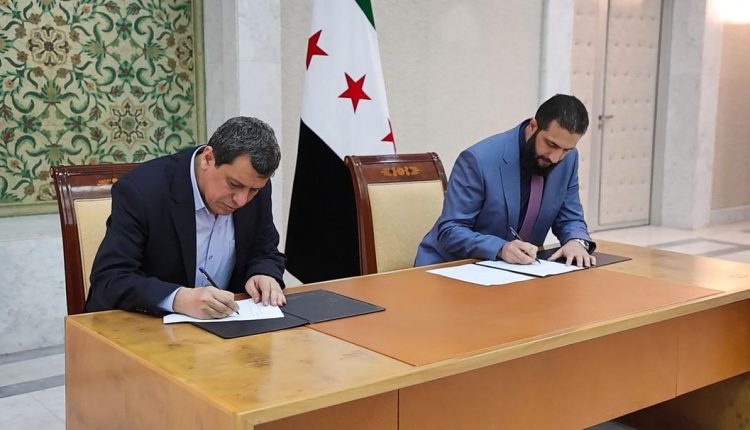
The Syrian Future Movement believes that today’s meeting between President Ahmad al-Sharaa, US Special Envoy Tom Barrack, and Syrian Democratic Forces (SDF) Commander Mazloum Abdi represents a rare political and constitutional opportunity to redefine the relationship between Syrian components within the framework of a just state, shared development, and open sovereignty, far removed from the logic of division, containment, or hegemony. The movement emphasizes that the March 2025 agreement does not represent a top-down deal, but rather must be translated into a constitutional and societal framework that respects the cultural and political rights of the Kurdish component and upholds the principles of justice, equality of wealth, institutional integration, and the guarantee of Syrian territorial integrity. It also notes that the integration of the SDF’s civilian and military institutions must be conducted in accordance with the rules of participatory political transition, not through the logic of acquiescence or haste.
The Syrian Future Movement welcomes France’s joining the United States in sponsoring integration arrangements, but stresses the need to prioritize building a new Syrian social contract that restores inclusive citizenship and promotes decentralized, cooperative participation within a functionally unified, politically participatory national administration based on the fair distribution of power and wealth.
The Syrian Future Movement calls for transforming the current environmental disasters and political complexities into a gateway to re-establishing Syria as a cohesive state in terms of territory, rational in terms of governance, and productive in terms of institutions.
Amid the fires that have ravaged the forests and the dialogues that are driving destiny, a critical national moment emerges, requiring rational leadership, new rules for national partnership, and policies that serve humanity and liberate the state from the discourse of denial, disintegration, and isolation.
Political Bureau
Statement