
Introduction:
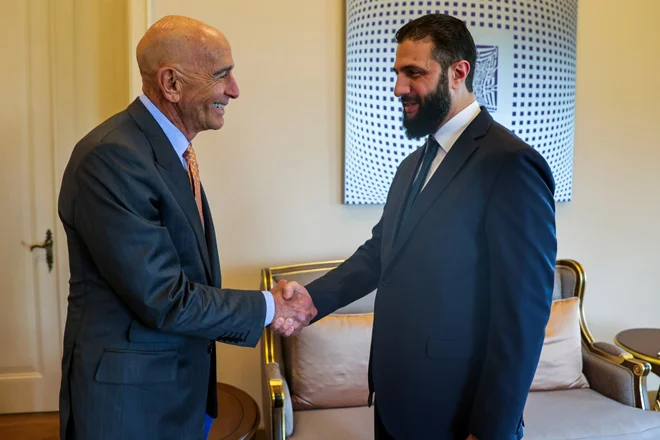
Amid escalating security tensions in southern Syria, the American website Axios revealed that the United States is prepared to mediate a tripartite meeting between senior officials from Syria and Israel, headed by US Special Envoy to Syria Tom Barrack, on Thursday, July 24, 2025.
This development comes in the wake of intensive Israeli airstrikes on Damascus and As-Suwayda, and internal clashes between local groups. This raises fundamental questions about the nature of the negotiations, their legitimacy, and their impact on Syria’s political future.
First, the historical background of the Syrian-Israeli negotiations:
Since the 1974 Disengagement Agreement, the Syrian regime has maintained a “no war, no peace” stance with Israel, with a rhetoric of formal resistance in exchange for a relatively stable border situation.
The 1990s also witnessed negotiation attempts, most notably the Madrid Conference (1991), but these failed due to the intransigence of both sides, particularly regarding the Golan Heights issue.
The Syrian regime, under both Hafez al-Assad and his son, used the relationship with Israel as a tool to consolidate its external legitimacy, in exchange for systematic internal repression, without any real progress toward a just settlement or the restoration of rights.
Second, the current political and security context:
According to Axios, the upcoming meeting aims to establish security arrangements in southern Syria and avoid crises similar to what occurred in Sweida last week, where Israel launched airstrikes on more than 160 targets in four governorates, killing three people and wounding 34 others.
Israel is demanding a “demilitarized zone” and a permanent presence along the 1974 ceasefire line, under the pretext of “protecting the Druze,” reflecting a desire to reengineer the security of southern Syria without a comprehensive political settlement.
On the other hand, Turkey is playing a mediating role and conducting consultations with Syria and Israel on issues involving the SDF, the Druze, and the Alawites, reflecting a convergence of regional interests rather than consensus.
Third, constitutional and legal issues:
There is currently no legitimate constitutional authority that determines who has the right to negotiate on behalf of Syria, making any understandings subject to legal and political challenge. The absence of a transitional negotiating framework that safeguards sovereign rights and prevents the use of negotiations as a tool to exclude the opposition or reproduce the secret security relations that characterized the Assad era.
Any negotiations must therefore be subject to the principle of balanced national representation and conducted within a temporary charter or transitional constitution that defines the objectives, limits, and ethical guidelines of the negotiations.
Fourth: Strategic Dimensions:
Negotiating in the shadow of ongoing Israeli airstrikes and the absence of a commitment to halt them threatens to transform southern Syria into an undeclared Israeli security zone. The continued exclusion of Syrian political forces from any agreements reproduces the logic of “regime security above citizen security” and weakens the chances of building a new social contract. Security agreements without legal guarantees or international oversight could be used to eliminate local opposition forces, as occurred in previous phases of the Syrian-Israeli relationship.
Conclusion:
The potential negotiating path between Syria and Israel, in the context of US mediation revealed by Axios sources on July 21, 2025, represents a highly sensitive test of the potential for generating new negotiating legitimacy outside the traditional authoritarian context that has governed Damascus’s relationship with Tel Aviv for decades. The nature of the anticipated security meeting in southern Syria and the official secrecy surrounding the parties represented reflect the persistence of structural problems within the Syrian political system, particularly those related to the absence of a constitutional-legitimate framework defining the boundaries of sovereignty, the conditions of representation, and the parameters of negotiation.
Accordingly, any security understandings concluded in the absence of a transitional constitution or a clear social contract pose a threat to the identity of the Syrian state and could lead to the reproduction of the security governance model that characterized the Assad era, where the relationship with Israel was a tool for reengineering the political interior, not for restoring national rights.
For all of the above, we, in the Political Bureau of the Syrian Future Movement, recommend the following:
- Establishing the principle of negotiating transparency: Any negotiation must take place within a public framework, be subject to national and international accountability, and be managed by a legitimate negotiating body.
- Constitutionally fortifying negotiations: Any transitional constitution must stipulate the conditions for negotiations with hostile states, preventing monopolization and protecting rights.
- Opening a new page based on rights: Negotiations must be a means to end the exploitation of the relationship with Israel against the Syrian interior, not a continuation of Assad’s policies.
- Involving national forces: Syrian national political forces must be represented without reservation in any understandings to ensure balance and prevent exclusion. We also recommend that Mr. Farouk al-Sharaa be a key part of this process.
- International Guarantees: Any security understandings must be accompanied by clear international guarantees that prevent violations and protect Syrian sovereignty. Building a legitimate negotiating framework, while also requiring a review of institutional formulas, also—and more importantly—requires a multi-level approach that includes constitutional reform, internal political balance, and international oversight to prevent southern Syria from becoming a unilateral security bargaining zone. While negotiations represent an opportunity to redefine sovereignty on rights-based and participatory grounds, their separation from the national constitutional context will prevent the achievement of these goals and keep the Syrian-Israeli relationship hostage to the logic of tyranny, which invests in hostility without resolution and in conflict without justice.