
A Conceptual Introduction: From Traditional Sovereignty to Participatory Legitimacy:
The Syrian state, like most post-independence Arab entities, inherited a model of sovereignty based on the center’s monopoly on political and administrative decision-making, while marginalizing the peripheries and suspending the concepts of social pluralism and balanced representation.
This model, founded on two pillars: sovereign prestige vis-à-vis the outside world and administrative control vis-à-vis the inside world, failed to accommodate shifting social and political dynamics, especially in moments of crisis that expose the fragility of the instruments of domination and re-raise the question of legitimacy.
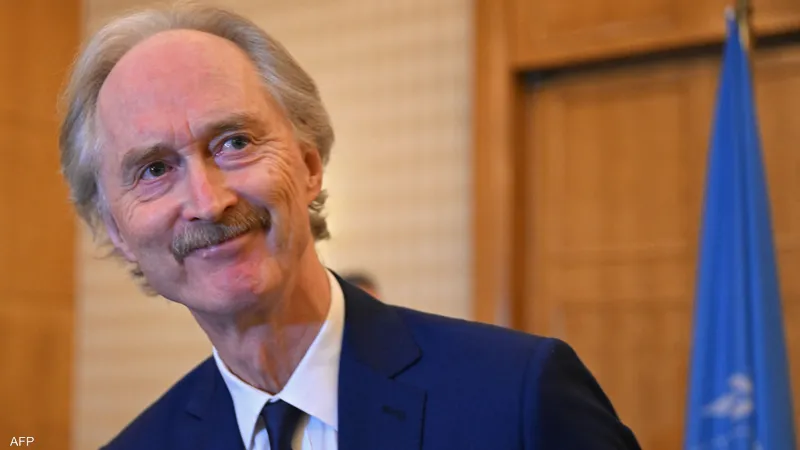
The statements of Geir Pedersen, the UN envoy to Syria, regarding the specificity of Sweida, and his explicit statement that “loyalty cannot be imposed by military force,” reflect a shift in official international discourse from recognizing formal sovereignty to demanding that the state rebuild its legitimacy from within.
This places the concept of sovereignty under a profound philosophical test, in that it is not merely territorial control but a moral-representative contract between the government and the citizens.
In the Syrian context, it becomes legitimate to ask questions such as:
- Is sovereignty the ability to impose decisions, or the legitimacy of representing the public will?
- Should the loyalty required of citizens be based on fear, or on trust and empowerment?
- Can security control be considered an indicator of the state’s unity, or its failure to produce political consensus? A political reading of the events in Sweida: The local reality differs from the central assumptions:
Since the outbreak of tensions in Sweida, and the central authority’s inability to secure a rational response, three characteristics of this local reality have emerged:
First, the unarmed, communal nature of the demands. Protest activities in Sweida were not based on a desire for secession, but rather on a rejection of marginalization and a search for more equitable political representation. These demands are closer to the logic of reform than rebellion.
Second, the local forces’ reluctance to engage in sectarian debates. Unlike other regions, Sweida has maintained a highly civil and communal tone, making ignoring it a threat not only to stability but also to the unity of the national narrative itself.
Third, the absence of authoritarian ambitions in contrast to the demand for empowerment. No groups have emerged in Sweida demanding independent authority, but rather focused on administrative decentralization, respect for rights, and participation in the management of public affairs.
These characteristics establish an undeniable distinction between Sweida and the coastal regions, as Pedersen points out. This requires the central authority to treat it not as an “out-of-control region,” but rather as a community demanding a new formulation of its relationship with the state.
A Philosophical Analysis of Political Loyalty: The State as a Social Contract or a Coercive Apparatus?
In political philosophy, loyalty is a concept that blurs the line between legitimate obedience and political affiliation. Thomas Hobbes believed that loyalty stems from the human need for security and justifies submission to the powerful “Leviathan.”
Rousseau, on the other hand, considered loyalty a direct result of a social contract based on the general will, not force.
From this perspective, Pedersen’s statement that “loyalty is not built by military force” restores consideration to the democratic model of authority, which is based on:
- True representation of citizens.
- Protecting rights and interests.
- Promoting trust and legal equality. This means that if the Syrian state wants to regain popular loyalty, it cannot rely solely on security tools. Rather, it must undergo a comprehensive redefinition of its functions:
- Is the state a servant of society? Or merely a guardian?
- Does it express its will? Or does it impose its will?
- Is citizens’ loyalty a reward for representing them? Or a tribute for their continued existence?
Political transition as a condition for stability… reengineering power and representation:
Pedersen’s assertion that “achieving security and stability is closely linked to a successful political transition” does not merely reflect an international position; it redraws the relationship between the state as an apparatus and society as an actor. In modern political theory, stability is viewed not as a result of force, but as the outcome of a relationship of historical satisfaction and understanding between the ruler and the ruled.
Political transition in the Syrian case does not simply mean replacing the elite or modifying the power structure; it requires rebuilding the political and constitutional system that regulates the relationship between the center and the periphery, between the individual and institutions, and between rights and duties.
Repeating the approach of “re-establishing sovereignty by force” may succeed in creating a truce, but it fails to produce sustainable stability, and has always remained:
- Institutions are subject to security will, not popular accountability.
- Political representation is based on affiliation, not competence or rights.
- The state treats citizens as subjects, not as partners in the establishment and construction. Hence, political transition becomes a cognitive and moral necessity before it becomes an international requirement. This alone ensures that Damascus’s response to the Sweida file is not merely a security maneuver, or a solution to Sheikh Hikmat al-Hajri’s stubbornness and stupidity, but rather a foundational step toward a new political contract that redefines the concepts of homeland and citizenship.
The diplomatic structure of Pedersen’s statements: From moral neutrality to formative mediation:
Pedersen’s statements represent a shift in the role of the UN envoy from a mere negotiating mediator to a political-moral actor who participates in shaping public perceptions of Syria’s future. His speech did not simply re-characterize events, but also presented philosophical concepts about sovereignty, legitimacy, and loyalty, placing him in an exceptional position among UN mediators in contemporary conflicts.
This transformation is based on four central implications:
- Transcending the concept of “cold neutrality” to a value-based neutrality that condemns violations and advocates for participation.
- Linking the field solution to the constitutional vision strengthens the weight of the political process as an inevitable outcome, not a negotiated option.
- Recognizing the specificities of local communities without threatening the unity of the state, which emulates the logic of participatory federalism, not separatism. Undermining the official narrative, which may view any opposition as a threat and exploits the state of displacement to generalize it to all genuine national opposition voices. Rehabilitating dialogue as a foundational, not tactical, space.
- This type of mediation, if developed, could contribute to the engineering of a new constitution built on a local understanding of legitimacy, rather than on superficial, copied assumptions. It could also serve as a moral guarantee for the balance between political and social components.
Sweida’s Position in the National Equation: Between Social Particularity and Constitutional Entitlement:
Sweida represents a microcosm of the relationship between identity and citizenship, and authority and society.
Through what has happened there, three pillars have emerged, making its position pivotal in any national reform process:
First, the moral strength of the protest. Sweida has been able to maintain a peaceful protest with clear demands, without slipping into militarism or sectarianism, which has earned it lofty civic and moral legitimacy, of course, before the Hijri coup.
Second, the complex social structure. The existence of a cohesive societal structure, based on collective awareness and a historical legacy of abstaining from violence, renders any security response toward Sweida out of context if the escalation and tribal mobilization end.
Third, its geopolitical location. Sweida lies between the south and the coast, thus representing a delicate balance point that could transform into an experimental space for local democracy, or a gateway to the collapse of national trust.
The Problem of International Protection and the Link to Equal Sovereignty: In response to calls by some local leaders for international protection, Pedersen considered this option “unrealistic.” This position, while seemingly conservative, carries a dual message:
The first: rejecting the transformation of Syria into a state of international trusteeship administered from abroad.
- The second: an implicit call for the central authority to take the initiative to protect its citizens and establish security and civil systems that protect life and guarantee dignity. However, in the philosophical analysis of sovereignty, protection is not measured solely by preventing external interference, but rather by the state’s ability to effectively guarantee the security and rights of its citizens without resorting to third parties.
- If this fails, the idea of international protection becomes a consequence, not a choice.
Here, the question that worries all state theorists arises: Is a state that demands non-intervention, lacks the tools for protection, and does not allow for partnership still qualified to monopolize sovereignty? Or must sovereignty be transformed into a distributed and balanced process that accommodates local demands within national unity?
Strategic conclusions and recommendations for the path to constitutional and institutional recovery:
In light of the above analysis, the Syrian Future Movement arrives at a set of practical conclusions and recommendations aimed at transforming Pedersen’s statements into a political and constitutional lever for rebuilding the Syrian state on new foundations:
First: The necessity of opening a direct negotiation process between Damascus and representatives of Sweida, sponsored by international or neutral parties, based on recognition of local representation rather than authoritarian denial. Negotiation should remain open to prevent any future repetition of the Sheikh al-Hijri experience.
Second: Incorporating the principle of “local empowerment within national sovereignty” into the new draft constitution as a compromise formula that guarantees the unity of the state without suppressing the specificities of communities. The issue is not limited to Sweida alone, but may extend deeper into northeastern Syria.
Third: Redefining the concept of national loyalty as a result of representative justice and effective services, not terror or security doctrine.
Fourth: Pushing for the establishment of a national council for community dialogue that includes representatives from all governorates and is concerned with formulating strategies for power distribution and administrative decentralization. Fifth: Questioning official performance in dealing with Sweida, exposing all violations that occurred, and holding those responsible accountable as part of restoring confidence in state institutions.
Sixth: Rejecting the reduction of sovereignty to the military concept, and calling for a multidimensional approach encompassing legal, economic, humanitarian, and cultural sovereignty.
conclusion:
Geir Pedersen’s statements in Sweida were not merely a diplomatic description of the event. They constituted an unofficial declaration of the expiration of the coercive sovereign model and the beginning of a new international-national vision that redefines power as a tool for representation, not coercion.
If we seize this moment wisely, Sweida could transform from a security landscape into a “constitutional platform” for rebuilding the relationship between state and society, based on partnership, justice, and dignity.
The Syrian Future Movement, observing this transformation responsibly, renews its call to all political and social forces to reconsider the concept of power and representation and to initiate a new discourse befitting an exhausted Syria—a discourse that does not imprison it in the past, but rather liberates its future from fear and monopoly, and writes the first pages of the new Syrian decade.
Jumaa Muhammad Lahib
Scientific Office
Political Office
Articles