
Analytical Introduction:
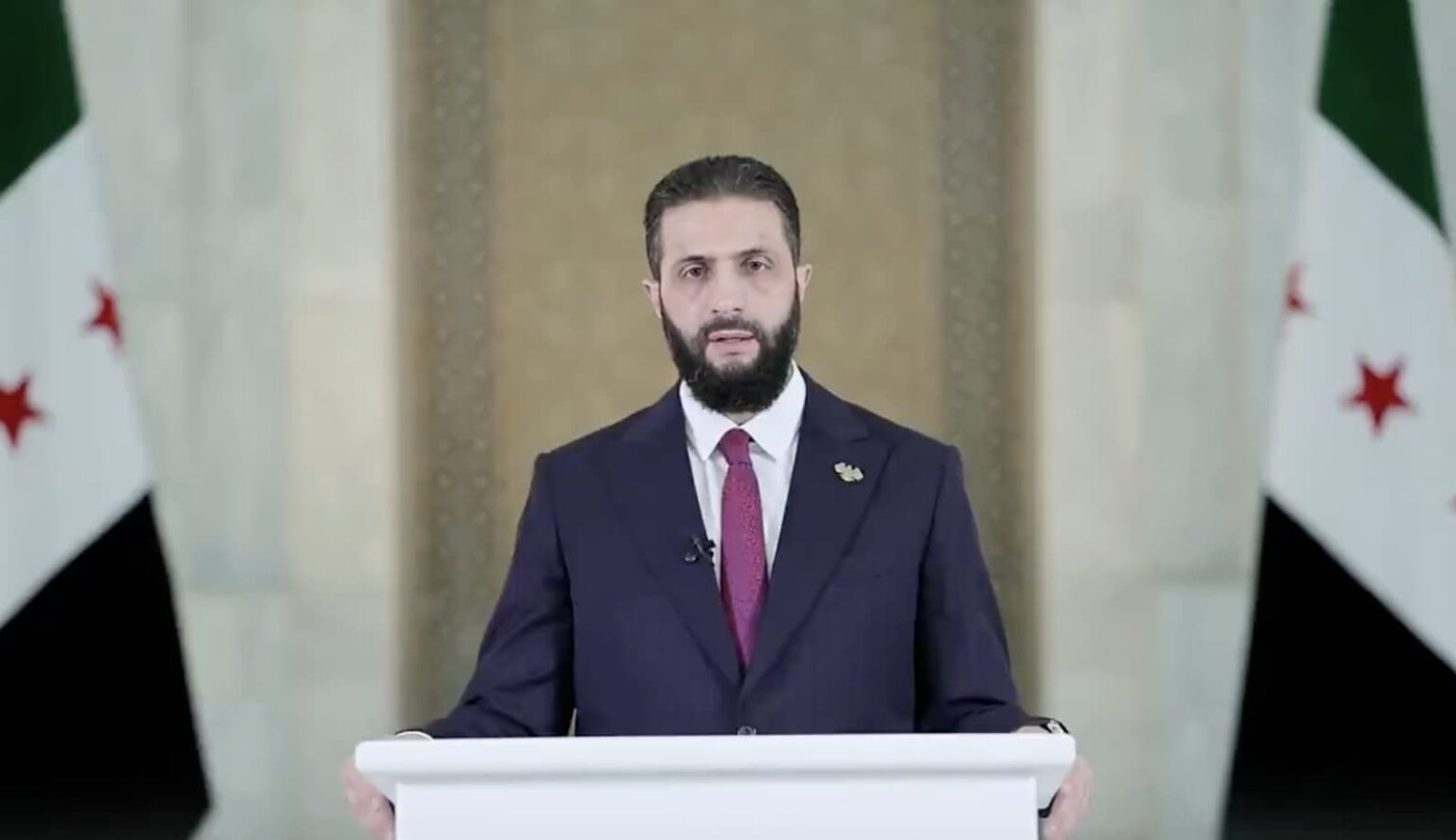
Amid escalating events in As-Suwayda Governorate, Syrian President Ahmad al-Sharaa delivered a speech, his second in 48 hours. This speech is considered one of the most prominent official interventions following the recent ceasefire agreement. The speech, issued on July 19, 2025, conveyed multi-layered messages, touching on the national structure, addressing social diversity, and openness to international mediation, at a time when the relationship between the state, society, and international actors is being reshaped.
This article seeks to analyze the structure of the speech and its main content, relying on its official text and using an approach that balances the elements of strength and weakness, without bias toward a pro- or anti-political assessment.
General Features of the Speech:
The President’s speech came at a sensitive political moment, which he himself described as a dangerous turning point. The clashes were close to spiraling out of control, had the Syrian state not intervened to calm the situation. The speech was divided into main themes: rejecting secession, neutralizing sects from collective accusations, calling on tribes to calm down, thanking the international community, and affirming the state’s commitment to national unity and justice.
Positives of the speech:
- Balanced and professional language, as the speech maintained a consistent tone that avoided escalation or threats, reflecting a desire to contain the crisis with rational discourse.
- Taking into account the societal composition, the president clearly distinguished between the Druze sect and the armed groups within it:
“The entire sect cannot be held accountable for the actions of a small group.” This constitutes an intentional deconstruction of the equation of collective accusations and an effort to contain sectarian tensions. - The emphasis on social ties between local communities and the call to strengthen relations between the Druze and Bedouin demonstrates a focus on internal reconciliation, rather than purely security-based approaches.
- The president’s multilateral diplomatic openness, with his thanks to the efforts of the United States, Turkey, Russia, China, and sister Arab states, reflects a desire to overcome polarization and present Syria as a platform for cooperation rather than an arena for conflict.
Weaknesses and shortcomings:
- Lack of a clear implementation plan. Despite the announcement of a ceasefire, the speech did not propose a practical mechanism to ensure implementation or address violations, leaving the agreement vulnerable to fragility on the ground.
- Lack of recognition of the legitimacy of local parties in Sweida. The speech did not mention the spiritual sheikhdom or local factions, despite their being influential actors on the ground. This reflects the persistence of the state’s traditional centralized view of the diversity of authorities.
- A reductionist analysis of the crisis, considering the events the result of “separatist ambitions of a narrow group,” ignores deeper factors related to governance, representation, and the cumulative societal tension in Sweida.
- Lack of reference to internal dialogue or political reform. The speech does not include a genuine call to engage the local community in a political-constitutional process, which reduces the chances of radically addressing the crisis.
President Ahmad al-Sharaa’s speech can be considered an important step toward domestic and regional political normalization, particularly through openness to multilateral mediation and the adoption of conciliatory language that takes into account the specificities of Sweida.
However, the speech lacks a local participatory dimension and does not offer a clear path for rebuilding trust between the state and the communities of southern Syria.
The success of the ceasefire agreement, as stated in parallel statements by US envoy Tom Barak, requires more than international understanding; it also requires internal political engineering that restores sectarian representation in national decision-making and leads to sustainable reconciliation beyond temporary appeasement.
Dr. Zaher Baadarani