Introduction:
Since the outbreak of the Syrian revolution in 2011, the country has witnessed profound political and social transformations. The most prominent results have been the erosion of the state as a central concept and the dispersion of its sovereign functions across a number of regions, resulting in a fragmented administrative reality and a society burdened by divisions.
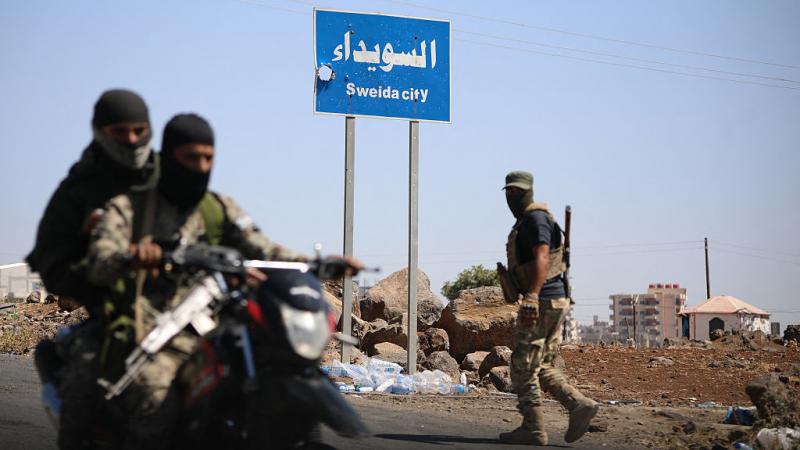
Nevertheless, recent events on the ground, particularly in As-Suwayda Governorate, raise the central question: Can the crisis be transformed into a moment of national revitalization? Can the state be re-established, not as an instrument of authority, but rather as a sovereign framework that encompasses all Syrians?
On July 29, 2025, the Syrian Ministry of Foreign Affairs issued an official statement calling on international organizations and the United Nations for urgent humanitarian intervention in As-Suwayda Governorate to address the growing needs in food security, health, education, water, and psychosocial support. This coincided with the entry of a fourth aid convoy of 22 trucks through the Busra al-Sham crossing. This development is not just a relief event, but a political turning point that must be carefully considered as part of a larger shift in the perception and function of the state.
First, the crisis reflects the erosion of trust in the central function of the state:
What has happened in Sweida over the past weeks highlights a structural flaw in the relationship between the state we are all working to build and its citizens in the peripheries!
With every crisis, a state of administrative isolation, a lack of coordination, and a decline in institutional responsiveness emerges, leading citizens to view the central state as absent or hesitant.
The government’s call for urgent humanitarian intervention, despite its delay, reaffirms the recognition that the state cannot be governed by a logic of denial or separation, but rather by a logic of full national responsibility.
Second, the state as a decentralized, inclusive, sovereign concept:
The issue in Sweida is not just the Syrian government’s restoration of control over security and administration, but rather the restructuring of the state as a flexible sovereign entity that encompasses all its components.
In this context, the Syrian Future Movement believes that consolidating the state as a unifying center must be based on the following principles:
- Fair political representation of components and regions within national institutions.
- Cooperative decentralization, proposed by the movement as an alternative to political and administrative centralization and decentralization, grants governorates real executive power.
- Permanent community oversight of security and administrative institutions to ensure integrity.
- Integrating local forces into a single security institution that reports to the state, not regions or agendas.
Third, the humanitarian dimension as a gateway to political reengineering:
When the state issues an urgent appeal to international organizations, it indirectly acknowledges its complete inability to meet basic needs, reopening the debate about reengineering sovereign functions.
This should not be understood as a weakness, but rather as an opportunity to rebuild on more rational and participatory foundations.
The Syrian Future Movement’s recommendations in this regard include:
- Forming a national body to manage the humanitarian response, linked to the prime minister, and including representatives from the local community.
- Establish coordination centers in the governorates to unify relief and public services under the state’s umbrella.
- Issuing the “National Social Responsibility” law obligates economic actors to support relief efforts under the supervision of legitimate institutions.
Fourth, there is no stability without a new social contract:
The recent events in Sweida remind us that the absence of justice and political representation is a constant driver of tension. Building a new Syria must begin with a modern social contract based on:
- Distributive justice of resources and services.
- Freedom of political organization within the state, not against it.
- Recognition of partial identities within the framework of a comprehensive national identity.
- Promoting competence in public office, regardless of political or regional affiliation.
Fifth, the state as an actor in managing pluralism, not negating it:
It is a mistake to imagine the future Syrian state as a unified framework in the coercive sense. Rather, it must be a flexible framework that embraces and regulates pluralism.
Here comes the role of legislative, media, and cultural institutions in managing diversity, not eradicating it.
Here, we can suggest:
- A national forum for cultural dialogue among components.
- Launching a national strategy for balanced media representation of different regions.
- Developing national education curricula to include multiple narratives about Syrian identity.
Sixth: Policy recommendations for decision-making centers and research centers:
At the end of this paper, the Syrian Future Movement presents a set of practical recommendations that can be adopted by official bodies and national research centers. We, in the Research and Studies Department of the Scientific Office of the Syrian Future Movement, are open to cooperation on these recommendations:
- Conducting a comprehensive national study on central administration gaps in marginalized governorates.
- Launching a training program for local administrative cadres on coordination skills with central institutions.
- Calling for a national forum entitled “The Inclusive Syrian State: From Crisis to Reconstruction.”
- Creating an electronic national services map that illustrates the developmental reality in each governorate, which can be used to identify investment priorities.
- Preparing a vision for integrating local security forces into a single institution subject to independent civilian oversight.
- Launching a comprehensive national media campaign.
Conclusion:
The state is founded in the center, and its legitimacy is built on everyone:
The shift from a logic of control to a logic of patronage is the first step toward a modern, inclusive, and just Syrian state.
What happened in Sweida should not be merely a passing humanitarian event, but rather the beginning of a new political foundation, in which the state becomes a legitimate center around which Syrians rally, not with which they intersect.
The state is not a privilege, but an existential necessity, and any delay in establishing it as a comprehensive, sovereign center is a continuation of the state of division.