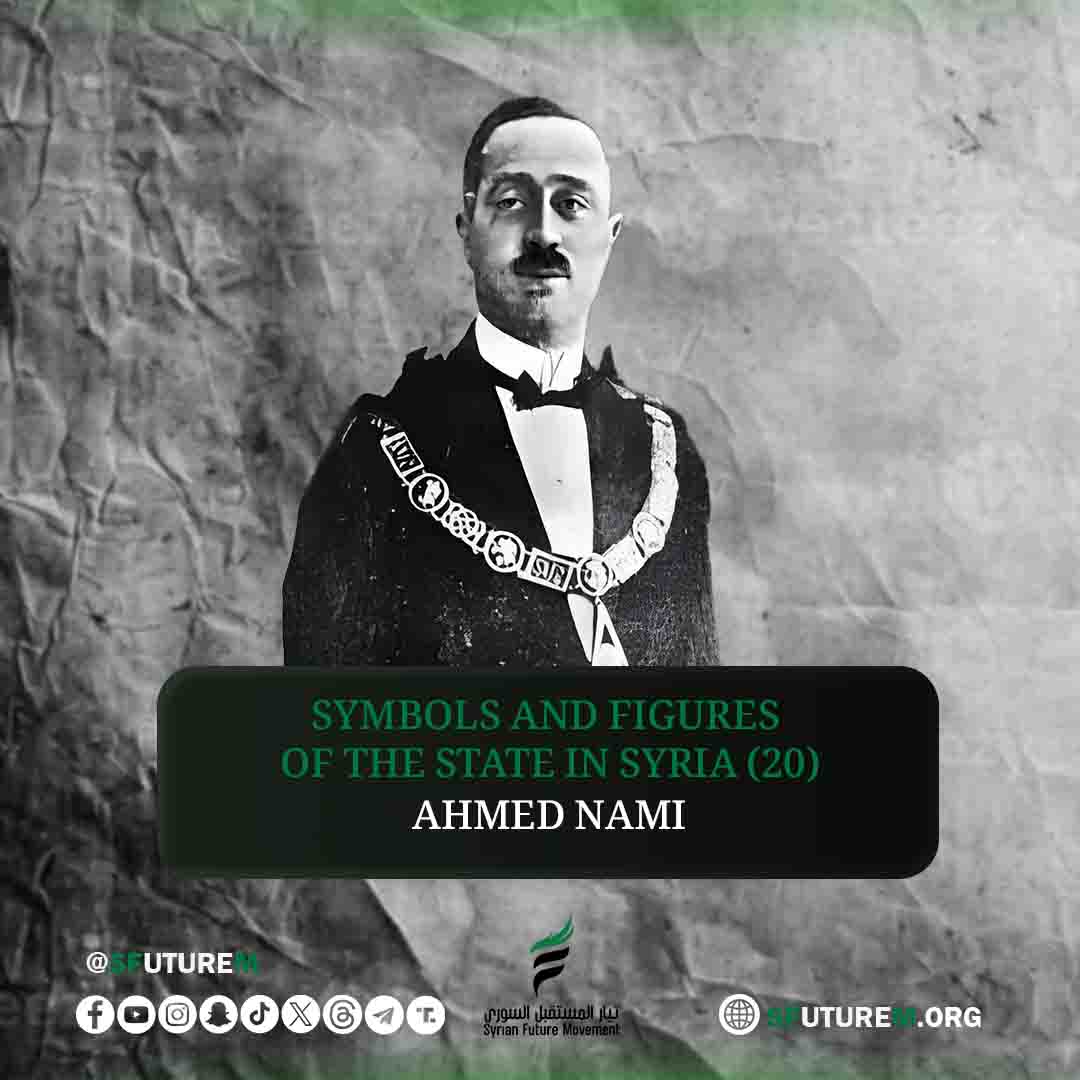
- Ahmad Nami is of Circassian descent from the Caucasian Shabsog tribe that settled in Syria in the late 18th century.
- His father, Fakhri Bey, served as mayor of Beirut and was one of its prominent presidents. He was known for his architectural works such as opening roads, constructing buildings, and creating gardens, including Hamidiya Park, Burj Square, and Khan Fakhri Bey.
- He was born in Beirut in 1873 and was educated by private tutors.
- His father sent him to Istanbul, where he enrolled in the military academy, entered the staff officer corps for a short time, and then abandoned it in favor of administrative work.
- He was employed at the Ottoman Debt Management Office.
- He was then appointed secretary of the Beirut Province.
- He was then appointed Secretary General of Izmir Province during his friend Kamil Pasha’s tenure as Grand Vizier.
- He married Aisha Sultan, daughter of Sultan Abdul Hamid II, and was nicknamed “Damad,” meaning son-in-law.
- At the outbreak of World War I, he moved out of the country and took up residence in Switzerland.
- After the end of the war, he moved to France and settled in Paris, where he developed a close relationship with its politicians.
- A number of his children settled there permanently, and his favoritism toward France’s policies in the region was the cornerstone of his appointment as head of the Syrian state.
- He was famous for being a Freemason and the head of the Masonic lodges in Syria and Lebanon, supported by the French Grand Orient Lodge and the Egyptian Lodge, which he headed from 1923 to 1930.
- In addition to his Masonic activities, he founded a political party called the Islamic Democratic Party.
- After the resignation of Subhi Barakat, the first president of Syria, and the appointment of General Andrea as military governor of the Damascus and Druze Mountain regions, General Andrea offered Ata al-Ayoubi to form the government, but he declined the presidency, then on February 9, General François-Pierre Alib was appointed as the French delegate to the State of Syria and the State of Druze Mountain.
- François Alib spent most of his time pursuing the rebels in the Ghouta of Damascus, Homs, and Sweida, and after consultations, on April 30, 1926, it was decided to appoint Nami.
- He was summoned from Beirut to Damascus, from where he announced the formation of the government on May 2, 1926, at the age of forty-eight.
- According to Yusuf al-Hakim, the news was received “with joy, relief and great hopes for the future, because of Damad’s fame and flawless past.”
- He formed his first cabinet of six ministers, headed by the same head of state as the rest of the Syrian government at the time.
- He agreed with de Jouvenel that the government would be a 50-50 split between moderates and nationalists within the framework of cooperation between all components of the people to put down the Great Syrian Revolution.
- Saadallah al-Jabri and Husni al-Barazi were among the nationalist leaders who participated in the consultations to form the government, as were moderates Shaker al-Shaabani and Saadallah al-Jabri.
- He was able to put together a cabinet that included three ministers who supported Abdel Rahman al-Shahbandar’s party and thus the country’s largest popular force.
- During the government’s first meeting, the council, under his chairmanship, adopted a ten-point program. The program, which was agreed upon with de Jouvenel, included calling for the election of a constituent assembly to draft a constitution for the country, converting the mandate into a thirty-year treaty between Syria and France, as was the case between Britain and Iraq, achieving the unity of the Syrian country, creating a national army, annexing Syria to the League of Nations and giving it foreign political representation, reforming the monetary system and unifying the judicial system, including giving up exceptional and mixed courts, issuing a general pardon for the revolutionaries and compensating the victims of the revolutionary uprising.
- Following the first meeting, he addressed the people on Radio Damascus, announcing these ten points.
- General Bijan was dismissed for his involvement in the torture and killing of dozens of Syrians during the suppression of the Syrian revolution. General Jouvenel agreed to this, but Bijan was not prosecuted and was transferred to Africa.
- He ordered the release of all those who had been detained without an official warrant issued by the Syrian judiciary, and these measures had an impact on his growing popularity and public confidence in him.
- He wanted to issue a general amnesty, but the French commissioner refused, saying that the French authority would not accept a general amnesty issued under “revolutionary pressure.” However, in fulfillment of his promise to the people, he issued a decree abolishing the exceptional courts formed during the revolution, provided that the ordinary courts would hear the cases before them.
- On August 1, 1926, he began a tour of the Syrian interior, the first for a Syrian ruler in the country except for Faisal I’s brief visit to Aleppo and Homs in June 1919.
- He traveled to Beirut, where he met Jouvenel, and from there he traveled by sea to Iskenderun.
- According to Yusuf al-Hakim, who was minister of justice at the time and accompanied Nami on his tour, “the celebrations held in Iskenderun and Antakya in honor of the head of state were magnificent.” Arabs, Turks, Armenians, and Kurds, the four components of the brigade, participated equally, gathering on the roads through which the motorcade passed and chanting for the life of the head of state.
- He stayed in Iskenderun for two days and gave a speech in which he emphasized the unity of the Syrian country and his desire to draw up a new constitution for the country based on broad decentralization and granting all components their full rights, and stressed that France does not want to confiscate the freedom of peoples.
- He moved on to Antioch, where he stayed for two days, and from there he headed to Aleppo, where “the celebrations exceeded what he met in Iskenderun.” President Nami rode in an open car with the French High Commissioner in Aleppo next to him, and greeted the crowds gathered in the streets of the city, then to Hama and Homs, before returning to Damascus.
- Shortly after Nami returned to Damascus from Homs, its governor, Fawzi al-Maliki, was assassinated for siding with the mandate, as the revolution had not yet ended, and as a result of the investigation, it was discovered that the assassin was a revolutionary from Homs Ghouta named Khairu Abu Shahla.
- Abu Shahla was sentenced to death and a blood money of three thousand Ottoman gold liras was imposed on the people of Homs, to be paid to the governor’s heirs.
- The Council of Ministers decided to task Justice Minister Yousef al-Hakim and Finance Minister Shaker al-Shaabani with traveling to Iskenderun to discuss the issue of reconnecting the brigade to Syria, which was then an independent state directly governed by a French military governor.
- The presidential delegation traveled to Aleppo and from there to Iskenderun, where several topics were discussed, including maintaining financial and administrative independence according to the principle of administrative decentralization, as well as granting full rights to the various components of the brigade, including Arabs, Turks, Armenians and Kurds, and agreeing to maintain Iskenderun as the capital of the brigade.
- Arabs and Armenians greeted the news of the recovery of the brigade, which was historically an annex of Aleppo province, with only a few Turks objecting, despite being a minority within the brigade itself.
- On the second day, the representative council of Iskenderun, the state’s parliament, met and officially approved the joining of the Syrian state. Ibrahim al-Adham, the governor of the brigade, and the mayor of Iskenderun, General Philippi, also endorsed it at the same ceremony, thus returning the Iskenderun Brigade as part of the Syrian state.
- France separated the brigade in 1932 and made it an independent state, then agreed to annex it to Turkey despite the fact that the majority of its population is Arab in 1939 as a consolation prize for neutralizing Turkey in World War II, and thus Syria lost one of the most important achievements of the Ahmad Nami era.
- The project offered to restore the Alawite mountain state to Syria, in exchange for maintaining the country’s administrative and financial independence, and for the Alawites to receive full rights, since they were deprived of most of these rights during the Ottoman era.
- Less than a month after the formation of the government, and before the delegation returned from Iskenderun, the French military authority arrested three ministers in the government who were affiliated with the nationalist line: Hosni al-Barazi, Minister of Interior, Fares al-Khoury, Minister of Education, and Lotfi al-Haffar, Minister of Public Works. The French authority did not justify the reason for the arrest and no statement was issued by the presidential house, which resulted in great popular discontent, especially in Hama and Homs.
- President Nami informed General François-Pierre Alib, the military governor in Syria, of his intention to resign unless the ministers were released. He justified the decision by explaining that the country was under martial law as a result of the Great Syrian Revolution, and then accepted the ministers’ exile to Hasakah in northern Syria.
- Relations between the president and General Alib, who sent the decrees for a second cabinet headed by Nami for signature, became very bad, and the president accepted under pressure, thus forming the second cabinet “entirely of moderate faces.”
- The president wanted to ease the atmosphere by issuing a general amnesty, but de Jouvenel said that the amnesty would not be issued unless the revolutionaries cease hostilities. On this occasion, President Nami made a speech to the people calling on the revolutionaries to cease hostilities against France within four days to issue an amnesty that would pave the way for lifting the state of emergency and declaring Syrian unity and independence as agreed upon with the High Commissioner.
- The president sought to soften the banishment of the ministers and interceded with the French to relocate them from Hasakah to Mount Lebanon, which was done.
- While he was in Aleppo, Interior Minister Waiq al-Azm was plotting with the French to oust him in exchange for al-Azm’s own appointment as head of state. He collected signatures from notables and senior Damascus officials calling for Nami’s dismissal and demanding al-Azm as president, in preparation for submitting them to the French High Commission in Beirut.
- Minister al-Azm based his claim on the fact that Nami was a Circassian, while most Syrians are Arabs, and was born in Beirut. However, the invitation was not supported by senior civil servants, the French were not enthusiastic about it, and the president did not know about it at the time.
- He left Aleppo for Beirut via Homs to meet with General Quattro since de Jouvenel was in France. Nami gave the French a choice between Alib’s transfer or his own resignation, and in the meantime al-Azm agreed with three other ministers-four out of six-to boycott the president. However, two of the ministers reneged on the plan, and relations between the palace and the Interior Ministry remained suspended.
- The government imploded just four months after it was formed.
- After de Jouvenel’s resignation and the appointment of Henri Ponceau as the new French High Commissioner, Ponceau asked the president on October 12, 1926, to form his third government, giving him a free hand in forming it.
- After returning from Beirut, he began consulting with political parties to form his third government.
- He decided to separate the duties of head of state and prime minister, entrusting a figure to head the ministry while retaining the presidency to ease the pressure on him.
- However, al-Hakim, a Christian from Latakia, declined to accept the assignment for personal and family reasons. The president suggested that he appoint Atta al-Ayoubi as prime minister, but al-Ayoubi declined, citing his deteriorating health condition. Finally, he appointed Hashim al-Atassi, head of the National Bloc, but he declined, saying that accepting the position would lead to divisions within the bloc’s ranks. As a result, the president decided to head the government himself.
- Only ministers al-Hakim and al-Hanbali retained their portfolios from the seventh government, and the decrees forming the government were issued from Damad’s private palace in Beirut after his discussions with Henry Bonsu at the High Commission’s headquarters in the East.
- He wanted to accelerate work on holding elections for a constituent assembly to draw up a constitution, but Bonsu refused, fearing that the National Bloc would win the elections, and asked for three months to discuss the matter, after which the issue was never raised again.
- He tried to convince Bonsu to end François Alib’s mission in Syria, who was recalled to France shortly after the formation of the third government.
- He worked to re-raise the issue of annexing Latakia but failed.
- He threatened to resign in January 1928, after the third government lasted for more than a year, and most of the major files were frozen, when he explicitly asked to call for elections for a constituent assembly and issue a general amnesty in accordance with the agreement with de Jouvenel in 1926.
- France did not implement his demands for general elections, due to the opposition headed by Sheikh al-Taj and the constant opposition by the Al-Azm since the formation of the third government.
- On February 2, the government met in Damascus without its president, who was in Beirut after the death of his mother, and decided on a mass resignation of all ministers in response to France’s procrastination and support for the president’s opponents on the one hand.
- At his request, the decision was not published.
- On February 10, negotiations between France, Hanano, and Atassi, representatives of the National Bloc, were declared a failure because Ponceau refused to call for the election of a constituent assembly and thus proceed with the unification of Syria, in response to which Damascus and Aleppo witnessed mass demonstrations denouncing the mandate.
- He added his resignation to that of the ministers and submitted it to the High Commission, which accepted it and appointed Sheikh Taj al-Din al-Hasani as president on February 14, 1928.
- Between 1926 and the enactment of a constitution and the election of a president in 1932, there was talk in Syria about the possibility of declaring a constitutional monarchy. The candidates varied between the return of Faisal I of Iraq, combining the two crowns, or entrusting the deposed Khedive of Egypt Abbas Helmi II with the affairs of the crown, or Sharif Ali Haidar, a descendant of Sharif Hussein or a relative of King Abdullah I of Jordan, as well as Shukri Al-Qutli was inclined to assign the proposed crown to one of the sons of Abdulaziz bin Abdulrahman Al Saud, and Damad was circulated as one possible name, according to Syrian politicians and journalists.
- In December 1931, he became a member of the Syrian Consultative Council as a former head of state, but the council was dissolved after its first session.
- He refused to run when parliamentary elections were organized in 1932 despite pressure, preferring to distance himself from the division between “moderates” and “nationalists” during that period, and supported Muhammad Ali al-Abid, who would go on to become president of the republic.
- During World War II, after Syria was liberated from the Vichy government, General Dantz summoned President Nami and asked him to head the Syrian state in January 1941, and Nami accepted the position.
- During the Damascus political media, Khalid al-Azm led a strong opposition to the decision, arguing that Damad had spent most of his time in Beirut since his resignation in 1928.
- Al-Azm was supported by a number of men from the National Bloc, and Free France at the time did not want to spoil the relationship with the National Bloc during the war, so it apologized for Damad’s assignment and appointed Khalid Al-Azm to the post on April 3, 1941.
- From his resignation until his death in 1963, he did not engage in any political activity in Syria.
- When he died, he was buried in the family cemetery in Beirut, where he was the only ethnic Circassian to rule Syria.
We at Syrian Future Movement, as we recall the memory of the founding statesmen of Syria, we recall one of Syria’s influential men, and one of the symbols of the flags of the first Syrian state that contributed to influencing its structure, Damad “Ahmad Nami” within a sequential file that we present to you to include the symbols and flags of the Syrian state, in our desire to link our contemporary present to a solid past and historical stations, in the hope of reviving in our people the need to build and create statesmen par excellence. We hope to revive in our people the need to build and create excellent statesmen, learn from their experiences, overcome their negatives, build on their history, preserve the homeland, safeguard the gains, and restore the Syrian state to its glory after years of injustice, tyranny, and corruption.