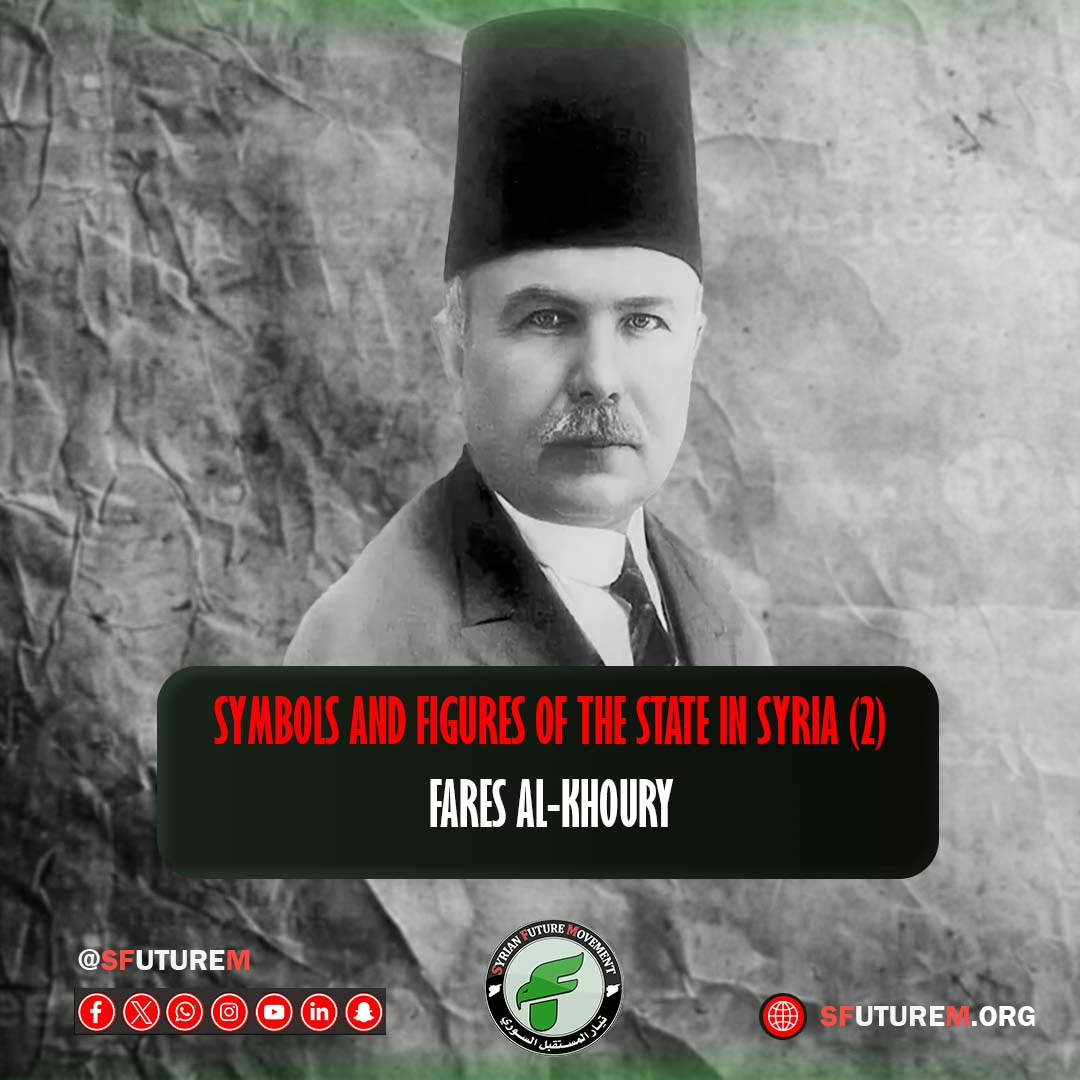
Symbols and Flags of the State in Syria (2) Fares al-Khoury
- Fares Al-Khoury was born in the village of Kafir at the foot of Mount Hermon, and studied in its schools, then at the American School in Sidon, where he graduated in 1890.
His paternal grandfather converted to Protestantism as a religion, rather than Christian orthodoxy.
- After graduating from school in Saida, he worked as a teacher in Majdal Shams and then in Batroun before attending the American University of Beirut, where he majored in mathematics.
- The university’s founder, the American monk Daniel Bliss, asked him to teach there for two years after his graduation.
- In 1899, Fares al-Khoury went to Damascus to work as the director of the Asiyah School of the Greek Orthodox Patriarchate of Antioch and All the East, and as a teacher at the Maktab Anbar High School, in addition to working as a translator at the British Consulate.
- In 1908, he studied law on his own, without affiliation to any university or institute, and opened a law office with lawyer Amin Zeidan, the brother of the writer Jurji Zeidan.
- Fares al-Khoury became an international authority on international law, and was one of the founding fathers of the Faculty of Law at Damascus University, where he taught from 1919 to 1940.
- He became dean of the Faculty of Law at Damascus University.
- Fares Al-Khoury was elected a member of the Damascus municipality in 1910, and four years later he ran for the Envoy Council in Istanbul, where he won the Christian seat representing Damascus, to enter the Ottoman legislature with a number of Arab notables, such as Muhammad Fawzi Pasha Al-Azm and Abdul Rahman Pasha Al-Yousef.
- In 1915, he became a member of the General Budget Committee of the Envoys Council, but clashed with Jamal Pasha, the military governor of Syria during World War I, because of his pan-Arabism and libertarian ideas.
- He was close to the Young Arab Society, which was established in Paris to advance the Arab nation, and a supporter of the Great Arab Revolt that was launched from Hijaz in 1916, led by the Emir of Mecca, Sharif Hussein bin Ali.
- Jamal Pasha interrogated him and imprisoned him along with the leaders of the Girl’s Association, including Shukri Pasha al-Ayoubi, Dr. Ahmed Qadri, and Shukri al-Qutli. He was then placed under house arrest in Istanbul, only to return to Damascus a few days before the fall of Ottoman rule at the end of World War I in 1918.
- On the eve of the withdrawal of the Ottoman army on September 26, 1918, Fares Al-Khoury was chosen as part of a transitional governing council formed in Damascus on the eve of the withdrawal of the Ottoman army, led by Prince Muhammad Said Al-Jazairi, grandson of the mujahideen Prince Abdelkader Al-Jazairi.
- Fares al-Khoury addressed the crowd from the balcony of the Government House, on behalf of Emir Mohammed Said al-Jazairy, announcing the country’s liberation from Turkish Ataturkist rule.
- The provisional government lasted only a few days and was dissolved as soon as the Allied armies entered the Syrian capital, arguing that the president, Prince Abdelkader al-Jazairy, was not authorized to govern the city, nor was he mandated by Sharif Hussein bin Ali or any of his British and Arab advisors.
- Fares Al-Khoury pledged allegiance to Prince Faisal bin Al-Hussein as the Arab ruler of Syria, and participated in his coronation ceremony on March 8, 1920.
- The next day, he was named minister of finance in the government of Lieutenant General Ali Rida Pasha al-Rikabi and a member of the Shura Council.
- King Faisal commissioned him to Arabize the curricula of the Faculty of Law, after his appointment as a professor in its faculty, and to establish the Arabic Language Academy in Damascus with Muhammad Kurd Ali in 1919.
- Fares al-Khoury succeeded in establishing a complete budget for the nascent Syrian state emerging from the war, along with a modern tax system. He also established the golden Syrian dinar, which was not in circulation due to the fall of the Faisalite era at the hands of the French army after the Battle of Maysaloun on July 24, 1920.
- Faisal I’s last decision before leaving Damascus was to form a new government headed by Alaeddin al-Droubi, in which Fares al-Khoury was again named finance minister.
- French High Commissioner Henri Gouraud entered Damascus as an occupier about two weeks after Faisal’s departure, and held an introductory ceremony for Syrian officials, which was attended by al-Khoury and his cabinet colleagues.
- Al-Droubi’s government resigned after the murder of its president on August 21, 1920, and Fares Al-Khoury preferred not to participate in the government that followed, to return to his work at the Faculty of Law and to the presidency of the Bar Association, which he assumed in the same year.
- He founded the Ain al-Fijeh project with his friend in the national movement, Lotfi al-Haffar. They presented the idea to the Damascus Chamber of Commerce, which immediately adopted it, and a national joint stock company was established, the first of its kind between the public and private sectors.
- He was one of the founders of the first political party under the Mandate, called the People’s Party.
- Fares al-Khoury co-wrote the objectives of the party, which included a number of national figures in its front ranks, such as lawyer Fawzi al-Ghazi, Lutfi al-Haffar, and Jamil Mardam Bey. Al-Shahbandar was elected president of the party and Fares al-Khoury was elected vice president.
- After the dissolution of the party, Fares al-Khoury was arrested on August 26, 1925, on charges of working with the Damascus Ghouta revolutionaries.
- He was transferred to the island of Arwad, where he remained a prisoner for 76 days before being released.
- On April 26, 1926, he was chosen to be the Minister of Knowledge in the government of Damad Ahmad Nami. Al-Khoury and his comrades agreed to participate on the condition that France stop its military campaign in Ghouta Damascus, issue a general amnesty for all detainees and deportees for political reasons, restore representative life to the country, with a new constitution and a promise that Syria would join the League of Nations.
- France arrested the three nationalist ministers, including al-Khoury, on charges of secretly collaborating with the leaders of the revolution, and ordered their exile to the city of Hasakah and then to Lebanon, where they remained under house arrest until 1928.
- Upon his release from detention, Fares Al-Khoury joined the ranks of the National Bloc, which was founded by his friend President Hashim Al-Atassi in 1927.
- A general conference of the National Bloc was held in the central city of Homs, where Atassi was elected president and Fares al-Khoury was elected “dean” of the bloc. However, al-Khoury was prevented from participating in the elections for the constitutional committee, because he is from a very small Christian minority that does not fulfill the conditions for representation in elected national bodies, and thus, he was excluded from the drafting of the 1928 constitution.
- One of Fares al-Khoury’s biggest contributions to the National Bloc was the establishment of a cement factory in Dummar to create additional sources of income for its activities, such as supporting the families of martyrs and educating their children.
- In 1935, due to the bloody events after Hanano’s death, France expelled Fares al-Khoury from the deanship of the Faculty of Law at Damascus University.
- Fares al-Khoury played a pivotal role in leading the street uprising against France as part of the sixty-day strike that forced the French government to modify its policy in Syria, releasing detainees in exchange for ending the strike and inviting a delegation from the National Bloc to Paris to negotiate the future of Syria.
- He participated in negotiations with the French government to give Syria independence within twenty-five years and annex the Alawite and Druze states to Syria, where Fares al-Khoury described the 1936 treaty as “the miracle of the twentieth century.”
- After the bloc returned from France, Fares al-Khoury was elected to be the speaker of parliament, the first Christian to ascend the legislative branch in Syria, only to resign due to the French parliament’s refusal to sign the treaty and the annexation of the Iskenderun Brigade.
- The National Bloc returned to power in the summer of 1943, after Shukri al-Qutli won the presidency of the Republic, and Fares al-Khoury was elected president of the new parliament, and Saadallah al-Jabri was tasked with forming a national government to supervise the evacuation negotiations with the French, and he remained in his position until his appointment as prime minister on October 14, 1945.
- He formed a mini-government of four ministers, in which he took the portfolios of knowledge and interior himself, in addition to the presidency of the government.
- On April 7, 1945, Khoury dissolved the government and formed a second ministry.
- Fares al-Khoury went to New York City to participate in the founding of the United Nations Organization, to which Syria had been invited after it declared war on the Axis powers in February 1945.
- Fares al-Khoury headed his country’s permanent and founding delegation to the United Nations, which included an elite group of Syrian dignitaries, all graduates of the American University of Beirut.
- After the evacuation of the French from Syria on April 17, 1946, he put his full weight with the Palestinian cause, in cooperation with the Lebanese delegate Charles Malik and the Saudi delegate Prince Faisal bin Abdulaziz, as they opposed the decision to partition Palestine when it was issued in 1947.
- While Khoury was at the UN, Syria was elected as a non-permanent member of the Security Council, and he presided over the UN sessions on December 31, 1946.
- Fares al-Khoury replied: “I do not work with the military, God forgive you, you have opened a door for Syria that history will find it difficult to close!” He refused Hosni al-Zaim’s offer after his coup.
- Fares al-Khoury was absent from any position inside Syria throughout the years of military rule, which began with Hosni al-Zaim in 1949 and ended with Adib al-Shishakli in 1954.
- In 1954, President Hashim Atassi returned to power after the end of the Shishakli era, and the constitution and parliamentary life were reinstated. President Atassi asked Fares al-Khoury to form a national government, succeeding independent Prime Minister Said al-Ghazi.
- Fares al-Khoury refused to enter the Baghdad Pact despite his proximity to the ruling royal family in Baghdad.
- Al-Khoury resigned on February 7, 1955.
- Supported the September 28, 1961 secessionist coup led by Lieutenant Colonel Abdul Karim al-Nahlawi on October 6, 1961.
- In the early months of the secession era, Fares al-Khoury died on January 2, 1962.
- President Nazem al-Qudsi decided to break protocol and hold a presidential funeral for Fares al-Khoury, in which his coffin, draped in the Syrian flag, was carried out on a cannon cart, and mourners were led by al-Qudsi and former President Shukri al-Qutli.
- Days after his death, episodes from Fares al-Khoury’s memoirs were published in the magazine Al-Maqri al-Mabki, for which he was introduced by editor-in-chief Habib Kahala.
- Many years later, his granddaughter, Colette Khoury, collected his papers and memoirs in a book, the first part of which was published in 1989, the second in 1997, and the third in 2015.
- Fares al-Khoury’s name was given to a large street in the center of Damascus and several researches and studies have been published about him, the most famous of which is the book “Fares al-Khoury: His Life and Times” by Pastor Hanna Khabbaz (a friend of al-Khoury since school days) and Dr. George Haddad, professor of history at Damascus University. The book was published in 1952 and was reprinted in 2014.
The second book, “Fares al-Khoury and Unforgettable Days,” was published in Beirut in 1965 and was written by journalist Mohammed al-Farhani, who accompanied Fares al-Khoury in his last years. We at Syrian Future Movement, as we recall the memory of the founding statesmen of Syria, we recall one of the men of independence and one of the symbols of the flags of the first Syrian state, His Excellency the Prime Minister and Parliament Speaker Fares al-Khoury, in a sequential file that we present to you to include symbols and flags of the Syrian state, in order to link our contemporary revolutionary present to a solid past and historical stations, hoping to revive in our people the need to build and create statesmen par excellence, to preserve the country, protect the gains, and restore the Syrian state its glory and glory, after the years of oppression, tyranny and corruption.
Share it on: