Introduction: Dr. Mahmoud Wazzaz
What is the One Health Project?
It encompasses a wide range of actors and actions in the areas of agricultural sustainability, animal and plant health, forestry, aquaculture safety, food safety, antimicrobial resistance, food security, nutrition, and livelihoods.
The U.S. Centers for Disease Control and Prevention estimates that each year, approximately 2.6 billion people suffer from zoonotic diseases, and approximately 2.7 million die from them.
Why does Syria need a One Health Project?
Addressing co-morbidities:
Many infectious diseases, such as leishmaniasis, tuberculosis, and brucellosis, have long incubation periods, and refugees will be susceptible to these infections, with the risk of re-emergence in neighboring countries. An increase in leishmaniasis cases has already been reported in Syria, and it is likely to be seen among refugees as well. Epidemics of bacterial meningitis and gastrointestinal infections such as hepatitis A, enterovirus, and giardia can be expected.
Food Security and Nutrition: #
Syria is among the six countries with the lowest levels of food security in the world. At the end of 2022, 12 million people were food insecure and 2.5 million were severely food insecure. Individuals in these categories represent more than half of Syria’s total population.
Antimicrobial Resistance: #
In the Syrian Arab Republic, in 2019, there were 1,700 deaths attributed to antimicrobial resistance and 6,400 deaths linked to antimicrobial resistance. The Syrian Arab Republic ranks 96th in the highest age-adjusted mortality rate per 100,000 population associated with antimicrobial resistance among 204 countries.
Environmental Health: #
Deforestation, overgrazing, soil erosion, desertification, water pollution from the dumping of raw sewage and petroleum refining waste, and insufficient potable water supplies.
Strengthening Health Systems: #
Enhance resource exchange between the health and animal sectors, thereby enhancing public health.
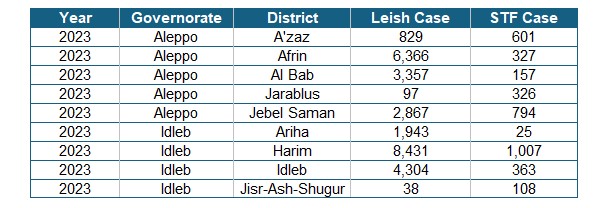
The following is a table of leishmaniasis and typhoid fever cases in Aleppo and Idlib governorates, prepared by the Assistance Coordination Unit.
When do we need a One Health project in Syria?
In addition, internally displaced persons (IDP) camps often lack access to services such as clean water, sanitation, and medical services—meaning they are a highly risky environment for disease outbreaks, such as cholera, which has killed 101 people and infected more than 92,000 so far, representing 18% of all suspected cases. The cases were from IDP camps on March 16, 2023.
Therefore, we recommend exploring steps to immediately launch a One Health project in Syria.
Where? Or what are the proposed areas for launching the Syrian One Health project?
The population of northwest Syria is 4.5 million, according to OCHA statistics.
The population of camps is estimated at 2 million, according to the same statistics, by the end of 2023.
This population density in camps is a vital environment for the spread of epidemic diseases.
Due to crowded living conditions, inadequate sanitation and hygiene facilities, and limited access to clean water and healthcare, displaced populations are particularly vulnerable to these diseases. Here are some of the most common environmental diseases in displacement camps:
Waterborne diseases: cholera, typhoid fever, dysentery, and hepatitis A
Vector-borne diseases: malaria, dengue fever, leishmaniasis, and Chagas disease
Respiratory diseases: pneumonia, tuberculosis, and COVID-19 (during outbreaks)
Skin diseases: scabies, impetigo, and fungal infections
Diarrheal diseases: rotavirus and bacterial diarrheal diseases
How do we start a One Health project in Syria?
(C4) What are the four pillars of the One Health project?
Communication, coordination, collaboration, capacity building
Main objectives:
Achieving universal health for all through a comprehensive approach focused on prevention, health promotion, and treatment.
Reducing health disparities among different segments of society.
Improving the quality of health services provided.
Enhancing the efficiency of the health system.
Key strategies:
Focusing on disease prevention and health promotion through awareness and health education programs.
Improving primary health care systems to deliver high-quality health services for all.
Promoting integration among various components of the health system.
Empowering individuals and communities to participate in managing their health.
Key initiatives:
Launching health awareness campaigns on topics such as proper nutrition, physical activity, and mental health.
Expanding the scope of early disease screening programs.
Improving the quality of health services provided in primary health care centers.
Establishing an integrated health information system.
Supporting health research programs.
Funding:
All supporters interested in sustainable development and One Health projects:
The European Union, the World Health Organization, the Food and Agriculture Organization, the World Organization for Animal Health, the United Nations Environment Programme, and the door is open to all supporters from around the world.
Responsibilities:
The Syrian Future Movement and its expertise in the field of health in northern Syria. Local organizations may cooperate or establish a specialized One Health organization under the name “ONE HEALTH” if a comprehensive project for all of northern Syria is approved.
Evaluation:
The One Health plan will be evaluated periodically to ensure the desired goals are achieved. The project will be accompanied by an internal monitoring and evaluation team and a team to draw on previous experiences and those of other nations.
Timeline:
The One Health plan will be implemented over three years, from 2024 to 2026, in accordance with the World Health Organization’s (WHO) plan.
Expected impacts:
Improved general population health.
Reduced health disparities among different segments of society.
Improved quality of health services provided.
Strengthening the Efficiency of the Health System
One Health and the United Nations Goals:
Goal 3: Healthy Lives and Well-being for All
Goal 6: Sustainable Water and Sanitation for All
Goal 13: Combat Climate Change
Goal 17: Strengthening Partnerships for the Goals
One Health and the World Bank Goals:
Eradicate Extreme Poverty
Promote Shared Prosperity
Addressing Climate Change
Opportunities for the Success of the One Health Approach in Northern Syria:
Supporting International Organizations
Community Engagement
Collaboration Between Different Sectors
Scientific Research
Examples of the Success of the One Health Approach in Northern Syria:
Reducing the Spread of Infectious Diseases
Improving Maternal and Child Health
Preventing Chronic Diseases
Challenges of the One Health Project in Syria:
Lack of Resources, Institutional Weaknesses, Social and Cultural Challenges, Environmental Challenges, Security Challenges, Reconstruction, Refugees, Climate Change, Food Insecurity Challenges
Strengths of the One Health Project in Syria:
A Comprehensive Approach Between Different Sectors, Improving Human, Animal, and Environmental Health, Strengthening Disease Prevention, Improving Epidemic Response, Promoting Scientific Research, Capacity Building, Promoting International Cooperation, Achieving Sustainable Development Goals, Improving Quality of Life
Weaknesses of the One Health Project:
Coordination Challenges, Lack of Funding, Lack of Data, Lack of Awareness, Resistance to Change
Finally, we must always remember that awareness and preventative medicine are more effective and convenient than falling ill and facing the challenges of treatment. We conclude with the famous Arabic proverb: “An ounce of prevention is worth a pound of cure.”
Dr. Mahmoud Wazzaz
Scientific Office
Independent Researchers